 Psalm 129v/130 (De Profundis) | >>

During the nine hundred years from 300 to 1200 when plainsong was the sole music of the church much artistic development must obviously have taken place; [The generic name for all service music was Cantus, the Chant. CantusPlanus, Plainchant or Plainsong, was used later to distinguish the monodic traditional music from organum and still later from harmonised mensural music.] but it can be traced only by experts owing to the notation of the manuscripts made previous to the year 1000. The work of Solesmes was therefore that of collating manuscripts to obtain the original or the most artistic text. Between 315 and 600 the chant shows alternate elaboration and simplification of detail, and we have seen that collection, organisation and simplification of the existing music was effected by Gregory. The golden age of plainsong may perhaps be taken as the years between 800 and 1100; unfortunately, however, for modern research the only notation used before the year 1000 was neumatic and it may truthfully be said that the invention and use of the stave for noting down melodies happened only just in time to rescue this music from the baffling oblivion from which, for example, Greek music has never been wrested. The neumatic notation was a purely mnemonic notation consisting of marks (neumes) placed over or at the side of the text and vaguely diagrammatic of the lie of the melody. They were, in fact, an elaboration of the marks used by the teachers of rhetoric to show the voice inflexions to be used in reading. The neume for a leap of a run down the scale did not tell the singer unfamiliar with the melody the interval of the leap or the note from which the run began, so that no sight-reading of the manuscript was possible. By collation with later stave-notation manuscripts, however, these neumatic manuscripts can give an accurate idea of any melody being studied.
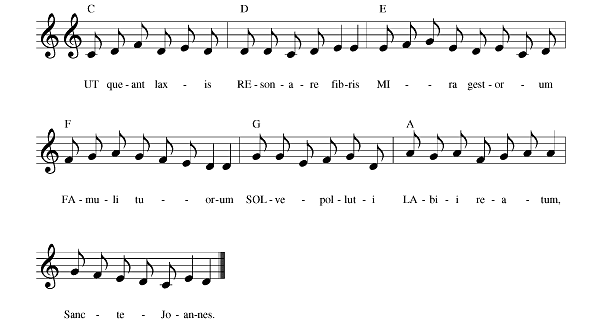
During the ninth and tenth centuries a group of French theoreticians of whom Abbot Otger is the best known, were writing treatises on notation and many teaching devices were invented which used lines and spaces as a diagram of the notes, to be discarded when the student had learnt his lesson. [The work of Odo of Cluny and Hucbald (Ubaldus - about 840-930), which was once supposed to have given the lead in this matter of notation, is now reckoned to have been concerned only with the explanation of the gamut (the series of possible notes) and the eight modes.] The stave as we know it, nevertheless, owes its origin to a piece of practical convenience, that of scratching a ruled line across the parchment above the words to guide the scribe in placing his neumes. Later, the line was ruled in red ink and represented F; a second line often being added in yellow to represent middle C a fifth above. From this idea the stave was born and reading at sight as well as composition in the sense of being able to write down one's effusion became possible. Guido of Arezzo (born about 990), an outstanding theoretician and an able teacher, combined the stave notation with a method of naming the notes akin to modern 'tonic sol-fa', which made reading at sight a much more certain business. The Guidonian 'sol-fa' method was arrived at by a typically medieval and ingenious piece of pedagogic subtlety: the hymn for St John's day could, it was noticed, be divided into phrases each beginning a note higher than the last. Everyone knew it and the students under his direction could always sing it over to remind themselves when they got into difficulties. The syllables under the successive first notes of the phrases were the ones he used in his method; the stanza of the lovely sapphic hymn he used went as follows:
Example 2. Version at No. 108,
Plainsong Hymn Book 
His system must have revolutionised the teaching, making performance more certain and cutting down the ten years asserted to be necessary to know the whole corpus to a two or three years' course in sight-singing. A four-lined stave usually sufficed for the compass of the melodies, which by 1550 had been enlarged to six lines for instrumental and harmonised music; the modern five-lined staves seem to be an adequate compromise, though it is often found that they are far from useful for large-compassed instrumental music. By 1100 when melodies could be accurately noted down in a form, which we can read, the melodies themselves were entering into a period of decadence. The published Solesmes texts are usually followed today, as giving the best form of the melody; in England translation of the texts into the vernacular has made slight alterations in the musical texts sometimes inevitable.
The Guidonian notation, written on its four-lined stave and founded on the neumatic system, was not really a notation of single notes in the modern sense. Based, possibly, in the dim past on the principles of rhetoric, the chant itself really showed a construction founded on phrases or melodic inflexions rather than on single notes, and the notation followed similar lines. Even if within the phrases the intervals might differ, most phrases could be divided into characteristic shapes. Thus the podatus, two notes ascending (like a question in rhetoric) and the torculus, three notes up and down (as an actor might deliver the phrase, 'I want to.') might occur in the following ways:

The modern transcription into quavers misses some of the finer points of the contemporary notation: the so-called liquescents, for instance, arranged for the easy pronunciation of certain consonants chiefly r, I and n. In the following, for example, where the two-note group on the syllable por- is called a cephalicus, the second note is sung very lightly and takes the consonantal r. It has a special contemporary notation different from the clivis, the ordinary group of two descending notes, but in the modern transcription this is not made clear:

Here we see an interesting refinement showing that the neumatic groups were the lineal successors of the old rules of rhetoric and suggesting also that the music and words were thought of as indivisible. The technique is, indeed, reminiscent of the supposed methods of classical Greek drama - also a religious art - and of the methods of recitative used in the seventeenth century. Further examples of such refinements may also be seen in the quilisma, written as three ascending notes and possibly meaning something like a turn (though the usual modern rendering burks the suggestion), and the strophicus, a kind of shake involving, it is thought, quarter-tones. They are as follows, though the rendering is not clearly established:

It is generally supposed that the musical theoreticians in Pope Gregory's entourage extracted from the existing melodies a system of fourteen modes of which two - the authentic and plagal versions of the Locrian, final on B - were purely theoretical. For teaching purposes in those days and now these modes may be set out dia-grammatically as on page 82, but modality was, of course, more than a given arrangement of tones and semitones. The connection between the words 'mode' and 'mood' is not fortuitous; each mode had a characteristic atmosphere and melodies in a given mode showed turns of phrase peculiar to the mode, so that one is immediately aware that a melody is in, say, the Dorian even before it has come to rest on its final. In Archbishop Barker's hymn-book, published by Day in 1567, to which Talk's wrote the tunes, the eight modes are thus described:
The first is meeke, devout to see, The second sad, in majesty, The third doth rage and roughly brayth, The fourth doth fayne and flattery playth. The fifth delight and laugheth the more, The sixth bewaileth and weepeth full sore, The seventh tredeth stoute in froward race, The eyghthe goeth milde in modest pace.
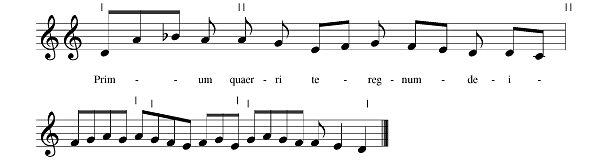
In the later middle ages the following tune was composed to the words 'Seek ye first the kingdom of God' to show off the characteristics of mode i; the words are a sort of pun in the medieval manner: [Similar phrases for all the modes are given in Grove's Dictionary under the title 'Modes, Ecclesiastical'.]
Example 6. Typical phrases of the
dorian mode.
Thus we can describe a melody in the Phrygian as one which shows the peculiar turns of phrase of that mode, one whose intermediate cadences are on certain notes, called dominants, and one which comes finally to rest on E.
A melody whose compass lay roughly between final and final - e.g. D to D in the Dorian- was stated as being in the authentic form of the mode, or in mode i; if the final lay roughly in the centre of the melodic compass - e.g. A to A in the Dorian - it was reckoned to be in the plagal form of the mode often called also the Hypo-Dorian or mode ii. The same distinction was drawn for other modes, giving a possible twelve in all, if we omit the theoretical B or Locrian mode; the distinction was hardly necessary (Ambrose is sometimes reputed to have sorted the melodies into only six modes) and it is perhaps clearer to think of the modes as six in number, those on D, E, F, G, A and C. The difference between the Hypo-Dorian, mode ii, running from A to A and the Aeolian, mode ix, also running from A to A, was seen in their finals: the final of mode ii is D, that of mode ix being A. The B-flat or B were used indiscriminately in every mode during the best period; careful consideration of the use of the B-flat must discount any idea that it was employed to avoid the tritone. The familiar tag:
Mi contra fa Est diabolus in musica,
meaning that B and F sounded unpleasant in close conjunction, was a principle discovered later in the early days of harmonised music. In the chant the choice of B or B-flat depended solely on the emotional effect it was intended to produce.
The Solesmes method of editing the texts presupposes that all the notes of a given melody were roughly equal in length, and their gramophone recordings show this method in practice. Many, however, consider the point anything but proved and certainly a smoother and more suave effect is got by a more conscious freedom with regard to note lengths. When the chant is sung to English words, which abound in unaccented syllables of short duration and no very definite vowel content, this is certainly the case. Thus in:
Example 7. Plainsong Hymn Book, No. 54 Ad cenam Agni Providi,

the syllables underlined sound better if sung not only lightly but more quickly than the surrounding accented syllables. No one can finally decide which method was in use in the middle ages, the free or the strict, nor is the point important; it is likely that both methods were used in different places as they are today.
Whether the free or strict method is used, it seems clear that in purely melodic phrases unencumbered by words - the Alleluias, for example - the notes can be divided into accentual groups of two and three notes. The principle may first be seen in a text abounding in words, Latin or English; thus, the following hymn would be accented in singing in groups of two (or four) and three in this way:
Example 8. Plainsong Hymn Book, No.
44
[Recorded on this method by the choir of the S.E.C.M. on Columbia ROX 195.]
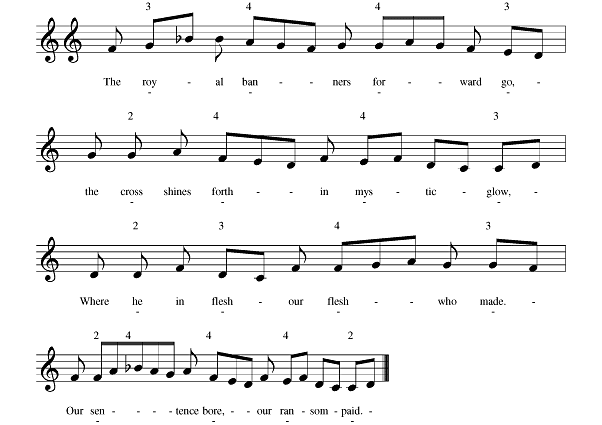
This method makes it perfectly easy to adjust the rhythm of the melody to that of the words when in other stanzas the word-stress occurs at different points from that in the first stanza, an obvious necessity in an English translation. In purely melodic passages the principle would be applied thus:
Example 9. Kyrie III from Kyrie 'Splendor
Eterne'

The music is always contrived so that each melodic phrase (marked off by quarter and half bar-lines) could be sung in one breath. In the hymns strict rhythmic parallelism between the lines of a stanza was, as a rule, carefully avoided. The familiar Before the ending of the day is an exception, being an entirely syllabic hymn. The syllabic scheme of the hymns is usually 8.8.8.8., but a welcome change is found in the so-called sapphics where the scheme, which produces some attractive results, is 11.11.11.5. [See as an example the St John hymn on page 29; a familiar modern example, which, however, does not keep to the rule of having a caesura after the fifth syllable in each line, will be found at hymn 214 in Hymns A.& M.] These rigid word schemes are seldom followed by the melody; almost any hymn will show the delightful, artistic unbalance which comes from lengthening out the answering phrase by some graceful melodic embellishment and so holding back the expected cadence. In the more melismatic chant the principle is the same, that of answering phrases which overbalance rather than balance their antecedent.
The restrictions placed by later contrapuntal theorists on certain melodic shapes do not find a place in the chant. Leaps are followed by movement in the same direction, the tritone is freely exploited and various other 'inelegancies' are to be found which would not be tolerated in harmonised music. Such passages as the following can be matched anywhere:
Example 10.
(a) Plainsong Hymn Book, No.19 (b) The same, No.18 (c) Sarum Litany
.gif)
Sung in a resonant building, such passages show the peculiar aptness and beauty of the chant. For the most part the compass is within a ninth, though in some of the longer sequences [See page 45.], intended to be sung by the soloists, certain sections differ so much from the general compass of the composition that one can only suppose some division of the choir into tenors and basses, used antiphonally, if both types of voice are not to be landed into difficulties.
In the underlaying a partiality is shown for little melismatic phrases on unaccented syllables [See example 1, page 25.], a method that much delighted the Elizabethans; they are essentially of the underlaying technique and when lightly sung, so that the music does not obtrude through the words, have an excellent effect. In the Jubilus, where the word Alleluia usually constitutes the sole text, and in the longer kyries, breaths were taken in the middle of words, much in the manner of the later 'hocket' (ochetus) and of the more recent Handel arias.
It is assumed that the chant was sung without accompaniment; the Christian church has always been sparing in its admission of instruments into the church. In 811, however, Byzantine musicians were causing wonder, and disapproval, with their organ at the court of Charlemagne at Aachen. If accompaniment was known before 1200 it must supposedly have been a mere doubling of the voices in unison, in the way we imagine the huge Temple orchestra at Jerusalem was used. It has been suggested that couplers on the instruments caused the simultaneous use of pipes an octave or even at other intervals above the sung melody; if so, it helps to explain the modern 'mixture' stop and give some inkling, perhaps, of the origin of organum, the name of which sounds suspicious in such a connection. At any rate, where it was installed, the organ would be useful in giving the intonation as nowadays and in helping the singers to keep the pitch constant. top
The modern problem of accompaniment is different. If, in a modern service, plainsong is not sung for its own sake, it has often been used where four-part singing is impracticable - for example, in 'men only' services or at services in monasteries and convents - or where the organ is temporarily not in use. The chant can be sung without accompaniment and in a resonant building sounds completely satisfactory even to an ear accustomed to an instrument. With the organ something is added to the effect which, if it is not historically correct, yet achieves an artistic result.
When it is used certain principles become clear with regard to the type of harmony to be employed. We may briefly summarise these as follows: the chords allowed are triads and their inversions with a free use of passing notes, anticipatory notes, downward- and upward-moving appoggiaturas, and suspensions. Chromatics and modulations will find no place if we are to keep the modal feeling of the chant, though the B-flat may be used freely. Essentially tonic-and-dominant effects like the perfect cadence give modern associations, which are best avoided. The final of the mode is always made the bass of the last chord except in modes iii and iv where it has been suggested by French authors that A or C form allowable basses. The plainsong is, of course, transposed into any suitable key.
In the nineteenth century one chord per note was the rule, but as this tends to restrict rhythmic freedom - especially that of the singer - the emphasis nowadays is rightly placed on securing chord-changes at the word-accents. Chords are changed as infrequently as may be and the general rule is followed that the greater the accent the greater the change; if it is realised that the more notes two consecutive chords have in common the less is the stress on the second chord, and that a conjunct bass tends to weaken the accent, the main principles will be clear. The Plainsong Hymn Book shows this very adequately: hymn 7, first tune, is successfully accompanied where hymn 27 is not, because of its too frequent chord-changes. A performance of both will convince the hearer which accompaniment less interferes with the singer's freedom. First lines of hymns and intonations, which are usually sung in the medieval way by a soloist or cantor - a necessity then to establish pace and pitch - are never accompanied.
The accompaniment should clearly form an unobtrusive background to the singing. A quiet tone, flute, string or diapason in quality, gives the desired effect. Variety is obtained by using these three types of tone antiphonally, by occasional unison passages, by varying the texture - a three-part texture is an adequate norm - by the sparing use of the pedals, or by placing the melody in an inner part. Only the experienced player will accomplish all this extempore; for most, the workable plan is to write out the accompaniment before playing. Plainsong being a reflective rather than an expressionist art, the accompaniment will keep to the principles enumerated above; loudness of tone is never required, while tampering with the psalmist's trumpets and thunder may be left to the modern expressionist school.