 gaudete (piae cantiones) | >>
nicene creed (merbecke)
gaudete (piae cantiones) | >>
nicene creed (merbecke)The gist of the rhythmic technique can be studied in a familiar phrase of Merbecke:
Example 14. From The Booke of Common Praier Noted. 

Accent in a musical phrase such as this is assured in three ways:
a long note acquires accent if surrounded
by shorter notes:
a high note takes accent if placed in the midst of lower notes (and vice versa):
and in the ending or cadence
the last note tends to be accented because of the harmony, implied or heard.
Thus we see accents on look, for, -rec-, dead.
Look gets its accent from the preliminary run up the scale.
It is followed immediately by another accent, this time the
result of length, on the word for.
Such pairs of contiguous accents are common in English;
a good example is found in psalm 48  (St Paul's cathedral choir: music details HERE.)
The hill of Zion is a fair place, the joy of the whole earth: upon the north side lieth the city of the great king; God is well known in her palaces as a sure refuge.
Merbecke's accent on for acts like a springboard for the concatenation of short, quick syllables following it. Notice the second run, this time further up the scale, on the re-sur- to the accented -rec-, got by length and pitch. In speech for would not be stressed: sung, the phrase is better with an accent here, unless the singer dwelt for two beats on look. But sung thus not only would it lose much of its rhythmic point and charm but unanimity would be more difficult. Merbecke, at any rate, felt otherwise; he was a musician as well as an orator and realised the tame musical effect of a long series of unaccented syllables. The phrase is not, in fact, in what is today called speech-rhythm. It is a mixture of that and musical Tightness and is characteristic of the technique of the period. Such rhythms will be found freely strewn on every page of the music of the time. Other examples will help to show the principle:
Example 15. Treble from Mundy's O Lord the maker

where the stress on of serves a similar purpose, and:
Example 16. Treble from the Magnificat of Gibbons' Service in F (Winchester
cathedral choirs: music details HERE.)

where the principle is clear at the word and.
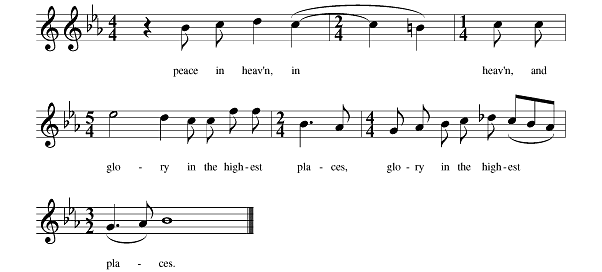
hosanna (gibbons)For church purposes the music never moved with fixed regular accents. Time signatures in the modern sense with their attendant bar-lines are therefore never found. [Time signatures were prefixed but only to show the subdivision of the unit-notes, long, breve or semibreve. Except at rare changes of this subdivision they may thus be disregarded. Bar-lines as indicators of regular or irregular accents are also unknown in the part-books. The singer presumably accented his music by ear and according to the text he sang. The Tudor Church Music edition inserts them for help to the eye at irregular intervals - usually in four-two and six-two groups.] The single voice part has a rhythm arising out of the music itself in combination with the words. As often in the printed part-books the words were not written in for whole stretches, much latitude was apparently left to the singer or his choirmaster - nowadays to the editor - to find the underlaying which best suited the passage. [Extant part-books occasionally show the underlaying inserted by hand, indicating how some careful precentors or choirmasters tackled the problem.] His part thus proceeded like good prose, now in groups of two, now in three, much like plainsong except that for reasons of harmony and unanimity there must be a stricter unit-beat in his mind as he sang. In the following passage bar-lines and time-signatures are inserted in the modern manner to show the rhythmic scheme at the back of the singer's mind if he is to deliver the phrases well; [This method of indicating the rhythms would of course be too worrying to the eye to be of practical use. The Fellowes editions use a stress-mark to show where the chief accents occur, when these conflict with the inserted bar-lines or with one another. This seems the most satisfactory method.] it is not necessarily the only scheme that would fit:
Example 17. Tenor from gibbons' Hosanna (Winchester
Cathedral Choirs: music details HERE.)
Thus to find the rhythmic structure of his part must be the singer's first duty; it was forced upon a sixteenth-century choir man as scores were apparently unknown and he sang from a part-book containing only his part. [Part-books: usually five each for Decani and Cantoris, making ten in all for the whole choir plus duplicate treble books. Books Decani 1 and Cantoris 1 would contain all the top parts of anthems even if, for example, in a men's anthem this was the first alto. Thus books Decani 4 and Cantoris 4 would contain the lowest part of all four-part anthems but the next to lowest of five-part works. There would be no bass parts to four-part works in books 5.] Reading a new work must therefore have been difficult, but once the work was familiar the use of a single part-book must have added to the independent reading and freedom of the individual singer.
With such a scheme it can be imagined what endless possibilities there were in rhythmic counterpoint. Such counterpoint is indeed the salient feature of the music. To show the effect a typical example is given in which the rhythm of the parts is shown by bar-lines:
Example 18. Extract from Gibbons' O Lord increase my faith
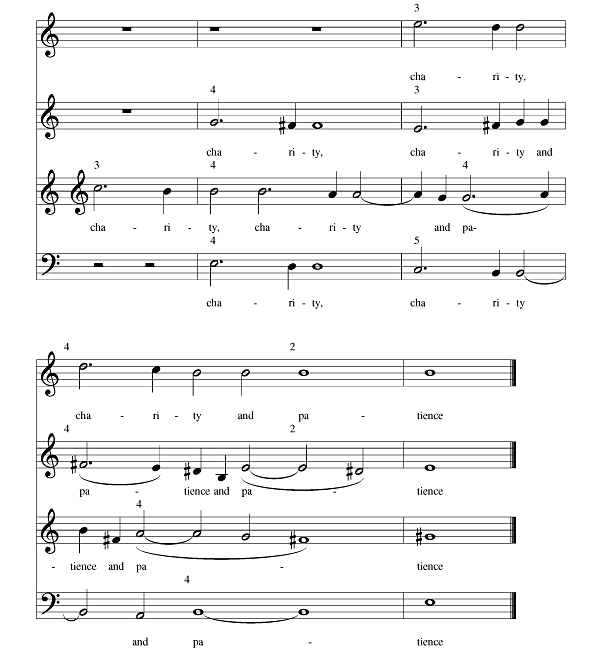
The expressive power of these rhythmic waves on the word charity-can be matched on any page of the period. Nothing could better suggest to the listener a dwelling, a meditation on 'charity' than these gentle eddies with their delightful overlappings. [For contrast with the modern technique see the last few bars of Though I speak - B airstow (publ. Banks) where a similar meditative effect springs from the counterpoint. The rhythm used is that of Gibbons.]
To divorce melody from rhythm is impossible: the melody is the up and down movement hung on the rhythm. We may, however, here shortly consider the habits of the composers so far as the pitch-shape of the phrase goes.
No church composer of the period ever wrote a melody and then accompanied it in the part-song manner; such a method was used in the secular 'ballets' and is found in some settings of hymn-like melodies by Dowland in the seventeenth century [Some inner parts of these settings, recently discovered, are very ornate, the melody and bass remaining simple. Apart from the 'short' services the outstanding example of block harmony is Byrd's Christe qui lux, a beautiful setting in faux-bourdon of a plainsong melody which appears in each of the five parts in turn.], but is foreign to the general technique of the time. In the church music there is at times some atavistic feeling that the main interest lies in the tenor, the other parts making a faux-bourdon; but on the whole the interest is shared by all the parts, except in the 'short' services where the treble and tenor sometimes have a more adventurous line than the other voices, none of whom, however, in the average short service [Short service: a simple, block harmony setting designed to get over the ground quickly.] can be said to sing anything approaching a 'melody'.
Melodic habits are best understood by remembering Morley's dictum that the full close (that is, the perfect cadence) can come only at the full stop in the text. [On page 178 of his Plaine and Easie Introduction to Practicall Musicke 1597, where he makes the following astute remarks:
'Lastlie, you must not make a close (especiallie a full close) till the full sence of the words be perfect: so that keeping these rules you shall have a perfect agreement, and as it were a harmonicall concent betwixt the matter and the musicke, and likewise you shall be perfectly understoode of the auditor what you sing, which is one of the highest degrees of praise which a musicion in dittying' - that is, setting words to music - 'can attaine unto or wish for.']
The method is never to write a 'tuney' phrase of eight bars or so, but to divide the text into short clauses and set each either harmonically or contrapuntally. Thus in Gibbons' O Lord, increase my faith the text is cut up as follows, a short melody being given to each clause:
O Lord, increase my faith - strengthen me - and confirm me in thy true faith - endue, me with wisdom - charity - and patience - in all my adversity - sweet Jesus, say Amen - sweet Jesus, say Amen - sweet Jesus, say Amen.
In each little phrase there is always a studied lack of regular lilt to preserve the soberness which Cranmer
suggested, and the melody moves, as in all the music of the time, English and foreign, stepwise with an admixture of short leaps.
English music is, however, often lax in this principle [See page 70, Example 15, the first four
notes.], the bass sometimes moving a fourth and then another in the same direction, or a part ending one phrase on, say,
F-sharp and beginning the next on the F-natural above.
Gibbons in F Magnificat shows the following in the treble (St Paul's
Cathedral choir: music details HERE.)

The small notes are in the part, and whether they are meant to be sung as written or as a portamento, the octave leap to an unstressed syllable is a bold, almost unwarrantable stroke needing much care in the performance. In contrapuntal passages a few simple melodic formulae are used again and again because of the ease with which they work in imitation. Cadence idioms such as:
Example 20. (a) (b) (c)
(a) Alto in Tallis' Salvator Mundi
(b) 1st treble in Gibbons' Hosanna (Winchester Cathedral Choirs: music details HERE.)
(c) 1st alto in Gibbons' Hosanna



are used as perfunctorily as Mozart and Handel used theirs. Both these sets of formulae were indeed the stock in trade. They are perhaps the first idioms to strike a modern listener and seem to give the music its peculiar flavour, but to a contemporary they were banal, and a too liberal use of them, though perhaps attractive to shows the composer with a lazy mind. That men like the incomparable Byrd could use them for expressive ends is shown by the final bars of his Agnus Dei from the three-part mass, a lovely message based entirely on a cadence formula.
rejoice ... (purcell)Worthy of notice too is the tendency to sing sheer melodic phrases on unimportant, unaccented syllables, an idea which seems forever to have departed from our music. It lasted, indeed, to Purcell, who writes:
Example 21. Treble from Purcell's Rejoice in the Lord

The most common use of the idiom is in the three-time dotted rhythm, which is always underlayed thus:

Not only does this underlaying give a tripping, forward-moving feeling to the phrase, but it is easier to sing than the modern plan of giving the first two notes to the first syllable of the word. The sixteenth century method gives the singer a better chance of easily pronouncing his consonants and the two notes on -ra- throw the secondary accent - usually on the third beat of a three-beat metre - back a quaver, so producing a temporary syncopation which prevents the passage becoming 'waltzy'. Just as Shakespeare varies the dull jingle underlying blank verse so the Elizabethan composer fights shy of a too regular metre. For the same reason four quavers are always split into one plus three rather than two plus two, as
Example 23. Tenor from Weelkes' Hosanna (St Paul's
Cathedral choir: music details HERE.)

In its counterpoint, both rhythmic and melodic, lies the glory of this music. Its attractive freedom is the product of two idioms, the lack of regular accent and the use of short melodic 'points' for imitation. If one voice can be singing an accented note while another is singing an unstressed syllable the contrapuntal possibilities become limitless; if in addition only short phrases, a breath long, are used for imitation the resulting fugato becomes freer to work and can easily be prolonged to any length desired. To show-the freedom obtained on this system we need only contrast it with the counterpoint of the early nineteenth century where a regular accent makes the entries start always on the same beat of the bar-metre, where the four-plus-four-bars form of the composition forces the unwilling imitations into its unyielding chains, and where the prevailing tonic and dominant harmony dictate only certain possibilities of imitation and even more strongly restrict the sort of phrase which can be imitated. The difference is also seen by contrasting Tye's childlike imitation in:
Example 24. Extract from Tye's Laudate nomen (words added later)
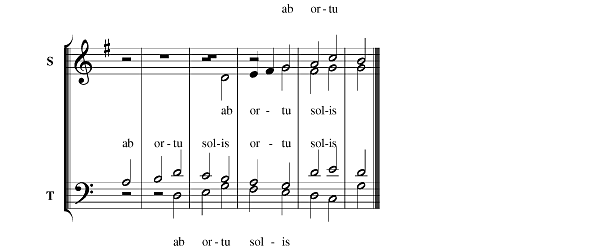
where the composer is shackled by his regular metre, with the consummate freedom of Byrd's:
Example 25. Extract from Byrd's Three-part mass
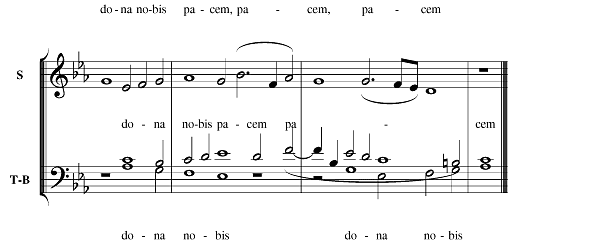
The points used in the imitations are simple, easily recognisable - an important point to the listener - and enter so naturally that the whole texture shows that apparent ease which is the hall-mark of a mastered technique. Between these extremes of lucid simplicity and thoughtful complication the Tudor composer expressed himself in counterpoint. In simple and complicated passages alike the point starting the fugato was always childishly obvious. On paper nothing could look simpler than:
Example 26. Extract from Byrd's Ave Verum (Winchester Cathedral
choir: music details HERE.)
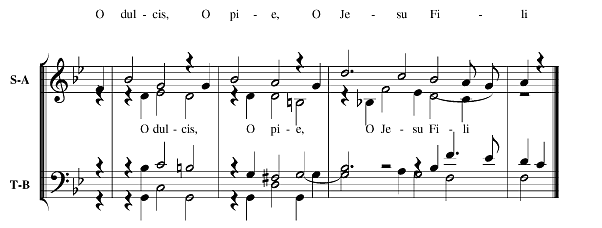
Its effect in the atmosphere of the church service is indescribably expressive. Yet the device of echoing a treble phrase of three notes by the under parts is little more than a stock idiom, turned by Byrd into 'something rich and strange'.
The normal procedure in a fugato is for all the voices to take part, the interval of entry being free but tending, because of voice compass, to be at the fourth or fifth. The old tetrachord rule, which answered a leap of a fifth by a fourth, is usually kept, so retaining the music in the mould of its own mode. A familiar example is the opening of Tallis' Salvator mundi:
Example 27. Opening of Tallis' Salvator Mundi (Winchester Cathedral choir: music details HERE.)
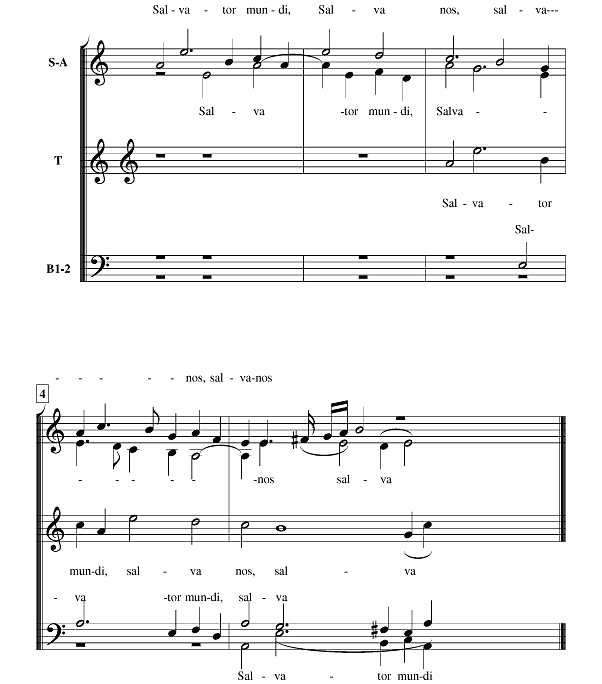
Here the point is not conjunct after the leap but uses an oscillatory phrase on -vator mundi, which makes for a certain stiffness not found in the later work where conjunct motion was almost a rule and gives more ease to a fugato passage.
Gibbons is guilty of an experimental mind and we find him occasionally trying other methods:
Example 28. From Gibbons' O Lord increase my faith
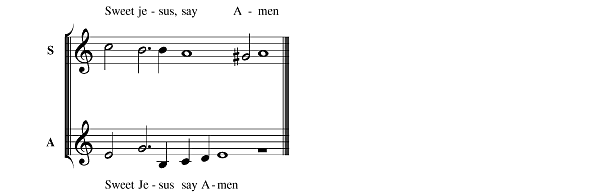
This shows a point in two parts used not very convincingly.
Verbally it is a repetition of a phrase already
satisfactorily treated, while here it is left too undeveloped to have much musical raison d'etre.
The parts are
rhythmically too similar and the drop of a sixth in the alto seldom comes off.
A daring experiment that does come off, however, is
found in the Gloria to Nunc dimittis in the service in F
(Winchester Cathedral choirs: music details HERE.)
Here Gibbons
writes a masterly and unobtrusive accompanied canon at the fourth below between treble and alto.
This lengthy piece of canonic
writing is a rare feat contrasting with the usual short phrase technique.
In both these cases one might imagine the two parts
accompanied by a continuo in the manner of the seventeenth century.
Consecutive fifths and octaves, later banned absolutely by shortsighted theoreticians, were not considered so forbidding before 1625. The objection to them is obvious: they underline the melody rather than provide it with a counterpart, and a melody underlined at the fifth or octave is more thoroughly underlined than at the third or sixth as the two voices involved simultaneously move the same amount. Contrast for instance:
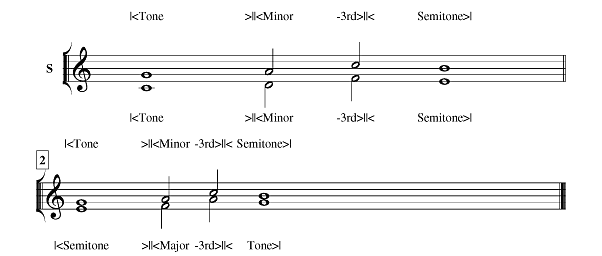
Even consecutive thirds and sixths spoil the independent movement of parts, especially when continued for more than a few notes [The Restoration period sometimes writes whole strings of thirds. Stanford was perhaps too fond of strings of sixths.]; but consecutive fifths and octaves belie the name of counterpoint. The rule is not absolute, however, and the ear can often delight in them. In the sixteenth century they were freely used, perhaps to give the music an archaic flavour, for the old organum [See page 47.] out of which part-writing grew had not got completely out of the composers' system. It was a measle germ in their blood stream and occasionally showed up. Usually the composer excused himself by slightly altering the rhythm of one of the parts. Rhythmic underlining was in fact more eschewed than melodic; it is merely dull [See Example 28, page 78.]. Examples of such consecutives will be found on almost any page of the period.
There is little need to consider the vertical, chordal aspect of this music. To say that it consists of triads and their inversions with a very occasional dominant seventh - mostly in the experimental Byrd - is to state nothing useful. The technique of dealing with suspensions was quite formal though various ornamental resolutions were cultivated which would have given Palestrina an uneasy mind. They are easily recognisable on every page:
Example 30. (a) Alto from Byrd's Three-part mass
(b) Treble from Tallis' O Lord, give thy Holy Spirit
(c) Treble from Gibbons' Almighty and everlasting God



The chief harmonic interest, however, is to be found by considering the progressions horizontally and from the sequence of chords we pass to the design or form, the way, in other words, in which the music moves from cadence to cadence. The prevailing contrapuntal texture is relieved by formal cadences in more or less block harmony, each fugato leading to a cadence out of which another fugato starts. A typical design is found in the familiar O Lord, increase my faith of Gibbons:
A: |
O Lord, increase my faith block harmony leading to a plagal cadence on E. |
B: |
strengthen me echoing phrase founded on the G chord. |
C: |
and confirm me in thy true faith block harmony leading to perfect cadence on A. |
D: |
endue me with wisdom imitative counterpoint: two entries at the unison founded on the A scale, two entries at the octave founded on the E scale. |
E: |
charity and patience imitative counterpoint at the fifth and sixth on charity, leading to a perfect cadence on E for and patience. |
F: |
in all my adversity imitative counterpoint at the fifth, leading to a perfect cadence on D. |
G: |
sweet Jesus, say Amen echoing phrase leading to perfect cadence on B; repeated leading to a perfect cadence on E. |
H: |
sweet Jesus, say Amen two-part point repeated, leading to a final perfect cadence on A. |
about church modesIt is clear that the words key and modulation cannot be used for such a scheme. There are short passages leading to cadences, perfect or plagal, carefully arranged so that two similar ones are never consecutively used, but nowhere before the final cadence does the music come to a complete halt; it has no sections. The whole is, in fact, definitely in the A mode: it revolves about A as round a pivot. When the words sweet Jesus, say Amen first appear there is a sudden feeling of softness, almost of 'modulation', one might say, as the music moves for the only time to a new, rich cadence, that on B. The feeling is at once cancelled by the next cadence on E, a cadence we have heard three times before. Such is the usual ground-plan of the Elizabethan anthem; in very long works the music sometimes comes to a definite halt midway, but even then there is no attempt to write successive sections in contrasted keys in the modern manner. Extended canticles like Te Deum or the Nicene Creed are treated as the anthems: the variety of cadences saves them from becoming dull. To say that Gibbons' anthem here analysed is in mode A or the Aeolian mode is pure convention. It begins with A as a centre, often comes back to its pivot, and ends with A in the tenor; but it is no more entirely in the Aeolian than Beethoven's Fifth Symphony is all in C-minor. It is, however, clearly not in A-major. despite the C-sharp in its final cadence. The conventions of musica ficta had by 1625 caused the imminent breakdown of the old system of modes by making all the modes group themselves into two kinds, those like our modern major scale and those like our minor. The transformation could hardly be called complete before 1660 but in 1625 it was well on the way. In musica ficta accidentals were added to the seventh and sometimes the sixth of the mode to provide a cadence in which the note a semitone below the final of the mode was used instead of the real seventh, which was a tone below. The results of thus sharpening the seventh and sixth may be tabulated as follows:
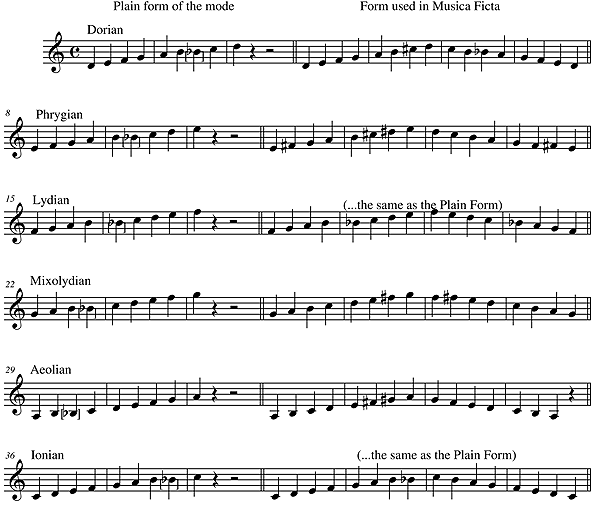
From the above it follows that the Dorian and Aeolian lost their distinctiveness, merging into a scale identical with our modern minor. [The 'scale' is of course merely a diagram of usable notes in a given mode. No composer ever wrote a full octave scale for his voices. From the usable notes he formed his chords and cadences. The 'accidentals', as we call them, which were used only in ascending passages, did not cause modulation; they were truly chromatic or decorative.] A piece written in the free form of the Dorian sounded exactly like a piece transposed from the free Aeolian. This levelling process was going on between 1500 and 1700 and in our period it had got halfway; ultimately the sameness of the two modes restricted the harmonic vocabulary, which under the free modal system had been very rich. The 'minor key' of 1700 left the composer with a handful of possible cadences in the key - a harmonic famine compared to the plenty of possible cadences under the free modal system where modulation in the modern sense was unknown. The free form of the Mixolydian was identical with the Ionian, our modern major. Only the Phrygian stood aside from this dual grouping because of the second note of its scale, which, unlike the second of any other mode, was only a semitone above the final. The mode was occasionally used with D-sharp and F-sharp when it became identical with the Dorian and Aeolian, but never with D-sharp and F-natural in the same chord, unless as a freak experiment. The characteristic Phrygian cadences with the F-natural were too beautiful to be dropped and have continued to this day:
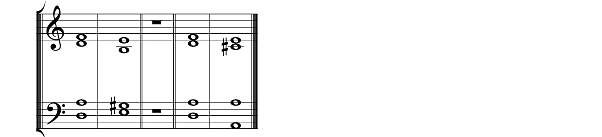
sanctus (byrd - 5 part mass)The free modal system has left many such traces still to be found in our modern music. It gave rise to the so-called English cadence, to he seen on any page of sixteenth century work; it was formed by using the descending form of the scale in one voice simultaneously with the ascending form in another. The three examples following show it in stages of increasing dissonance:
Example 33. (a) from Byrd's Five-part
mass (2nd tenor in italics)
(b) from Byrd's Christe qui lux (plainsong in
1st bass in italics)
(c) essential parts only from Tallis' Salvator Mundi (2nd tenor in italics)
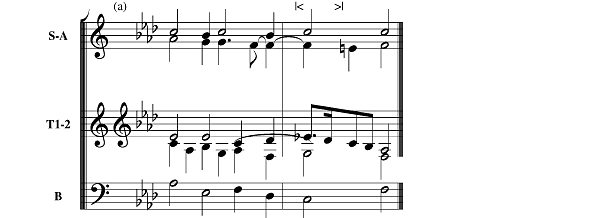
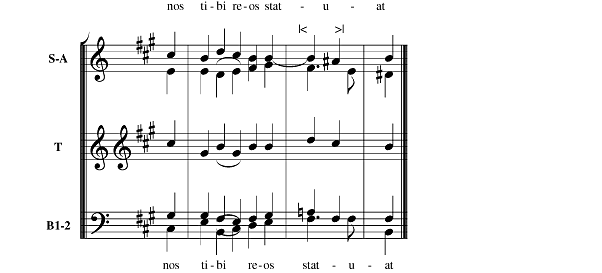
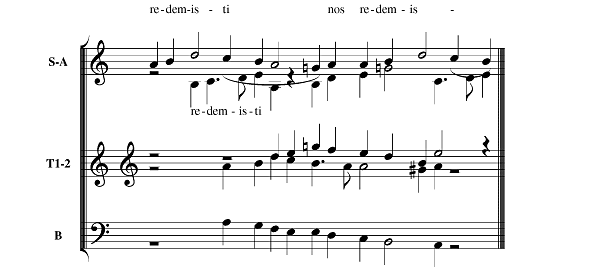
Of these examples we may note that the first was used by Purcell (died 1695) as a conscious antique - as in Rejoice in the Lord at the words let your requests be made known unto God - and the others died out with the passing of the sixteenth century.
Design in music is attained by contrast and repetition.
In Elizabethan church music repetition was sparingly
used but contrast was the very tissue of the score.
Every source of contrast was utilised:
the clashing of differing rhythms, the
successive use of block harmony and counterpoint, the variety of cadences towards which the music moved.
All these are methods of
appealing to the heart and brain of the listener;
but other contrasts are used which delight the ear by first satiating it with
sonority and then bringing it relief by the employment of a thinner texture.
At this last method of contrast the composers of the
sixteenth century were no less adept than the composers of other periods.
We find a deft use of pitch contrasts, especially in the
more ambitious works like Weelkes' Hosanna to the son of David
(Winchester Cathedral choir: music details HERE.)
where the
higher voices batter the ear with loud, close harmony alternating with deeper, rich effects obtained from the six voices engaged.
In five- and six-part work, indeed, the increased number of voices is used rather with such an end in view than to add to the
complexity of the counterpoint.
Relief is given to the ear by a careful use of differing combinations.
In four-part works there is
always a liberal use of two- and three-part passages, often following on the summing-up effect of some cadence.
Only in the
short services do we find all the parts singing all the time in the manner of a hymn-tune;
these are the 'bread-and-butter' work
of the period and the best that can be said of them is that they get over the ground quickly and sometimes beautifully.
The only
contrasts used are the alternating passages for decani, cantoris and full.
As one would expect in contrapuntal work the layout of the chords often breaks acoustical laws: the shape of the melodies will, of course, always account for the oddity. Even in five-part work chords occur without the third, the only apparent reason being that the composer liked them. Gibbons ends his Nunc dimittis in F with:

It looks a poor enough final chord on paper but seems to sound well in a building the size of a church. Except where a large number of parts are singing, the score is usually playable by the two hands, which shows that large gaps between the notes of a chord were studiously avoided; spacing is uniformly even, the inevitable consequence of keeping the compass of each voice within, as a rule, a ninth or a tenth. The singer is seldom, if ever, called upon for the extreme notes of his compass and that keeps the music sober in spirit. Melodically the parts are always easy and the short phrase technique ensured that the singer had time to breathe - points often forgotten in more recent works. A glance at any page will reveal a score littered with rests, the breathing spaces so essential not only to the singer but to the attention of the listener. And if after a rest the part enters on a point, before the rest the composer is invariably careful to end his phrase musically with a note of some length on which the singer can dwell with satisfaction. There is no 'snatch a breath and on again' feeling left in the singer's mind.
[The long phrases fashionable in modern works suit a large choir where any one singer can break the phrase without being noticed; the normal cathedral choir with perhaps only two men to each under part is essentially a 'chamber' combination and can seldom 'bring off' the sustained intensity required in these long phrases.]
In compass, alto parts alone give some anxiety to the modern choir-master; the extremes used in all voices are somewhat as follows (in actual sounds):
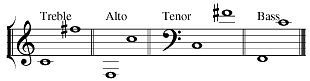
From this it is clear that the alto was expected to have an effective range of the same compass as that of other voices. The counter-tenor, a light head voice of tenor quality, was capable of delivering good notes in all parts of this range; our modern alto is a poor voice beside this, being often inaudible below D (above middle C) and incapable of anything higher than the C above. At times, therefore, editors have had to do some arranging in order to ensure an audible delivery of some of the low notes; it is still often the modern choir-master's duty to allow a tenor to lend a helping hand at difficult places.
Most works of the period are now transposed up often as much as a minor third. It is presumed that ecclesiastical pitch in the sixteenth century was higher than that now used [See page 143.]. Ouseley in his edition of Gibbons' works [Quoted by Bumpus, page 86.] quotes the following note from Tomkins' Musica Deo Sacra, published in 1668:
Example 36 Sit tonus fistulae apertae longitudine duorum pedum et semissis: sive 30
digitorum Geometricorum.
(Let this be the pitch of an open pipe two and a half feet, or 30 inches long.)
Sit tonus fistulae apertae longitudine duorum pedum et semissis: sive 30
digitorum Geometricorum.
(Let this be the pitch of an open pipe two and a half feet, or 30 inches long.)
A pipe thirty inches long produces a note, which we should call a slightly sharp G; this would seem to make our modern transposition up a minor third a trifle on the sharp side. At any rate, this transposition brings all the voice parts within a singable compass, though it sometimes makes the tessitura of the tenor lie a little high.
The whiteness of the printed page should not restrict the choir-master in his choice of a vigorous pace where such is needed for the full effect of the music. The minim should be looked upon as in a hymn-tune - merely a convenient symbol for the unit-beat; it is well, often, to imagine the score printed in notes half the length.
The works are seldom sung today with accompaniment. What the contemporary practice was no one knows. The 'sketch' scores extant give only the leads; whether these are conductor's scores or meant somehow to be played from - highly improbable, surely - is uncertain, though, of course, they might have been used by players already familiar with the work as 'reminder' scores. Most of this music sounds better unaccompanied; the lack of accompaniment allows freer rhythmic singing and does not deaden the silken quality of chords founded on natural intervals with an organ tuned on equal temperament.