Chapter 3 - ORIGINS OF THE SERVICE MUSIC
HOME | contents | << | cantus responsorius | cantus antiphonarius | the musical background established | the Gregorian revision | the scola cantorum | >>CANTUS RESPONSORIUS |  cantus responsarius |
While music is in no sense an essential in public worship (though some sort of concerted act is essential if there is to be any public worship) even a cursory knowledge of the psalms will show the important part it played in the services of the Jewish Temple. Many of the psalms, which have come down to us, are obviously liturgical or arranged with recurring refrains for singing. After the last supper the apostles sang 'an hymn', perhaps one of the psalms we know, and Paul exhorts his converts to sing 'psalms and hymns and spiritual songs.' Later, when Roman law persecuted the Christian church, singing was perhaps less indulged in for services would be held in secret. When in 515 the Edict of Milan made Christianity the religion of the Empire, singing came into its own again. But singing can never have died completely and the form of music used in Christian worship followed the model of that heard in the synagogues. One of the chief features of synagogue music was the solo melismatic, or ornate, chant, in which a soloist sang a phrase that was repeated verbatim by the people or answered by them with a refrain, as, for instance, in psalm 156. This refrain might be, as in the psalm mentioned, such a phrase as 'for his mercy endureth for ever', or an Amen or Alleluia, and in Christian times Gloria Patri. This two-fold method of singing was called Cantus Responsorius; it had been used no doubt from ancient times in public worship and was clearly the natural result of having present at the service both skilled and unskilled singers. We see it today in a simplified form in the versicle and response or the litany. The frequency of papal fulminations against the melismatic chant shows that the soloists tended to over-indulge by elaborating their chants; their joy in their skill tended to thrust aside the purpose of public worship. Most of this solo chant disappeared with the publication of the 1549 and 1552 Book of Common Prayer.
CANTUS ANTIPHONARIUS | cantus antiphonarius |
During the fourth century another method of singing spread, like the monastic ideal, from the east where boys were first used as singers; this was called Cantus Antiphonarius. The term was first used to denote singing by boys and men together in octaves as well as antiphonal singing. Later it meant antiphonal singing only - one body of voices answering another. Being peculiarly suitable for the singing of the psalms, with their strophic, parallel structure, it was freely used in the new monastic services and brought with it the hymn, a new type of composition founded on accentual rhythm and possibly of Semitic origin. [Paul's 'hymn' in the passage quoted above probably meant something like a psalm.] Though Ephraem Syrus (505? 375) and Hilary of Poitiers (died 567) are credited with its introduction into Christian services, it was Ambrose, Bishop of Milan from 574 to 397, who first brought it to the form we know, that of a number of four-lined stanzas in iambic dimeters. The subjects of his hymns are always the fundamentals of the Christian dogma and the language is simple and dignified; the tunes, which may or may not be by Ambrose, are perfect models of directness and sober beauty. Of the many hymns claimed to be from his pen four are generally reckoned as authentic:
1. Aeterna rerum Conditor. | Aeterna ... |
2. Deus Creator omnium.  (Gothic Voices: Music details HERE.) | Aeterna ... |
3. Jam surgit hora tertia. | Jam surgit ... |
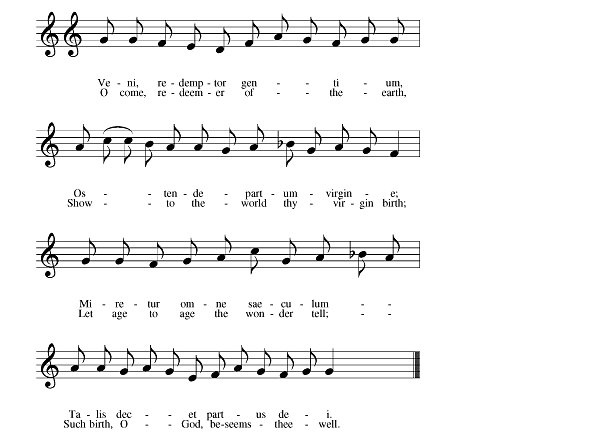
4. Veni Redemptor gentium. | Veni Redem ... |
A stanza of the last with its translation and melody will serve as an example of his art.

THE MUSICAL GROUNDWORK ESTABLISHED
We see then that by the end of the fourth century three distinct types of chant were used in the now well established services: Cantus Responsorius, consisting of the more ornate solos with less florid refrains, Cantus Antiphonarius, antiphonal congregational singing which was usually simple, and the metric Hymns. During the centuries that followed these three types were the groundwork of the service music; derived originally from the synagogue music, this music shows other influences like those of folk-music or the infiltrations of Greek and Byzantine elements during the seventh and eighth centuries. It is also possible to distinguish later between the music for the various rites - Roman, Milanese (Ambrosian), Gallican, Mozarabic (Spanish), and Sarum (English) - but the ground-plan remained clear and is common to all in modality, rhythmic scheme and word treatment.
THE GREGORIAN REVISION
The liturgy and chant introduced by Augustine into Britain in 597 was thus already a well-developed system. The work of Pope Gregory (590-601) was in no sense creative; it took the scattered elements so far achieved and welded them into an ordered whole. It was this newly organised system, which survived in England during the Middle Ages, and in essentials it is the same as the system used today in the Roman church. This Gregorian revision, a gathering together and a reform at the same time of the liturgy and its chant, was contained essentially in two books. The so-called Gregorian Sacramentary dealt with four matters: Proprium de Tempore, the regulation of the daily services, Proprium de Sanctis, that of saints' day services, Missae, the ordering of the mass, and Orationes Communes, the book of prayers; the musical counterpart to the Sacramentary consisted of two parts, the first concerned with the mass and lesser sacraments, the other with the Divine Offices or hours of prayer. The extent of the labour entailed may be gauged from the fact that the mass portion contained over 600 pieces (introits, graduals, etc.) and that for the hours about 2000 antiphons besides over 1000 smaller responds, versicles and responses, etc. As well as collecting it, the musical books simplified and curtailed the music of the soloists and choir so that it should be truly subordinate to the worship; singers then as now were apparently over-eager to display their skill.
THE SCHOLA CANTORUM
To advise him, possibly, on the musical revision and to put into practical use the collected and reformed chant, Gregory founded his famous Schola Cantorum in Rome giving it an income derived from property and two houses in which to work. [Other Song Schools, not so famous, had existed in Rome before this time.] The boys were recruited from a neighbouring orphanage and their training was undertaken seriously enough for many of them later to hold the highest offices in the church, even the papacy; musical popes indeed abounded during the next hundred years. A Prior Scholae or director was appointed with two assistants, the Quartus Scholae having charge of the boys. The music was learnt entirely by ear and is said to have involved a training of ten years. Though primarily founded for the provision of music in the papal chapel, the school became a model and many of its alumni were sent out to direct the reform of the chant and the singing in other parts of Europe; we may imagine that some of its members accompanied Augustine on his mission to Britain. The school's influence helped to effect the penetration of the Gregorian Sacramentary and the approved methods of singing its musical settings to all parts of the church, so that by the year 1000 the system can be said to have spread everywhere to the ultimate exclusion of the Gallican and Mozarabic systems. The only exception was the Milanese or Ambrosian tradition, which held out against the prevailing Roman system, becoming a sort of liturgical island. The Milanese tradition was not, in fact, finally broken until about 1500.