 THE SCHOOL OF CHARITY - Meditations on the Christian Creed. By Evelyn Underhill. Published by
Longmans, Green & Co., London, New York, Toronto. First published 1934. -
Prepared for katapi by Paul Ingram 2005.
THE SCHOOL OF CHARITY - Meditations on the Christian Creed. By Evelyn Underhill. Published by
Longmans, Green & Co., London, New York, Toronto. First published 1934. -
Prepared for katapi by Paul Ingram 2005.
Thy holy life is our way,
and by holy patience we walk to thee,
who art our head and governor.
And if thou, Lord, hadst not gone before and showed us the way,
who would have endeavoured to have followed?
– Thomas A Kempis.
Then thought I with myself, who that goeth on pilgrimage,
but would have one of these maps about him, that he may look,
when he is at a stand,
which is the way he must take.
– The Pilgrim's Progress.
NOT long ago, I was standing in an artist's studio before an altar-piece
which she had just made.
It represented the Nativity:
or rather, the eternal incarnation of the Holy, self-given for the world.
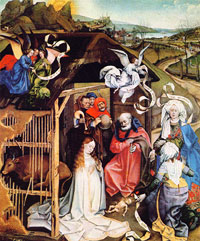
In the foreground one saw the Blessed Virgin, its ordained instrument,
and St. Joseph, watching by her bed.
There was a patient grave simplicity about them both;
reflected in the serious young angels,
whose majestic scale suggested the greatness of that world of spirit from
which they had been drawn,
Below, the sheep were feeding very quietly too:
innocent nature entirely at home among the mysteries of the supernatural
order,
one lamb turning from its mother to press more closely to the Mother of the
Lamb of God.
And behind the Blessed Virgin, the focus of the mystery,
the link as it were between two worlds,
the Child lay peacefully and helplessly on a small stone altar, as on a bed.
The stillness of an eternal event brooded over the whole.
I spoke to the artist of the beauty of this ancient conception;
and she answered,
"Yes, laid on the altar straight away.
I like that.
There's something so sturdy about it."
 Listen to the Ambrosian Singers with Handel's "For unto us a child is
born" from The Messiah.
Listen to the Ambrosian Singers with Handel's "For unto us a child is
born" from The Messiah.
Our modern religion hardly
makes enough of this element in the mystery of the Divine revelation;
in His pattern declared to humanity,
or in the life of prayer.
Yet sturdiness, shouldering the burden and accepting the tension inevitable
to all great undertakings
– getting to grips with the dread problems of life, and the cost of all redemptive
action
– comes nearer than any fervour to the Mind of Christ, and the demands of
Charity.
It is comparatively easy for devout minds to feel moved, contrite, exalted,
adoring;
much more difficult to discount all feeling, and be sturdy about it.
Christ was trained in a carpenter's shop;
and we persist in preferring a confectioner's shop.
But the energy of rescue,
the outpouring of sacrificial love, which the supernatural life demands,
is not to be got from a diet of devotional meringues and eclairs.
The whole life made an oblation from the first
– placed on the altar, and lived right through as a reasonable sacrifice from
beginning to end
– this is the pattern put before us.
Only thus can humanity use to the full its strange power of embodying eternal
realities;
and uniting the extremes of mystery and homeliness.
Nothing in this story,
perhaps, is more significant than the quietness and simplicity of its beginning.
The birth of the Child,
the Shepherds and the Magi,
the little boy of Nazareth and his wonderful experience in the Temple,
and the long quiet years in the carpenter's shop;
there seems at first sight nothing very supernatural in these things.
Indeed, one of the most convicting aspects of Christianity, if we try to
see it in terms of our own day, is the contrast between its homely and inconspicuous
beginnings and the holy powers it brought into the world. It keeps us in
perpetual dread of despising small things, bumble people, little groups.
The Incarnation means that the Eternal God enters our common human life with
all the energy of His creative love,
to transform it,
to exhibit to us its richness,
its unguessed significance;
speaking our language,
and showing us His secret beauty on our own scale.
Thus the spiritual life
does not begin in an arrogant attempt at some peculiar kind of other-worldliness,
a rejection of ordinary experience.
It begins in the humble recognition that human things can be very holy, full
of God;
whereas high-minded speculations about His nature need not be holy at all.
Since all life is engulfed in Him,
He can reach out to us anywhere and at any level.
The depth and richness of His Eternal Being are unknown to us.
Yet Christianity declares that this unsearchable Life,
which is in essence a self-giving Love,
and is wholly present wherever it loves,
so loved this world as to desire to reveal within it the deepest secret of
His thought;
appearing within and through His small, fugitive, imperfect creatures, in closest
union with humanity.
In the beginning was the Word:
and the Word was God,
and without Him was not anything made that hath been made:
and the Word became flesh and dwelt among us.
That seems immense.
A complete philosophy is contained in it.
And then we come down to the actual setting of this supreme event,
and at once all our notions of the suitable and the significant are set aside;
all our pet values reversed.
A Baby, just that;
and moreover, a Baby born in the most unfortunate circumstances.
The extremes of the transcendent and the homely
are suddenly brought together in this disconcerting revelation of reality.
The hard life of the poor,
its ceaseless preoccupation with the lowliest of human needs and duties,
the absolute surrender and helplessness,
the half-animal status of babyhood;
all this is the chosen vehicle for the unmeasured in-pouring of the Divine
Life and Love.
So too the strange simplicity of its beginning both rebukes and reassures
us.

The Lord is with thee...
and calling forth the one and only answer,
Behold the handmaid of the Lord,
be it unto me according to thy Word !
Humble self-abandonment
is found and declared to be enough to give us God.
First in one way and then in another, all the incidents which cluster round
the mystery of the Incarnation seem designed to show us this; the simplest
yet the deepest truth about His relation to the soul.
Listen to the choir of Winchester Cathedral chanting Gibbons'
Magnificat.
Look for instance at the
story of the Magi;
those scholars of the ancient world,
turning from their abstruse calculations and searching of the heavens because
they saw a new star,
and driven to seek along fresh paths for a clue to the mystery of life.
What they found does not seem at first sight what we should now call "
intellectually satisfying."
It was not a revelation of the Cosmic Mind, but a poor little family party;
yet there they were brought to their knees
– because, like the truly wise, they were really humble-minded –
before a little, living, growing thing.
The utmost man can achieve on his own here capitulates
before the unspeakable and mysterious simplicity of the method of God;
His stooping down to us.
His self-disclosure at the very heart of life.
After all, the shepherds got there long before the Magi;
and even so, the animals were already in position when the shepherds arrived.
He comes to His own;
the God of our natural life makes of that natural life
the very material of His self-revelation.
His smile kindles the whole universe;
His hallowing touch lies upon all life.
The animal world and the natural world have their own rights and their own
place within the Thought of God.
There never was a religion more deeply in touch with natural things than
Christianity, although it is infinite in its scope.
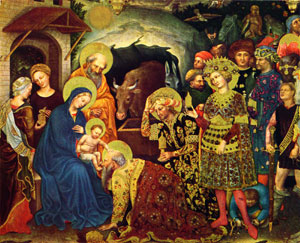
The story of the Magi
shows the new life which has appeared within the rich texture of our normal
experience,
casting its purifying radiance upon the whole existence of man:
the Light of the world,
not the sanctuary lamp of a well-appointed church.
Cosy religious exclusiveness is condemned in this mystery.
It is easy for the pious to join the shepherds, and feel in place at the
Crib,
and look out into the surrounding darkness saying,
"Look at those extraordinary intellectuals wandering about after a star;
they seem to have no religious sense.
Look what curious gifts and odd types of self-consecration they are bringing;
not at all the sort of people one sees in church."
Yet the child who began by receiving those unexpected pilgrims had a woman
of the streets for His most faithful friend,
and two thieves for His comrades at the last.
Looking at these extremes, so deeply significant of the Christian spirit,
we can learn something, perhaps, of the height and depth and breadth of that
divine generosity into which our narrow and fragmentary loves must be absorbed.
It was said of Father Wainright that he cared above all for the scamp, the
drunkard and the outsider,
least of all for those who came regularly to church;
and no man of our time has been fuller of the Spirit of Christ.
The Epiphany means the free pouring out of a limitless light
– the Light of the World
– not its careful communication to those whom we hold worthy to receive it.
The Magi, after all, took more trouble than the shepherds.
They came a longer journey, by more perilous paths.
The intellectual virtues and longings of men are all blessed in Christ,
"the intellectual radiance full of love."
We turn to another point
which every mystery in its turn will show us;
for they are there to light up the cycle of our own interior growth.
In our souls too the Divine Charity must be incarnate;
take visible, tangible form.
We are not really Christians until this has been done.
The Eternal Birth, says Eckhart, must take place in you.
And another mystic says that human nature is like a stable,
inhabited by the ox of passion and the ass of prejudice;
animals which take up a lot of room,
and which I suppose that most of us are feeding on the quiet.
It is there, between them, pushing them out of the way, that the Divine Child
is to be born,
and in their very manger He will be laid:
and they will be the first to fall down before Him.
Sometimes Christians seem far nearer to those animals than to the child in
His simple poverty and self-abandonment.
And here again, God's mysterious and life-giving action in the soul is for
a purpose that points beyond ourselves.
It happens not merely for our sakes;
but because His manifestation to the world must be through us.
Every real Christian is part of the dust-laden air which shall radiate the
glowing Charity of God;
catch and reflect His golden light.
Ye are the light of the world,
because you are irradiated by the one Light of the World,
the holy generosity of God.
The great New Testament saints
– in fact, all saints
– look right through and past the outward appearance of men's lives,
and seek only for the seed of the divine life within them, the hidden Child
of God.
Ye are of God, little children,
exclaims St. John
greater is He that is in you than he that is in the world.
That is the awful truth which rules the inner life of man.
And now we turn from the
central mystery to the clustered events, through which its character is
disclosed.
We see the new life growing in secret.
Nothing very startling happens.
We see the child in the carpenter's workshop.
He does not go outside the frame of the homely life in which He appeared.
It did quite well for Him, and will do quite well for us;
there is no need for peculiar conditions in order to grow in the spiritual
life,
for the pressure of God's Spirit is present everywhere and at all times.
Our environment itself,
our home and our job,
is the medium through which we experience His moulding action and His besetting
love.
It is not Christian to try and get out of our frame,
or separate our outward life from our life of prayer,
since both are the creation of one Charity.
The third-rate little town in the hills,
with its limited social contacts and monotonous manual work,
reproves us when we begin to fuss about our opportunities and our scope.
And this quality of quietness, ordinariness, simplicity,
with which the saving action of God enters history,
endures from the beginning to the end.
The child grows like other children,
and the lad works like other lads:
there is a total abandonment of the individual to the vast Divine purpose,
working at its own pace and through ordinary life,
and often to us in mysterious ways.
We must surely believe
that much in Christ's own destiny was deeply mysterious to Him.
It seems part of a completed manhood, that He shared our strange human situation,
our entire dependence, in this too.
The New Testament narrative,
with its emphasis on moments when the clouds parted, and He saw His call
and what was at work in Him
seems to suggest by contrast other, longer stretches;
when He looked out from His earthly tabernacle on no clear view,
but a path to be trodden in pure abandonment to God.
Here again our interior life is conformed to the same pattern.
In a general way we must go on steadily, without presuming to demand a clear
view.
We cannot break the cloud of unknowing in which our lives are folded:
like Nicodemus, we must come to Him by night.
This should make us realize how deeply hidden,
how gradual and unseen by us,
the soul's growth in the life of prayer is likely to be.
It is like the hidden life at Nazareth.
We must be content with the wholesome routine of the nursery,
doing ordinary things, learning ordinary lessons and eating ordinary food,
if we are to grow truly and organically in wisdom and stature and favour
with God and man.
Growth in God is a far more gradual, less conscious process than we realize
at first.
We are so raw and superficial in our notions, that we cannot conceive the
nature of those tremendous changes by which the child of grace becomes the
man of God.
We all want to be up and doing long before we are ready to do.
To contemplate the proportions
of Christ's life is a terrible rebuke to spiritual impatience and uppish
hurry.
There we see how slow, according to our time-span, is the maturing of the
thought of God.
Ephemeral insects become adult in a few minutes,
the new-born lamb gets up and starts grazing straight away,
but the child depends for months on its mother's love.
Sanctity,
which is childhood in God,
partakes of the long divine duration.
We often feel that we ought to get on quickly,
reach a new stage of knowledge or prayer,
like spiritual may-flies.
But Christ's short earthly life is divided into thirty years for growth and
two and a half for action.
The pause, the hush, the hiddenness, which intervenes between the Birth and
the Ministry, is part of the divine method, and an earnest of the greatness
of that which is to come.
Only when that quiet growth has reached the right stage is there a revelation
of God's purpose,
and the stress and discipline of a crucial choice.
Baptism, Fasting and Temptation come together as signs of maturity.
It is much the same with us in the life of prayer.
The Spirit fills us as we grow and make room.
It keeps pace with us;
does not suddenly stretch us like a pneumatic tyre, with dangerous results.
To contemplate the life of Christ, said St. Augustine,
"cures inflation, and nourishes humility."
We see in Him the gradual action of God,
subdued to the material on which it works,
and fostering and sanctifying growth –
that holy secret process –
especially growth in the hidden, interior life,
which is the unique source of His power in us.
All gardeners know the
importance of good root development before we force the leaves and flowers.
So our life in God should be deeply rooted and grounded before we presume
to expect to produce flowers and fruits;
otherwise we risk shooting up into one of those lanky plants which can never
do without a stick.
We are constantly beset by the notion that we ought to perceive ourselves
springing up quickly, like the seed on stony ground;
show striking signs of spiritual growth.
But perhaps we are only required to go on quietly, making root, growing nice
and bushy;
docile to the great slow rhythm of life.
When we see no startling marks of our own religious progress or our usefulness
to God,
it is well to remember the baby in the stable and the little boy in the streets
of Nazareth.
The very life was there present, which was to change the whole history of
the human race;
the rescuing action of God.
At that stage there was not much to show for it;
yet there is perfect continuity between the stable and the Easter garden,
and the thread that unites them is the hidden Will of God.
The childish prayer of Nazareth was the right preparation for the awful prayer
of the Cross.
So it is that the life
of the Spirit is to unfold gently and steadily within us;
till at the last the full stature for which God designed us is attained.
It is an organic process, a continuous Divine action;
not a sudden miracle or a series of jerks.
Therefore there should be no struggle, impatience, self-willed effort in
our prayer and self-discipline;
but rather a great flexibility, a homely ordered life, a gentle acceptance
of what comes to us, and a still gentler acceptance of the fact that much
we see in others is still out of our own reach.
The prayer of the growing spirit should be free, humble, simple; full of
confidence and full of initiative too.
The mystics constantly tell us, that the goal of this prayer and of the hidden
life which shall itself become more and more of a prayer, is union with God.
We meet this phrase often:
far too often, for we lose the wholesome sense of its awfulness.
What does union with God mean?
Not a nice feeling which we enjoy in devout moments.
This may or may not be a by-product of union with God; probably not.
It can never be its substance.
Union with God means such an entire self-giving to the Divine Charity,
such identification with its interests,
that the whole of our human nature is transformed in God,
irradiated by His absolute light,
His sanctifying grace.
Thus it is woven up into the organ of His creative activity, His redeeming
purpose;
conformed to the pattern of Christ, heart, soul, mind and strength.
Each time this happens, it means that one more creature has achieved its
destiny;
and each soul in whom the life of the Spirit is born, sets out towards that
goal.
If men and women want
to know what this means in terms of human nature and human experience,
one sovereign way is offered them;
the contemplation of Christ's life.
There we see that we are not to grow in wisdom and stature for our own sakes,
in order to achieve what is really a self-interested spirituality.
The growth is for a reason that points beyond ourselves:
in order that the teaching, healing, life-changing power of the Divine Charity
may possess us,
and work through us.
We must lose our own lives, in order to be possessed by that life:
that unmeasured Divine generosity which enters the human world in such great
humility,
as the Infinite Light pours through narrow lancets,
conformed to our human limitations,
growing at our human pace.
The Holy Child sets up a standard for both the simple and the learned;
teaching a great simplicity and self-oblivion,
a willingness and readiness to respond to life wherever we may find it,
and to grow and change,
not according to our preconceived ideas of pace and method,
but according to the overruling will and pace of God.