 THE SCHOOL OF CHARITY - Meditations on the Christian Creed. By Evelyn Underhill. Published by
Longmans, Green & Co., London, New York, Toronto. First published 1934. -
Prepared for katapi by Paul Ingram 2005.
THE SCHOOL OF CHARITY - Meditations on the Christian Creed. By Evelyn Underhill. Published by
Longmans, Green & Co., London, New York, Toronto. First published 1934. -
Prepared for katapi by Paul Ingram 2005.
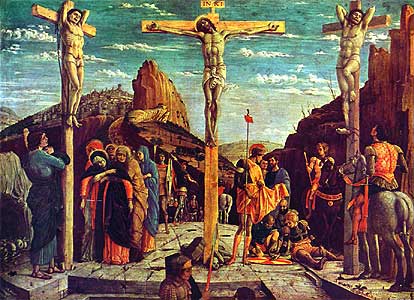
Truth is to be worshipped,
though it hang naked on a Cross.
– St. Bruno.
The mystery revealed,
in a unique degree and form, in Christ's life,
is really a universal spiritual-human law;
the law of suffering and sacrifice,
as the one way to joy and possession,
which has existed, though veiled till now,
since the foundation of the world.
– P. von Hugel.
A CHRISTIAN'S belief about reality is a wonderful blend of confidence and
experience.
On one hand it asks great faith in the invisible world that enfolds us.
On the other hand it includes and embraces the hardest facts of the actual
life we know, and gives them a creative quality.
It is a religion which leaves nothing out.
After the great phrases in which the Creed tries to describe or suggest the
eternal Divine Nature,
and the mystery of that Infinite God
disclosing Himself in and through His creatures –
incarnate by the action of the Holy Spirit of Charity –
it goes on to a series of plain statements about the life of Christ.
He was born, a baby;
made man;
entered completely into our human situation.
He was crucified at a particular moment in the history of a particular country,
suffered,
was buried,
and rose again to a new quality of life.
This sequence of facts,
deliberately picked out as specially significant moments in the revelation
of Divine Charity to us,
is not merely a series of symbolic or spiritual events.
These things, on their surface so well known –
but in their deep significance and bearing on life so carefully ignored by
us –
happened in time and space to a real man, a real body;
of flesh and nerve and bone,
accessible to all the demands of our physical nature
and all the humiliations of physical pain.
To the world He merely appeared a local prophet of somewhat limited appeal;
yet endowed with the strange power of healing and transforming all lives
given into His hand.
Having roused the hostility of official religion by His generous freedom
of love,
He was condemned by a combination of political cowardice and ecclesiastical
malice
to a barbarous and degrading death;
and made of that death the supreme triumph of self-abandoned Charity.
Yet as we meditate on these familiar facts,
and recollect that in and through them
the One God in whom we believe is self-revealed to man's soul,
we are gradually aware of a light which comes through them,
and shames us by its disclosure of what a perfected human nature might be,
and is therefore intended to be.
Lumen Christi.
The Light of the World
enters our life to show us reality;
and forces us to accept the fact that it is the whole of that life,
not some supposed spiritual part of it,
which is involved in our response to God,
and must be self-given to the mysterious purposes of Charity.
Christianity is a religion which concerns us as we are here and now,
creatures of body and soul.
We do not " follow the footsteps of His most holy life"
by the exercise of a trained religious imagination;
but by treading the firm rough earth,
up hill and down dale,
on the mountain,
by the lake-side,
in garden, temple, street,
or up the strait way to Calvary.
The whole physical scene counts and is of vital importance to Christians;
it can and does test us, save us or break us.
So, to dismiss the pressures, limitations and crucial problems of practical
life,
bodily sufferings and self-denials,
or even the most childlike and crude devotional exercises,
as merely material, merely external, and so on,
witnesses to a cheap and fundamentally unchristian attitude of mind;
a complete misunderstanding of our real situation
and the many-levelled richness of God's revelation within life.
Dear Wood, dear Iron!
says the great hymn of the Cross, with relentless realism,
Dear the Weight that hung on thee!
Human beings are saved by a Love which enters
and shares their actual struggle, darkness and bewilderment,
their subjection to earthly conditions.
By a supreme exercise of humility
the deep purposes of God are worked out through man's natural life
with all its powers, humiliations, conflicts and sufferings,
its immense capacity for heroic self-giving, disinterested love;
not by means of ideas, insights, and spiritual experiences even of the loftiest
kind.
Charity, generosity,
accepting the vocation of sacrifice,
girding itself with lowliness as one that serveth
and then going straight through with it,
suffering long,
never flinching,
never seeking its own,
discloses its sacred powers to us within the arena of our homely everyday
existence:
and it is by the varied experiences and opportunities of that daily existence,
that our dull and stubborn nature shall be trained for the glorious liberty
of eternal life.
The Word, the Thought of God, made flesh and dwelling among us, accepted
our conditions, did not impose His.
He took the journey we have to take, with the burden we have to carry.
We cannot then take refuge in our unfortunate heredity, temperament, or health
when faced by the demands of the spiritual life.
It is as complete human beings, taught and led by a complete Humanity, that
we respond to the pressure of God.
The saints carried the burdens of heredity, temperament, and health.
It is no easy amiability which we see transformed to the purpose of Creative
Love in St. Paul or St. Augustine.
St. Catherine of Genoa had no natural gift of joy, or St. Francis Xavier
of humility.
Bunyan and Fox knew conflicts as bitter as our own.
These are they that came out of much tribulation.
There are other forms of saving tribulation than martyrdom,
many ways of enduring to the end;
but none that does not involve the painful conflict
between softness and sturdiness, natural self-love and supernatural divine
love.
Grace does not work in vacua :
it works on the whole man, that many-levelled creature;
and shows its perfect work in One who is described as Very Man,
and of whom we cannot think without the conflict of Gethsemane and the surrender
of the Cross.
Since, then, the career which begins upon the altar as a living sacrifice
to the purposes of Charity,
and works out this sublime vocation to the bitter end,
is to be the pattern of the Christian's inner life,
there must always be something in this life
which is the equivalent of the Passion and the Cross.
Suffering has its place within the Divine purpose,
and is transfigured by the touch of God.
A desperate crisis,
the demand for a total self-giving,
a willingness to risk everything,
an apparent failure,
darkness and death –
all these are likely to be incidents of a spiritual course.
Those who complain that they make no progress in the life of prayer because
they "cannot meditate"
should examine, not their capacity for meditation,
but their capacity for suffering and love.
For there is a hard and costly element,
a deep seriousness,
a crucial choice in all genuine religion,
of which the New Testament warns us on every page;
and this is more and more made plain to us as we leave its surface and penetrate
to its solemn deeps.
There we find a suffering and love twined so closely together, that we cannot
wrench them apart:
and if we try to do so, the love is maimed in the process –
loses its creative power –
and the suffering remains, but without its aureole of willing sacrifice.
Love, after-all, makes the whole difference between an execution and a martyrdom.
Pain,
or at least the willingness to risk pain,
alone gives dignity to human love,
and is
the price of its creative power:
without this, it is mere emotional enjoyment.
It costs much to love any human being to the bitter end;
and on every plane a total generosity,
a love that includes pain and embraces it,
is the price of all genuine achievement.
The son of man must suffer, in the last desperate conflict between supernatural
self-giving and natural self-love.
The Cross means the ultimate helplessness and dependence of man,
when he comes up to his own limit and has nothing left but charity;
and his willing acceptance of that helplessness and limit,
because it throws him back upon the God he trusts and loves.
So here,
by the Crucifix and what it means to them,
Christians must test their position.
What we really think about the Cross
means, ultimately, what we really think about life.
It stands upon the frontier of two worlds;
the final test of humanity's worth.
Seek where you will,
says Thomas a Kempis,
everywhere you will find the Cross.
When you have found it, what are you going to do about it?
That is the supreme question which decides our spiritual destiny.
Are we merely to look at it with horror,
or accept it with adoration and gratitude,
as the' soul's unique chance of union with the Charity of God?
It has been said that the whole of Christ's life was a Cross.
I think that saying does grave injustice to its richness of response;
the real joy and beauty of His contacts with nature, children, friends,
the true happiness we find in the saints nearest to Him,
the hours snatched for the deeply satisfying prayer of communion,
the outburst of rejoicing when He discerns the Father's will.
The span of perfect manhood surely includes and ratifies all this.
But it was the deep happiness of the entirely self-abandoned,
giving without stint truth, health and rescue,
and always at His own cost:
not the easy, shallow satisfaction of those who live to express themselves.
There is a marked contrast between the first phase of the Ministry,
with its confident movement within the natural world –
healing what is wrong in it,
and using what is right in it,
and sharing with simplicity the social life of men –
and the second phase, from the Transfiguration to the end.
Then, we get a sense of increasing conflict with that same world,
and the
growing conviction that what is so deeply wrong with it
can only be mended
by a love that is expressed in sacrifice.
The Suffering Servant, bearing its griefs and carrying its sorrows,
is the
one who most perfectly conveys the Divine Charity, and serves his brethren
best.
If anyone would come after Me,
let him take up the Cross.
The spiritually natural life is very charming and the exclusively spiritual
life is very attractive.
But both stop short of that unconditioned self-giving,
that willing entrance
into the world's sufferings and confusion which God asks of rescuing souls.
It was in the Passion, says St. John of the Cross,
that Christ
accomplished that supreme work
which His whole life, its miracles and works of power,
had not accomplished –
the union and reconciliation of human nature with the life of God.
Here we learn what it really means to volunteer for the Christian life.
The first movement of His soul was self-donation to the purposes of the Father.
'I must be about my Father's business.
It seems the most lovely, most privileged, of vocations at that point.
The last movement of His soul was the utter self-giving of the Cross:
Father, into Thy Hands I commend my spirit;
the perfection of self-oblivious love.
That is the true culmination of the story which began with the child of Bethlehem.
It is a very lopsided revelation of love which gives us the Manger without
the Cross.
They are like two windows standing North and South of that altar where the
Divine Life is eternally self-given to men.
We are made partakers of Christ,
says the writer of Hebrews,
if we hold the beginning of our confidence steadfast to the end.
The beginning is easy and lovely.
It is the end that tests to the utmost our courage and love.
Can you drink of My cup and be baptized with My baptism?
Not unless you care far more about God and His purposes than you do about
your own soul;
but that is the very essence of a spiritual life.
Profound submission to the Will of God declared through circumstances:
being what we are,
and the world what it is,
that means sooner or later Gethsemane,
and the Cross,
and the darkness of the Cross.
Most of the saints have been through that.
We do not begin to understand the strange power of the Passion,
the light it casts on existence,
till we see what it was in their lives.
For union with the Cross means experience of the dread fact of human nature,
that only those who are willing to accept suffering up to the limit are capable
of giving love up to the limit;
and that this is the only kind of love which
can be used for the purposes of the redeeming life.
It is on Good Friday,
and only then,
that the ancient liturgies hail Christ
as the Strong, the Holy, the Immortal;
as if this crisis alone could disclose in its fulness His mysterious power.
And it is at the Institution of the Eucharist,
on the eve of that apparent
failure,
that they place in His mouth the words of the Psalmist,
The right hand of the Lord bringeth mighty things to pass!
I shall not die but live, and declare the works of the Lord!
Every Christian altar witnesses to that.
The living power of Christ within the world,
the Food He gives eternally to men,
have been won by the costly exercise of a heroic love.
In the chapter-house of S. Marco at Florence,
the artist-saint, Fra Angelico, has painted the patrons of the city and the
founders of the great religious orders –
dedicated servants of the Eternal Charity –
adoring the Crucified who is their Pattern, and from whom their mandate comes.
There they are: real human beings of every type, transfigured by a single
costly loyalty.
There is Mark, the self-effacing writer of the earliest Gospel.
There is the Magdalen, completely sanctified by penitence and love.
There are the holy women, whose service was of the homeliest kind.
There are Cosmo and Damian, the good and honest physicians.
There too are the devoted scholars, Jerome and Augustine;
and Benedict, the creator of an ordered life of work and prayer.
There are Francis, lost in an ecstacy of loving worship,
and Thomas Aquinas gazing at the key to that great Mystery of Being to which
he had given his vast intellectual powers.
All these –
mystics, lovers, teachers, scholars, workers –
are linked with the Crucified, the Holy and Self-given,
whose agents they are and from whom they draw power and love.
The whole range of human accomplishment, in these its chosen representatives,
is shown to us in direct and glad dependence on the ever-flowing Charity
of God.
That is the very substance of religion.
Like an immense impetus of generosity, it pours out from the Heart of Reality;
self-given through generous and adoring spirits of every sort and kind, to
rescue and transform the world.
If then we look at the Crucifix –
"that supreme symbol of our august religion,"
as von Hugel loved to call it –
and then at our selves, testing by the Cross the quality of our courage and
love;
if we do this honestly and unflinchingly,
this will be in itself a complete self-examination, judgment, purgatory.
It is useless to talk in a large vague way about the Love of God.
Here is its point of insertion in the world of men, in action, example and
demand.
Every Christian is required to be an instrument of God's rescuing action;
and His power will not be exerted through us except at considerable cost
to ourselves.
Muzzy, safety-first Christianity is useless here.
We must accept the world's worst if we are to give it of our best.
The stinging lash of humiliation and disillusionment,
those unfortunate events which strip us of the seamless robe of convention
and reserve,
and expose us naked to the world in the weakness of our common humanity,
the wounds given by those we love best,
the revelation that someone we had trusted could not be trusted any more,
and the peculiar loneliness and darkness inseparable from some phases of
the spiritual life,
when it looks as though we were forsaken and our ultimate hope betrayed:
all these are sufficiently common experiences, and all can be united to the
Cross.
Here again Christ remains within our limitations.
He hallows real life, and invites us to hallow it
by the willing consecration
of our small humiliations, sacrifices and pains;
transmuting them into part of that creative sacrifice,
that movement of faith,
hope and charity
in which the human spirit is most deeply united to the Spirit
of God.
And indeed, unless
we can do this
our world is chaos;
for we cannot escape suffering,
and we never understand it
till we have embraced
it,
turned it into sacrifice,
and given ourselves in it to God.
Then, looking from this vantage-point upon the Crucifix,
we see beyond the torment and the darkness,
the cruel physical pain and its results.
As in some of the great creations of mediaeval art,
we are allowed to discern
the peace of a divine and absolute acceptance,
a selfless and abandoned love,
tranquil, unstrained, strangely full of joy:
the joy of suffering accepted
and transfigured by the passion of redeeming charity.
And in the end, of course, we too only triumph by that which we can endure
and renounce.
The only victories worth having in any department of life must be won on
Calvary.
There is a phrase which the Greek Liturgy constantly applies to God in Christ:
O Lord and Lover of Men!
The whole meaning and drama of the Passion is gathered up in that.
The Evangelists' accounts –
all the curt notes crowded together –
reveal, when we take them separately and dwell upon them,
the deep entrance into human suffering in all its phases,
the utter self-giving to the vocation of sacrifice,
of One Who is, in completeness, both the Lord and Lover of mankind.
Consider some of these episodes.
The anointing by the woman of Bethany,
of one who never seemed more divine than at this moment,
accepting so peacefully the menacing web of events that are closing in;
and then even that gesture of love spoilt by the sordid displeasure of His
own disciple.
Then the incredible beauty of that two-fold act of selfless generosity,
the Last Supper and the Washing of the Feet;
the humble cleansing and feeding of the imperfect human creature,
with its deep reverence for that human creature's limitations and concern
for that human creature's needs.
And then Gethsemane,
the real crisis and victory.
The first' prayer of natural agony:
"If it is possible, don't let this happen! I can't face it."
And the second prayer:
"If I must go through with this,
Thy Will be done."
Because of that scene, at the very heart of human suffering, even its rebellions
and fears, we are never alone.
We often feel that we make a mess of our suffering
and lose the essence of
sacrifice,
waste our opportunity, fail God,
because we cannot stand up to
it.
Gethsemane is the answer of the Divine Compassion to that fear.

After that, He seems to move with a strange serenity through the scenes
of the Betrayal and the Trial.
If we think of all these events as they actually were,
crowded together,
beating one after another in swift succession
on a soul unique in its sensitiveness
to evil, sorrow, and love,
and remember that within them
went forward the
most crucial event in the history of man,
we reach a new conviction of the
mysterious energy of pain,
its necessary presence in all deep religion.
We sometimes think we need a "quiet time" before making a great
spiritual effort.
Our Lord's quiet time was Gethsemane;
and we know what that was like.
At all these points the soul's interior life is moulded very closely on
its Pattern.
We too, setting our face towards Jerusalem, must serve with humble self-oblivion
meeting every demand on our patience and pity,
and faithfully dispensing
the Water of Life
which may pour through us while leaving our own thirst
unquenched.
We must, when the moment comes for us,
endure
in apparent loneliness
the
assault of sin, agony, and darkness.
We too must elect for the Will of God
when it means the complete frustration
of our own efforts,
the apparent death of our very selfhood;
and only so
enter into the life-giving life.
We cannot expect to reflect the joy and the power of that strange victory,
if we dodge the pain and conflict in which it was won.
Prayer in darkness and forsakenness,
the complete disappearance of everything
that could minister
to spiritual self-love,
humiliating falls and bitter
deprivations,
the apparent failure even of faith,
bufferings of Satan renewed
when least expected,
long sojourn in that solitary valley where Christian
"was
so confounded that he did not know his own voice":
these are all part of that long process,
which sometimes seems like a plodding
journey and sometimes like a swaying battle,
through which the mighty purposes
of the Divine Charity are fulfilled in human souls.
All this, the Creed assures us, is part of the inner life of man.
Little
wonder that the Christian must be sturdy about it;
fit for all weathers, and indifferent to his interior ups and downs.
Umbrellas, mackintoshes and digestive tabloids are not issued to genuine
travellers on this way.
Comfort and safety-first must give place to courage and love,
if we are to become – as we should be – -
the travelling agents of the Divine Charity.
If the road on which we find ourselves is narrow,
with a bad surface and
many sudden gradients,
it is probably the right route.
The obvious and convenient by-pass which skirts the worst hill
also by-passes
the city set upon the hill:
the City of the Contemplation of the Love of God.
It gives a very nice general view to the pious motorist;
but those who want to enter the City must put up with the bad approach.
After a certain point the right road is marked "unfit for motors,"
and the traveller must go forward alone.