 Codex VATICANUS(B).
THERE are still readers of the Bible whose thoughts have never been carried to any stage in its history behind the
Authorized Version.
They know that the Greek Testament has come down to us; but how, they have never thought of inquiring.
Printing having begun in the age of Caxton, the books must have been preserved in nothing but handwriting during the centuries
before that.
And the study of the manuscripts themselves (apart from their contents), which is called palaeography, is a
fascinating study, possible only to a few experts, but the results of which are indispensable for the scientific examination of
the text of the New Testament.
The material of which they are composed, the arrangement of sheets, columns, and so on, the style
of handwriting, scholia or notes by the scribes, even the ink employed, can all help in the determination of their date, and
sometimes of their place of origin.
But more important than all palaeographical details is
the 'text' found in them.
If the reader were to examine twenty manuscripts of, say, the First Gospel, he would find, in all
probability, that no two of them were verbally identical throughout a single chapter.
That is to say, their text would not be
identical.
Not one of them would contain a text exactly the same as what the evangelist wrote, but the object of textual criticism
is to discover that as nearly as possible.
If it were found that the manuscripts divided themselves into four groups, those in
each group containing a text very similar to each other's, but with a good many marked differences from the text in the other
groups, we should say that they presented four types of text.
And if, on studying the history of the
manuscripts, we found
reason to believe that the four types of text represented more or less the forms in which the Gospel was read in four well-defined
areas or districts, we should speak of them as 'local texts'.
And that is, in fact, what we do find, as we shall see later on.
A printer can make a thousand copies of a book
absolutely identical because each sheet is an impression of the same type.
But when scribes copied manuscripts they were always
subject to limitations of eye and hand.
Add to that the fact that in the early days of writing there were numerous abbreviations,
no spaces between the words, no small as distinct from capital letters, and practically no stops, and it will be seen that the
opportunity for slips was very large.
If we imagine the opening of this chapter to run:
THEREARESTILLREADERSOFT
BIBWHOSETHOUGHTSHAVENEV
BNCARRIETOANYSTAGEINITS
we get some idea of how a careless or sleepy scribe
could go wrong.
Jerome himself speaks of librariis dormientibus (Pref. to Vulg. Gospels).
The following are among the
commonest of purely clerical errors:
Confusion between letters, e.g. Ο and Θ.
Omission of a final word
or letter before a clause or word beginning with the same word or letter, and conversely of an initial word or' letter after a
clause or word ending with the same word or letter.
'Homoeoteleuton', i.e. the passing of the scribe's eye from words or letters
in one sentence to the same words or letters in a subsequent sentence, omitting everything between.
(The name implies that the
words or letters stand at the end of a clause, but the same slip is often made in respect of words or letters that stand in any
position.)
'Dittography', i.e. the accidental repetition of one or more letters.
Transposition.
The misunderstanding of an
abbreviation; e.g. in Acts i.23 CΩΤΗΡΑ or IHCOΩVN was apparently
abbreviated CΩTHPAIN or CPAIN which a scribe read
as CΩTHPIAN or CPIAN.
These have
operated at all times, and the most conscientious and highly trained scribes never wholly escaped them.
But the great majority of corruptions had found their
way into the text before the end of the third century, in a period during which a much more disturbing element was at work.
The
history of the Canon makes it clear that it was some time before the books of the New Testament came to be invested with a
sacredness equal to that of the Old.
If a scribe reproduced what he felt to be the exact sense that the writer intended, 'the
reverence', as Hort says, 'paid to the apostolic writings, even to the most highly and widely venerated among them, was not of the
kind that exacted a scrupulous jealousy as to their text as distinguished from their substance'.
So that it was 'quite possible to
intend nothing but faithful transcription, and yet to introduce changes due to interpretation of sense'.
Sometimes this took the
form of a scarcely conscious alteration, which was, from the scribe's point of view, an emendation in order to preserve what he
felt sure the writer meant, but it did, in fact, depart from the writer's wording, and often from his meaning.
Often, though not
as often as von Soden imagined, a scribe familiar with a harmony like Tatian's would be influenced by it.
Let us picture an
earnest-minded Christian, say from Rome, visiting Antioch.
He has known the Third Gospel for the last year or two; he has heard it
read on Sundays, and loved and valued it, and knows parts of it by heart.
And he now, for the first time, hears the First Gospel
read, and obtains permission to make a copy of it.
When Matthew and Luke are very similar, he is in constant danger of putting
down the words from Luke that he knows by heart, instead of looking word by word at the manuscript before him, to be sure of
preserving all the little differences, in which he would not be greatly interested.
Thus he carries home a 'text' of Matthew that
has been corrupted by assimilation with Luke, and all the manuscripts which are copied from his, and all which are in turn copied
from them, will carry on the corrupt text.
Conversely, a Christian from Antioch comes to Rome, and in copying Luke corrupts his
manuscript by assimilation in other passages, and other copyists hand on those corruptions.
This kind of thing happened with
practically every copy made. Sometimes, too, intentional alterations were made to 'improve' the narrative even doctrinally. [Cf. C. S. C. Williams, Alterations to the Text of the Synoptic Gospels and Acts.]
Assimilation, though the commonest, was not the only
source of corruption.
The author might quote an Old Testament passage in a translation known to him, or might possibly
translate it himself from the Hebrew, while the scribe inadvertently put down the wording of the better-known LXX.
Or
the manuscript that was being copied contained an Old-Testament sentence, and the scribe carelessly continued it to the extent of
a few words because he knew the LXX passage by heart.
Or he had heard some preacher tell a story about Jesus Christ, and when he
found the same story in the manuscript that he was copying, he deliberately enriched it by some details or words from his own
knowledge.
The critical sense had not yet been born which would make people anxious to compare copies with the original to be sure
of their accuracy.
And when copies had begun to be made, perhaps on better papyrus, or more durable vellum, it was not thought
worth while to preserve the original, which was very likely beginning to be faded or frayed, though to us it would be worth many
times its weight in gold.
Lastly, if a scribe had before him two manuscripts of the same writing, each with its different
heritage of corruption, he would be convinced that they were both too valuable to disregard, and he would copy details from
both, some right and some wrong, thus making a 'mixed' text which other copyists would perpetuate after him.
So the history of every book and chapter, almost of
every verse, was a history of corruption.
And the task of textual criticism is to discover these corruptions and by the scientific
means known to modern scholars to try to arrive at a text as close as possible to that which the author wrote.
It is obvious that
the need for it is great. Very small, it is true, for that kind of reading of the New Testament, which is by far the most
important.
We steep ourselves in it in order to know the great facts and doctrines of our religion, to obtain the spiritual food
that comes from a devotional study of the words and deeds and character of our Lord, and of those who knew Him best.
For that
greatest of all purposes any text, or, for that matter, any translation, will suffice.
But for an intellectual grasp even of these
great things it is important, and for scientific, literary study it is essential, to search for the text of every verse and clause
which is as far as possible free from corruptions.
How much needs to be done can be realized from the fact that, apart from the
more ancient papyri, the oldest Greek manuscripts that have come down to us are not earlier than the fourth century, and only
two are earlier than the fifth.
When the books had become canonical, accepted as sacred and inspired Scripture, expert scribes
copied them with far greater care; but in the second and third centuries the care taken over them was nothing like so scrupulous,
and most Christians were confined to the humbler classes and largely devoid of literary or clerical skill.
Quotations by Christian
writers, and translations of the books made before the fourth century, are often a help in determining the text of a given passage
at that time and place, before later corruptions sprang up.
But the copyists of these translations, and of the works of the
Fathers, made mistakes in them of exactly the same kinds - clerical slips, errors of assimilation, and so on - requiring textual
criticism of the versions and Fathers if they are to be of use in the textual criticism of the Greek manuscripts of the New
Testament.
top
Table of MSS | Gospels | Acts | Pauline Epistles | Catholic Epistles | Apocalypse | Versions | Bibliography
Before studying the methods that have been employed it
is necessary to have some idea of the material at our disposal.
In extent and variety it is many times as great as that for any
other literature in the world.
[An introduction to one of the modern editions of the
Greek text, such as A. Merk's or J. M. Dover's or A. Souter's (and ed., 1947), indicates the wealth of material and the sigla employed.]
That might seem to be
favourable to an accurate knowledge of the
original wording.
And broadly speaking it is.
For the great purposes of the Christian religion we may be confident that we possess
a very close approximation to what was originally written, and that no future discoveries have the least chance of altering our
New Testament in any essential.
But in details of scientific study the multiplicity of the material offers complex problems, which
only a long succession of scholars can expect to solve.
The manuscripts here given are not in their
alphabetical or numerical order, which has no relation to their value or date.
They comprise only the more important ones, and are
arranged in groups, the meaning of which will be explained later.
The capital letters denote manuscripts written, as all Greek
manuscripts of the New Testament were in the early centuries, in large letters like capitals, called Uncials;
the numerals those
written in the ordinary, small running hand, called Cursives or Minuscules;
while small italic letters stand for the manuscripts
of the Old Latin version.
The cursives were mostly later in time than the Uncials, and date from the ninth
century;
but some of
them are of greater value than some of the Uncials, having been copied from good early manuscripts.
The grouping here indicated
represents the general position that these manuscripts may be said to occupy in the distribution of texts.
But it must be
remembered that every one of them contains a larger or smaller proportion of readings that belong to other groups, some deeply
affected by the Byzantine revision.
The mention of some of them - only a few of the more important - implies only that readings
characteristic of the group can be found in them in sufficient quantities to warrant their being placed as members of the group.
| Gospels | ||||
|---|---|---|---|---|
(a) |
Alexandrian |
B א C L Δ (in Mk.) 33 Ψ Z Θ 579 (except Matt.) 892 1241 157 X and the following papyri, P1 P3 P4 P5 P19 P22 P28 P35 P39 P55, and the Coptic versions, the Sahidic and Bohairic. |
||
(b) |
Eastern |
|||
1. |
'Antiochene' |
the old Syriac, extant in the Sinaitic and Curetonian MSS. |
||
2. |
'Caesarean' |
|||
(i) |
P45 W (in part) fam.1 28 fam.13 and |
|||
(ii] |
Θ 565 700 P6(?) P37. |
|||
(c) |
Western |
|||
1 |
African |
W (for Mk.i.1-v.30) k (Mk. Matt.) e and c (Mk. Lk.) [m]. |
||
2 |
European |
D b a ff2 h (Matt.) i r c (Matt. Jn.) n ff g g2 l q. |
||
| Acts | ||||
(a) |
Alexandrian |
B א A C Ψ 33 81 P45. |
||
(b) |
Eastern (?) |
181 307 88 1739 P8(?) P41(?). |
||
(c) |
Western |
|||
(i) |
African |
h(?) p m and citations in Cyprian and Augustine, |
||
(ii) |
European |
D E2 P29 P38 P48 gig g2 s m t d and the Harklean Syriac margin. |
||
| Pauline epistles | ||||
(a) |
Alexandrian |
B א A C I M P Ψ 17 1739 P10 P11 P13 P14 P15 Pl6 Pl7 P26 P27 P30 P31 P32 P34 P40 P46 P49 P51 P61. |
||
(b) |
Eastern |
H3. |
||
(c) |
Western |
|||
(i) |
African |
No true representative, [m] . |
||
(ii] |
European |
D2 F2 G3. |
||
| Catholic epistles | ||||
(a) |
Alexandrian |
B א A C Ψ P2 33 81 P20 P23 P54. |
||
(b) |
Western |
H m ff s q and citations in Tertullian. |
||
| Apocalypse | ||||
A א C P2 (025) B2 (046) 44 (051) 183 (052) 38 (2020) 95 (2040) P18 P24 P43 P47. |
||||
African |
H [m]. |
|||
European |
g. |
|||
Byzantine ('Syrian' or 'Antiochian ') representing on the whole the later, standardized or Antioch-Constantinople text:
For the Gospels: A E S V; for Acts and the Epistles: H2 L2 P2 (in Acts and 1 Pet.) and (except Acts) K2.
These may be mentioned as typical, but the revised text
is to be found in several other uncials, and in the mass of cursives.
The Versions, other than those named above,
will be described on pp.408-13.
top
Codex VATICANUS(B).Vatican, Rome.
This famous codex is in the Vatican library at Rome, and was already there when the first catalogue was made in 1475, the library having been founded by Pope Nicholas in 1448.
It originally contained the whole Bible, but parts of
both Testaments are now lost.
From the New Testament are lacking part of Hebrews (from the middle of the word καθαριεῖ - kathariei in
ix.14), 1, 2 Tim., Tit., Philem., Apoc.
According to one series of its chapter divisions the Pauline epistles are treated as if
they were one continuous book, and the figures show that in some earlier manuscript from which they were taken Hebrews stood after
Galatians.
Hort [Introd., p.233.] says, 'The scribe
reached by no means a high standard of accuracy, and on the other hand his slips are not proportionately numerous or bad'; and
he goes on to describe them.
Although it is not the age of a manuscript that is important but its text, it is of interest that B is the oldest known vellum codex of the New Testament, having been
written in the fourth century.
(A papyrus fragment of the first half of the second century has been found, P52.)
Its chapter divisions require a separate note.
Eusebius divided each of the Gospels into little sections.
These he numbered, and arranged tables consisting of parallel columns
in which were placed the numbers of those sections in each Gospel dealing with the same event.
This was equivalent to making a
harmony of the Gospels without writing out all the sections at length.
This division was based on a harmony, which is lost to us,
made by Ammonius of Alexandria on the basis of Matthew.
It has been noticed that the chapter divisions in cod. B א (partly) Θ 579 seem to be the
remains of a scheme which appears to have belonged originally to such a harmony; and A. Schmidtke in his edition of codex 579 (Leipzig, 1903) suggests that it was that of Ammonius.
And
accepting the view that B represents the Hesychian
revision (see p.434), he thinks that Hesychius may have extended the system of Ammonius.
The latter, in basing his harmony on
Matthew, omitted a good deal of material in the other Gospels, and Hesychius preserved his divisions but went on, with less care
and minuteness, to divide the passages which Ammonius had not used.
But when the separate Gospels were written in full, the
apparatus for the harmony was of no further use, and, when considered apart from the original scheme, the length of the several
divisions was very different.
Eusebius, therefore, made a new division into chapters and subdivisions to
combine the usefulness
of the Ammonian harmony with the presentation of the separate Gospels. Lake [J.T.S. vii, 1905-6, pp. 292 ff.] thinks that though this is not proved, it is very likely true.
At any rate a
harmony lies behind B א, their relationship to
which is somewhat analogous to that of the sin. and cur. Syriac MSS. to the Diatessaron.
 Codex SINAITICUS(א).
 British Museum, London.
Discovered by Tischendorf in the monastery of St.
Catherine on Mt. Sinai in separate pieces in 1844 and 1859, finally published by him and presented by the monks of Sinai to the
Czar of Russia in 1862.
It was bought in 1933 from the Soviet Government for the British Museum for £100,000.
It contained the whole Bible, with the addition of Ep. Barnabas and a mutilated fragment of the Shepherd of Hermas, written in four columns to a page.
It suffered from the hands of a succession of
correctors, and illustrates the process of conforming manuscripts to the Byzantine standard (see pp.430 f.).
Of the seven
detected by Tischendorf the third (אc or אc.a. ) has an importance of his own, since he has written a colophon at the end of Esther stating that the manuscript had
been collated with a copy which had itself been corrected by the hand of the holy martyr Pamphilus.
His corrections thus have a
connexion with the Eastern text.
The codex belongs to the fourth, or perhaps the fifth, century.
 Codex EPHRAEMI rescriptus (C).
In the National Library at Paris.
This is a palimpsest, as the Latin participle in the
title indicates, i.e. a manuscript from which the original writing was almost erased by a later scribe who used it as material for
another writing.
A twelfth-century scribe wrote over it a Greek translation of thirty-eight tractates of Ephraem the Syrian.
Before it was mutilated it contained the whole Greek Bible.
It now contains portions of the Old Testament, and considerable
fragments of every book of the New except 2 Thessalonians and 2 John.
It is written in one column to a page, which became the
usual practice.
As in the case of א, correctors endeavoured to bring it into conformity with the Byzantine standard.
Tischendorf speaks of two,
whose work, however, affected Matthew and Luke more than Mark and John.
Codex C, with L and the Boh., shows the most
characteristic forms of grammatical and stylistic correction which Hort classed as Alexandrian and thought might be the work of
the reviser Hesychius (see p.431).
At the same time C has a good deal of mixture with the Western text.
It belongs to the early fifth century.
In the National Library at Paris.
Two columns to a page.
Contains the Four Gospels, with small lacunae in each of them except the Third.
It is badly written by a scribe who was perhaps
ignorant of Greek, a feature which, as Streeter [The Four Gospels, p.
2.] points out, is noticeable in other important manuscripts which have a large non-Byzantine element,
e.g. D 28, and still more
conspicuously Θ; he thinks that
they must have been written in out-of-the-way places, where the Byzantine revision had not yet, or had only recently,
penetrated.
Next to B א it is the most important witness to the Alexandrian
text of the Gospels, the Byzantine infusion being found chiefly in Matt.i-xviii; Mk.i, ii.
It belongs to the eighth century.
In the monastery of St. Gall,
where it was probably written; but it was perhaps brought thither by an Irish
scribe of the ninth century.
One column to a page.
Contains the Four Gospels, with a short lacuna in John xix.
It is a Graeco-Latin manuscript, the Latin being written between the lines of the Greek.
The Latin is of little value, except for
the occasional Old Latin readings that it preserves; it is mainly Vulgate with some assimilations to the Greek.
And the Greek is
of interest only in Mark, especially chs.iii-, where the text is closely allied with that of the C L 33 group; in the other Gospels it is mostly Byzantine with a few earlier
readings.
It belongs to the ninth century or possibly later.
In the National Library at Paris.
One column to a page.
Contains the New Testament except the Apocalypse.
This manuscript, which Eichhorn called 'the Queen of Cursives', is a great deal more valuable than many of the Uncials, because in
spite of many Byzantine, and some 'Western', readings it sides, on the whole, with the foregoing manuscripts, and is thus the best
cursive that we possess containing an Alexandrian type of Gospel text.
It belongs to the ninth century.
In the Laura on Mt. Athos.
One column to a page.
It originally contained the New Testament except the Apocalypse, but has lost Matthew and Mark i-ix. 5 (το σοὶ μίαν - to soi mian), and one page of Hebrews.
The Catholic
epistles are in the curious order Pet., Jas., Jn., Jude.
The whole of it except Mark has been more or less corrected into
conformity with the Byzantine text.
In Mark, on the other hand, the fundamental text is later Alexandrian of the C L 33 type, with a few Byzantine readings, but also [Lake, J.T.S. i, 1900, pp. 290 ff.] some Western readings
of an early, pre-Origenistic type, which hold
somewhat the same textual position as the Western elements in Clem. Alex.
In the other Gospels there is a rather larger proportion
of Alexandrian readings than in A.
It probably belongs to the eighth century.
In Rome at the College
De Propaganda Fide.
Two columns to a page.
It is a remarkable manuscript in more ways than one.
It is Graeco-Sahidic, con?taining fragments of Lk.x, xi; Jn.vi-viii,
of which the Greek has preserved a little more than the Sahidic.
The text is Alexandrian, and the presence of the Sahidic is one
of the proofs that this type of text belongs to Egypt.
It is valuable in that it stands even nearer to B than to M, so that if we possessed more of it than these fragments, it would probably rank next to B as a primary authority for the early Alexandrian text.
It belongs to the fifth century.
In the library of Trinity College, Dublin.
One column to a page.
It is a palimpsest containing fragments of Matthew amounting to about one-third of the Gospel, the upper writing being various
patristic passages.
The text is valuable, having a close affinity with that of א.
It belongs to the sixth, or possibly the fifth, century.
London.
The property of the British and Foreign Bible Society;
obtained from the island of Zacynthus, and presented to the Society in 1820.
It possesses chapter-divisions found in B and 579.
It belongs to the eighth century.
In the National Library at Paris.
One column to a page.
Contains the Four Gospels, but lacking Jn.xx.15-xxi.25.
In Matthew it has an ordinary Byzantine text; but in the other Gospels it
affords a good instance of the possibility of a late cursive having a high value.
It belongs to the
thirteenth century, but is
probably copied directly from a sixth-century Uncial (So A. Schmidtke, Die
Evangelien eines alien Uncial codex, 1903; cited by Streeter.) that was thoroughly Alexandrian,
without being more markedly akin to one manuscript than to another in the main group.
Its non-Byzantine readings, therefore, which
are most numerous in Luke, have all the value of the text of its Uncial parent.
'The value of a MS. of this kind', as Streeter
says, 'appears where it supports a reading of B, , or L, which is otherwise unsupported. (V. Scheil, Revue Biblique, i, 1892, pp. 198-214 and J. Merell, ibid. xlvii, 1938,
pp. 1-22, cf. M. J. Lagrange, Critique textuelle, pp. 118-24.)
British Museum.
One column to a page.
Contains the Four Gospels, but lacking John x.6-12, 18; xiv.24-xxi.25.
Like the foregoing it has suffered a large amount of
Byzantine admixture, but the basis of its text is Alexandrian, which, as frequently, is best preserved in Mark.
It belongs to the ninth or tenth century.
In the monastery at Mt. Sinai.
Contains the whole New Testament, with a text somewhat similar to that of the foregoing.
It belongs to the twelfth, thirteenth, or fourteenth century.
In the Vatican Library at Rome.
One column to a page.
Contains the Four Gospels.
It is to be noted that although it was made for the Emperor its text is not simply the standard Byzantine, but is Alexandrian to
much the same extent as the three preceding manuscripts.
At the same time points of contact have been found between it and the
Palestinian Syriac (Syr.heir) on the one
hand and the text of Marcion on the other.
It contains a colophon at the end of each of the Gospels stating that it was 'copied
and corrected from the ancient exemplars from Jerusalem preserved on the Holy Mountain', i.e. probably Sinai.
This is found in the
compound half-Uncial, half-Cursive MS.Λ-566, and in several cursives of little value.
It was made for John II Comnenus in the twelfth century.
In the University Library at Munich.
Two columns to a page.
Contains two fragments of the Four-Gospels, in the order Jn., Lk., Mk., Matt., with patristic comments on each of them except
Mark, which illustrates the noticeable fact of the small attention paid to Mark as compared with the others.
A few notable
readings are to be found in it of the later Alexandrian type.
It belongs to the end of the tenth century.
P1 |
A third- or fourth-century papyrus codex,
Oxyrhynchus Pap.2. |
P3 |
A fifth-or sixth-century lectionary codex giving fragments of Lk.vii and x. [C. Wessely, Wiener Studien, iv. 198 ff.] |
P4 |
A fourth-century lectionary codex1 giving parts of Lk.i-vi. [V. Scheil, Revue Biblique, i, 1892, pp. 198-214 and J. Merell, ibid. xlvii, 1938, pp. 1-22, cf. M. J. Lagrange, Critique textuelle, pp.118-24.] |
P5 |
A third-century (lectionary?) papyrus, Ox.Papyri 208 and 1781, giving fragments of Jn.i, xvi, and xx. [Cf. C. Wessely, Patrologia Orientalis, iv. 142-4.] |
P19 |
A fifth-century codex, Ox. Pap. 1170, giving parts of Matt.x.32-xi.5. |
P22 |
A late third-century roll, Ox. Pap. 1228, having fragments of Jn.xv.25-xvi.32. |
P28 |
A fourth-century codex, Ox. Pap. 1596, with fragments of Jn.vi. |
P35 |
A seventh-century codex, having fragments of Matt.xxv. [Papiri Greci e Latini, i.1, ed. G. Vitelli, 1912.] |
P39 |
A fourth-century codex, Ox. Pap. 1780, having part of Jn.viii.I4-22. [Cf. Lagrange, Revue Biblique, xxxv, 1926, p. 90.] |
P55 |
A sixth-century codex, Pap. Gr. Vindob. 26214, having fragments of Jn.i. [P. Sanz, Griechische literarische Papyri christlichen Inhaltes, i (1946), pp. 58 f.. For fuller information about the papyri see G. Maldfeld and B. M. Metzger, Journal of Biblical Literature, Ixviii, 1949, pp. 359-70.] |
 The Coptic version
 in the SAHIDIC and BOHAIRIC dialects
(called by Hort Thebaic and Memphitic respectively) of southern and northern Egypt.
The former contains fragments of all the books of the
New Testament, except Titus and Philemon;
the latter contains the whole New Testament, in the order Gospels, Pauline epp.,
Catholic epp., Acts, Apocalypse.
But in both forms of the version the last book is treated as occupying an inferior position,
which may perhaps have been due to the criticisms passed on it by Dionysius of Alexandria.
Since St. Antony is said to have
heard the Gospels read in church in the vernacular when he was a boy, Egypt (if the tradition is correct) must have had a version
of them at least by the middle of the third century, if not by the end of the second.
And Hort claimed this date for the versions
that have come down to us, supporting thereby the high antiquity of the B text.
Many scholars were doubtful whether the Bohairic version was older than the seventh or eighth century,
however, though some of them have revised their opinion since Sir Herbert Thompson [The
Gospel of John according to the earliest Coptic Manuscript, 1924, cf. his The Coptic Version of the Acts and the Pauline
Epistles in the Sahidic Dialect, 1932.] published a fifth-century manuscript of John written in
sub-Akhmimic.
The Sahidic version, according to most modern scholars, dates from the third to the fourth centuries, though
Thompson and Horner urge a second-century date.
The latter [The Coptic versions of
the New Testament, 1898-1924.] published anonymously both versions, with an apparatus, which still
remains an indispensable supplement to Tischendorf's octavo, maior, for its evidence not only of the Coptic manuscripts but
also of the Syriac, Armenian, and Ethiopia versions.
The comparative purity of the Coptic text is explained by Tischendorf as due,
first, to the schism between the Jacobites and the Melchites, then to the Arab pressure, a century and a half later, which began
to thrust out the Coptic language, and lastly to the critical care of scholars in Egypt in the twelfth century.
Besides these there are fragments of Middle-Egyptian versions, Fayyumic, Memphitic, and Akhmimic manuscripts having been found. [Cf. M. M. Parvis and A. P. Wikgren, New Testament Manuscript Studies, 1950, pp.35-38.]
The most important witness to the Eastern text is not
a Greek manuscript but the Old Syriac version, which has reached us in two manuscripts.
[The term 'Eastern' is misleading if it implies that the Old Syriac version is not closely related to the
'Western' text, which it is, though it does not contain the more obvious 'Western' vagaries. Syr.cur is inferior to
Syr.sin as a witness to this type of text in the East.]
Two columns to a page.
Contains the Four Gospels in the usual order.
It seems to be earlier than the fifth century.
This is a manuscript of what was called the Evangelion da-Mepharreshe, 'The Evangel of the Separated ones', i.e. the Four
Gospels as separate writings, not combined into a harmony such as the Diatessaron of Tatian.
It is a
palimpsest, the
upper writing consisting of lives of saints written in 778, discovered by Mrs. Lewis [The
Old Syriac Gospels, 1910; cf. F. C. Burkitt, Evangelion da-Mepharreshe, 1904.] and Mrs.
Gibson of Cambridge in the convent of St. Catherine on Mt. Sinai in 1892, from which year till 1897 successive transcriptions and
photographs were taken.
It appears to have been written at some place near Antioch, possibly Edessa, though it is uncertain
whether the translation itself belonged to Antioch or Palestine (see pp.436 f.).
It contains some Georgian signatures, and formed
part of a collection of manuscripts, which found its way to Mt. Sinai.
CURETONIAN SYRIAC.So called because it was first edited by Dr. Cureton
in 1858.
There are 82½ leaves in the British Museum and 3 at Berlin.
It came from the library of the Convent of St. Mary Deipara in the
Natron valley, west of Cairo, to which it was presented by the monk Habibai.
Eighty of the surviving leaves reached England in 1842
as part of a volume of the Gospels made up in the year AD1222 from various MSS. of
the same size; the other leaves of the volume were taken from copies of the Peshitta, and the binder hardly seems to have been
aware that the text of C was different from the
rest.
The remaining leaves came to Europe as fly-leaves to strengthen the bindings of other books...
Two more detached leaves
reached the British Museum in 1847. [Ibid., p. 7.]
Two columns to a page.
Contains fragments of the Four Gospels in the unusual order Matt., Mk., Jn., Lk., the only
fragment of Mark
(xvi.i7b-20) being followed immediately by John on the same page.
It cannot be later than the early part of the fifth century.
The date of the Old Syriac version and its precise
relation to Tatian's Diatessaron are still matters of dispute.
[Cf. Parvis and
Wikgren, op. cit., pp. 27 ff. See also A. Voobus, Theologische Zeitschrift, vii, 1951, pp. 30-38.]
It is to B. H. Streeter more than anyone that credit
is due for the emergence of a theory that a textual family existed other than the Alexandrian and Western, though related
somehow to both, and other than the Byzantine, however much he was indebted to the work of others like Ferrar and Lake before
him for the isolation and grouping of certain minuscules like the fam.13 and the fam.1 groups (see
below) respectively.
He thought that the Koridethi MS. Θ (see below) stood at the head of this family and that 28, 565, and 700 with fam.1 and fam.13 and W for Mark (after v.30) provided secondary support, believing most
emphatically that von Soden had erred greatly in putting D in close conjunction with Θ.
This he took to be
proof that Origen had used an Alexandrian text in Alexandria and for a short time at Caesarea, and a 'Caesarean' or Θ text at Caesarea.
His Four Gospels appeared in 1924; and when the Chester Beatty papyrus of the Gospels (P45) was discovered in 1930 and published in 1933 [The Chester Beatty
Biblical Papyri, Fasc. ii, 1933, ed. Sir F. G. Kenyon.], and when its readings of Mark were seen to support many of the manuscripts of this family, if one disregarded their
variants which appeared to be Byzantine intrusions, it seemed as though Streeter's hypothesis had been brilliantly vindicated.
But in the meantime K. Lake, R. P. Blake, and S. New
(Mrs. Lake) had conducted a most thorough examination of all the relevant evidence, ['The
Caesarean Text of the Gospel of Mark', Harvard Theol. Rev., xxi, 1928, pp.207-404; cf. B. M. Metzger, Journal of
Biblical Literature, Ixiv, 1945, pp.457-89; T. Ayuso, Biblica, xvi, 1935, pp. 369-415.]
whose work indicated that while the manuscripts concerned are related, they are far from being homogeneous, and that the patristic
evidence in fact leads to the conclusion that Origen used a 'Caesarean' text at Alexandria, later also an Alexandrian text at
Caesarea, and then a Caesarean text there.
When it is remembered that papyri of a 'Western' as well as of a 'Caesarean' character
have been found in Egypt, at least for Acts, it will be seen that Streeter's 'local texts' have lost their clear-cut divisions.
Further, when it was observed that P45 sometimes supports 'Byzantine' readings almost alone, though it was written, of course, long before the Byzantine revision was
made, doubt was thrown on the whole method of excising 'Byzantine' readings from manuscripts of this group and of concentrating
solely on the remainder.
For the present it may be well to regard the members
of this group as those of a clan rather than of a family and to suppose that they came up out of Egypt into Palestine, where they
had a local influence at first, which spread later, perhaps, owing to Origen himself and the scribes in the library of Pamphilus
at Caesarea as far as to Armenia and to Georgia.
There is as yet no certain proof that a 'Caesarean' text of any part of the New
Testament ever existed beyond the Gospels, and even for the Gospels themselves it may be that the origin of this clan did not lie
in one particular manuscript but in several attempts made by a few Egyptian scribes to compromise between Alexandrian and the
'Western' texts known to them.
Any hopes based upon Streeter's work [The Four
Gospels, p.84.] that here we should find a pre-Byzantine textual type independent of and as valuable
as the 'Western' and the Alexandrian seem now very remote.
Following the suggestion of T. Ayuso [Loc. cit.], some of the
'Caesarean' clan may be regarded as
pre-Caesarean and the rest 'Caesarean' proper.
To the former would belong P45 W (partly] fam.1 28 and fam.13 P45 is a third-century
codex, containing parts of Matt.xx, xxi, xxv-xxvi, Mk.iv-, Lk.vi-xiv and Jn.x-xi. [With
Kenyon's edition compare M. J. Lagrange, Revue Biblique, xliii, 1934, pp.1-41.]
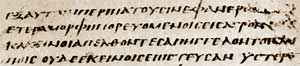 The FREER codex (W)
Washington.
It was
probably written in Egypt; it was bought from an Arab dealer in 1906.
It has one column to a page.
It contains the Gospels in the order Matt.,Jn., Lk., Mk., which is characteristic of Western
manuscripts till Jerome.
It lacks
Jn.xiv.26-xvi.7 and Mk.xv.12-38.
The text differs so widely in different parts that Lagrange calls it Protean.
Its editor, H. A.
Sanders [Facsimile of the Washington Manuscript... 1912.], suggested that its ancestor was a composite book made up of several rolls of the Gospels, which were saved in the
time of Diocletian's persecution, when the emperor tried to suppress Christianity by destroying its sacred books.
He also
suggested that it represents the Greek column of a trilingual, originally Greek-Latin-Syriac, the Syriac being replaced later by a Cop.sah version.
It seems probable that there
are traces of Syriac influence upon the text. [Cf. C. S. C. Williams, J.T.S. xlii, 1941, pp. 177 f.]
While in Mk.i.1-v.30 its text is strikingly Western, affording the only Greek
evidence of a text akin to that of African Latin manuscripts, in Mk.v.31-end, according to Streeter, it is Caesarean.
(Lagrange's
figures [Critique textuelle, p. 147.] suggest, however, that here W was akin to a Western
text.)
In Mk.xvi it has after verse 14 the 'Freer Logion' inserted into the Longer Ending and hitherto known, only in part, from a
citation by Jerome. [C. S. C. Williams, Alterations to the Text of the Synoptic
Gospels and Acts, pp. 42 f.]
Lk.i-viii.12 is mainly Alexandrian. Jn.i-v.11 does not appear to have
belonged to the original manuscript; it is written on different parchment by a different hand.
For the textual affinities of the
various parts of W the reader should consult Lagrange's Critique
textuelle.
W is probably a fifth-century manuscript.
The group of cursives or minuscules 1-118-131-209 was shown by K. Lake ['Codex 1 of the Gospels and its Allies', Texts and Studies, vii, 1902.] to be derived, in the Gospels, from a common ancestor; other cursives have been found akin to these: 22, 1582, 872 (in Mk.), 1278, and 2193.
Eleventh century, contains the Gospels with lacunae in all but Mk., where its readings are chiefly valuable.
Denotes another group of cursives, 13-69-124-346, which W. H. Ferrar and T. K. Abbott collated.
Apart
from 124, they were brought to Calabria.
They possess a
stichometric reckoning of ῥήματα - hremata, which occurs in a series of Syriac manuscripts, the earliest of which is of the ninth century.
The most
important manuscripts of this group are 69 and 124:
[ See
T. K. Abbott, The
Origin of the Leicester Codex... 1887.
Manuscripts of the same scribe are known, Emmanuel of Constantinople, which is a link
with the East (J.T.S. v, 1904, pp. 445 ff.).]
E. A. Hutton [J.T.S. , 1910-11, p. 621.] showed that anything of value in the readings
of this 'family' is to be found in either the one or the other.
Other cursives have been added to the group since the first four
were edited: 230-543-788-826-828-983-1689-1709.
[On 826-828 see K. Lake, J.T.S. i, 1900, pp. 117 ff.; for fam.13 as a whole see K. and S. Lake, Studies and Documents, xi, 1941.]
Was discovered by Bartholomée in the church of St. Kerykos and Julitta at Koridethi, which lies in a high valley in the district of the Swaneten in
the west of Caucasia.
It is now at Tiflis.
It was written probably by a Syrian scribe who knew little Greek, in two columns to a page.
It has the four Gospels in the usual order but lacks Matt.i.1-9, 21-25; ii-iv.4; iv.17-v.4.
It was edited by G. Beermann and C. R.
Gregory in 1913 with a study of the history of the manuscript as gleaned from numerous marginal notes in
different dates in
Greek and Gruse, which fix its date between the seventh and ninth centuries.
For 565 and 700 see Streeter, op. cit., p. 574.
Two papyri may belong to the Caesarean group, P6 and P37:
is a fragment of Jn.x and xi on a fifth- or
sixth-century codex.
[F. Ronsch, Bruchstucke des l
Clemensbriefes... 1910, pp. 144-6.]
is a third-century codex having part of
Matt.xxvi.19-52.
[H.A.Sanders, Harvard Theol. Rev. xix, 1926, pp.
215-26; cf. M.J. Lagrange, Critique textuelle, I, pp. 157 f. and Revue Biblique, xx, 1929, pp. 161-77. The latter is more definitely 'Caesarean'.]
The Freer codex (W)For Mk.i.i-v.30 has a Western text has been described above.
Turin.
It is extant only for Mk.viii-xvi, Matt.i-xv.
It is by
far the most important Old Latin manuscript, containing a text closely akin to that of Cyprian's citations, whence the name
'African' given to this type of text.
It belongs to the fourth or fifth century.
Mme A. Bakker has published a study (1933) and a
collation (1938) of it.
[Cf. J. Wordsworth, Old Latin Biblical Texts, ii, 1886,
cf. J.T.S. v, 1903, p. 88, and xxvii, 1925-6, pp. 91 ff.]
F. C. Burkitt valued very highly those
readings of k, which it
shares with Syr.sin, as a reaction from
Westcott and Hort's reliance on the B א text.
Of which parts are in
Trent, Dublin, and London.
Contains portions of the Four Gospels in a text which
is somewhat later African Latin than A, with a slight
European admixture. It belongs to the fifth century.
The best edition is that of H. J. Vogels, 1926.
[Cf. A. Souter, J.T.S. xi, 1922, pp. 284-6.]
Paris.
Contains the Four' Gospels.
Its text in Mark and Luke is about half Old Latin and half Vulgate, the former approximating to an African type.
[Cf. F. C. Burkitt, J.T.S. ix, 1908, pp. 307 ff.]
It belongs to
the twelfth century.
Rome.
This is not a New Testament manuscript, but a collection of passages from the whole
New Testament, which used to be ascribed to Augustine.
Its text has some affinity with that of Priscillian, and it may be of
Spanish origin.
It belongs to the eighth or ninth century.
 Codex BEZAE(D)
 Cambridge.
A Graeco-Latin manuscript containing the Four
Gospels in the order Matt.,Jn., Lk., Mk. (with lacunae), and the Acts, but at one time it contained also the Catholic epistles.
These stood, curiously, before the Acts; the Latin has preserved the last five verses of 3 John with the subscription
epistulae Johannis in explicit incipit Actus apostolorum.
Jude, therefore, either was absent or stood in an
earlier place.
The Greek is on the left, the Latin on the right-hand page, the former being the place of honour.
It contains one column to a page, and the lines
consist of cola, or short clauses according to the sense, so that the corresponding words in the Greek and the Latin could
more easily be kept parallel.
And a curious feature of the script is that the Greek letters are formed in such a way that they
somewhat resemble the Latin.
Providing the only complete Greek 'Western' text of the Gospels, it has given rise to a whole
literature on this text.
[Cf. A. F. J. Klijn, A Survey of the Researches into the
Western Text of the Gospels. and Acts, 1949.]
It was given to the University of Cambridge by the
reformer Beza in 1581, who succeeded Calvin as head of the Church at Geneva.
When he gave it he said that it had been found in
1562 in the monastery of lrenaeus at Lyons.
But some years later he wrote in his notes on the New Testament that it was found in
the monastery at Clermont, at no great distance, and he named it Codex Claromontanus, which is the title given to the MS. D2 of the Pauline epistles, which also belonged to him.
The similarity of its text to that of lrenaeus (noted by Sanday and Turner, Novum Testamentum S. Iren., 1923) is in favour
of the south of France as its original home.
But it contains certain lection marks, which Brightman holds to be Byzantine [J.T.S. i, 1900, pp. 446 ff.], and to point to south Italy where
the Byzantine use was followed. Kenyon, however, says [Handbook to the Textual
Criticism of the NT, p. 75.]'the chief objection to this theory is that Greek was so well
known in that region that we should have expected the Greek part of the MS. to be better than it is.
In point of fact, the Greek
has the appearance of having been written by a scribe whose native language was Latin; and some of the mistakes which he makes
(e.g. writing l for λ or c for κ) point in the same direction.
We want a locality where Latin was the prevalent tongue,
but Greek was still sufficiently known to make it desirable to have copies of the Scriptures in their original language as well as
in a translation.'
Two or three localities would suit the requirements
better than south Italy, but certainty is at present impossible.
A. C. Dark favoured an Egyptian origin or a Palestinian. [The Acts of the Apostles, 1933, pp. I f.]
E. A. Lowe [J.T.S. xxv, 1924, pp. 270 ff.] gives reasons for thinking that it was already in Lyons in the ninth century.
It belongs to the fifth century.
Verona.
Contains the Gospels (with lacunae) in the Western
order, as in D. H.
[This order is found also in W (see above) and several O.L. manuscripts.
It is stated in the 'Monarchian
Prologues' to the Gospels to be the order in the official Canon.]
J. White says, 'b, indeed, seems to be almost a typically European manuscript; as the
other manuscripts of European and of Italian origin, such as a f h i q r, all resemble b more closely than they
resemble each other'.
[O.L. Bibl. Texts, vol. iii, 1888, p.
x.)
It belongs to the fifth century.
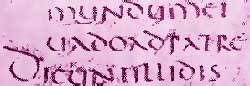 Codex VERCELLENSIS (a)
Among the relics at the cathedral of Vercelli.
Traditionally said to have been written by Eusebius of
Vercelli.
Contains the Gospels (with lacunae) in the Western order, as in D.
Its text stands between those of b and k, containing many African readings, and is farthest from b in Mark, where it may be said to contain a text which is neither
the typical European of b nor African.
Souter holds that
(at least in Lk.) it was the type of text used by Jerome for his revision.
[J.T.S. , 1910-11, pp. 583-97.]
It belongs to the fourth century.
Paris.
Contains the Gospels (with lacunae in all but Mk.) in
our usual order.
Its text is nearest to that of b.
Belongs to the fifth or sixth century.
Vatican.
Contains the Gospels; Matthew mutilated.
In Matthew alone it has an O.L. text;
in the
other Gospels it is Vulgate.
It belongs to the sixth century.
At Vienna, formerly at Naples.
A purple vellum manuscript containing only parts of Luke and Mark (in that order).
It belongs to the fifth or sixth century.
At Trinity College, Dublin.
Contains the Gospels in the Western order, as in D.
It belongs to the sixth century.
See above. Its text is of a European type in Matthew and John.
At St. Gall and Chur respectively.
The former [See Burkitt, J.T.S. v, 1904, p. 106.] contains parts of Matt., Jn., Mk., the
latter of Lk., all fragments of the same manuscript, whose text stands closest to that of a.
It belongs to the fifth century.
Leningrad.
Contains Matthew only.
Its text is mostly Vulgate, and more so after ch.ix.
It may be
a manuscript fundamentally Vulgate into which O.L. readings found their way (Hort), or it may exhibit a transmission from a
'Gallican' to a Vulgate text (Gregory).
It belongs to the tenth century.
Paris.
Contains the Gospels.
Only in Matthew is it O.L., the rest being mostly Vulgate.
Hort
thought the whole to be of the same character as the last, but Wordsworth regarded the text of Matthew as mixed O.L., in many
respects peculiar, but occasionally corrected to the Vulgate.
It belongs to the eighth century.
Paris.
Contains the Gospels, written, apparently, by an Irish hand.
There is a similar
difference of opinion regarding the whole manuscript between Hort and Wordsworth.
It belongs to the tenth century.
At Breslau, in the church of St. Elizabeth.
Contains the Gospels, but lacking Jn.xvi.13-xxi.25.
Hort, as in the case of the three foregoing manuscripts, thought it was a Vulgate MS. into which O.L. readings had
intruded.
Its value is almost confined to Luke and John.
It belongs to the early eighth century.
Munich.
Contains the Gospels (with lacunae) in the Western
order, as in D.
Its text is similar to that of f, but
with some approximation to the true European type of b.
It belongs to the sixth century.
On f see pp.442
f.
There are other fragments, some of them extending to
only a few verses;
but the above form the main part of the O.L. material.
[For further information about
editions of the above manuscripts see M. J. Lagrange, Critique textuelle, pp. 240 ff., cf. C. S. C. Williams, Alterations
to the Text of the Gospels and Acts, pp. ix ff.)
top
B א and C have been described above.
J. H. Ropes printed the text of B opposite that of D in his edition, Beginnings of Christianity, Pt. I, vol. iii,
1926.
 A, Codex ALEXANDRINUS
See below under 'Byzantine' cf. Ropes, op. cit., pp. li-lv.
In the monastery of the Laura
on Mount Athos.
Belongs to the eighth or ninth century, cf. K. Lake, J.T.S. i, 1899-1900, pp. 290-2 (see above).
In the British Museum, written in AD 1044.
81 has parts of Acts i-iv, vii-xvii, and xi, cf. Scrivener, Codex
Augiensis, 1859, pp. 415-53.
Ninth or tenth century; see above.
 P45
P45See above,
belongs to the Alexandrian family for
Acts, cf. Sir F. G. Kenyon, The Chester Beatty Biblical Papyri, Fasc. ii, 1933, p. xviii; cf. M. J. Lagrange, Revue
Biblique, xliii, 1934, pp. 164-71.
It contains parts of Acts iv-xvii.
Its most striking variant [Cf. C. S. C. Williams, op. cit., pp.72-75.] is the omission of καὶ τῆς πορωείας but not of πνικτοῦ in xv.20. Jerome may also witness to an
Alexandrian text.
[J. H. Ropes, op. cit., pp. cxxvii ff., thinks that Jerome's Latin
Vulgate text of Acts was derived largely from a manuscript akin to B א A C 81.]
181 |
An eleventh-century codex at the Vatican. |
307 |
A codex of the tenth or eleventh century at Paris. |
88 |
A tenth-century codex at Naples, cf. cod. 307. |
1739 |
A
tenth-century codex on Mt. Athos. |
P8 |
A fourth-century papyrus fragment of a roll possibly
rather than a codex. |
The same question might be asked of P41, which is
'probably a twelfth- to thirteenth-century
papyrus' (J. H. Ropes), printed by C. Wessely (Studien wr Palaographie und Papyruskunde, xv, 1914, pp. 107-18).
Though it
agrees with B in xix.14, 15, and 16, xx.12, 38, yet it
agrees with the 'Western' text, xix.3, xx.15, 24, xxi.1 (Myra).
The relationship for Acts between 181 307 88 917 1874 1898 1829 431 307 36 610 453 and1739 and the papyri P8 and P41 needs fuller investigation; with them the Armenian text of Acts should be compared.
Was at Fleury but is now at Paris.
It contains fragments of Apoc., Acts, 1, 2 Pet., 1 Jn.
in that order.
Its text is similar to that of Cyprian in his Testimonia where he quotes iii.6 and iv.8-12.
For this reason
it is usual to call h 'African' (cf. H. von
Soden, Das lateinische Neue Testament in Africa zur Zeit Cyprians, 1909, pp.551-67).
But its editor, E. S. Buchanan [Old Latin Biblical Texts, vol. v, 1907.], says also that it is
similar to that of the Latin of Irenaeus, which represents rather a European type, and A. C. Dark [The Acts of the Apostles, 1933, pp. 247-55; contrast J. H. Ropes, op. cit., pp. cvi f.], after a careful examination of some of the variants, concludes that it would be a mistake to think of the Greek
text represented by h as limited to Africa.
'What
is clear is that the Greek text on which h is based was widely circulated in the East at an early date.
This is shown by the
numerous agreements between h and the quotations
of Ephraem, the Peshitta and the Sahidic version... '
It is a palimpsest of the sixth
century, the De
Mundo of Isidore of Seville being written on top.
Paris.
It contains the New Testament, but only Acts i-i.6,
xxviii.16-30, and the Catholic epistles are Old Latin, perhaps copied from a
mutilated O.L. manuscript of the fourth or fifth
century; the rest is Vulgate, except where, like m, it agrees with Augustine.
The text is of a different strain from that of h, apparently Spanish, and in some ways unique.
[E. S. Buchanan, J.T.S. , 1910-11, pp. 497 ff.]
It belongs to the thirteenth century, illustrating the fact that a manuscript of late
date can preserve an early text.
See under Gospels, above.
Augustine, Acta de Felice Manichaeo, i, chs. 3,
4 contains a quotation from Acts i-ii.11 in a very pure African text.
Cyprian earlier had quoted from a Western, presumably
African, text, cf. A. C. dark, op. cit., pp. xli, 247, 249, 254, 259. 340, 360 f.
See under Gospels, above. Cf. J. H. Ropes, op. cit., iii.
Oxford.
Formerly in Sardinia, where it may have been written; brought to England, very likely by
Theodore of Tarsus in the seventh century.
It was one of the manuscripts used by Bede; and was finally
presented to the Bodleian
by Archbp. Laud (whence its name). Two columns to a page.
A Graeco-Latin manuscript, with the Latin occupying the place of honour on the left.
Contains the Acts only, and lacking xxvi.29-xxviii. 26.
At one time it was held that the Latin has been assimilated to the Greek;
later, the opposite was held to have occurred.
A. C. Clark concluded after discussion of the readings (op. cit., pp. 234-46)
that there can be no doubt that the basis of the Greek side was a non-Western manuscript, which was collated with a version
presumably Latin which had the extra material of the Western text and which resembled h.
These additions were translated into Greek
different from Codex Bezae's.
Later the enlarged Greek text was used as the Greek side of a bilingual manuscript and it was given
a Latin translation, which, though full of Graecisms, resembles g and the Vulgate.
As in D, the text is arranged in cola, sometimes very short.
It belongs to the sixth century.
To list three papyri found in Egypt under the heading
of 'Western' European may seem strange till it is realized how widely diffused this type of text was early in the second century.
Any implication that it arose in the West and spread to the East rather than vice versa is not intended.
A third- or fourth-century codex, Oxyrhynchus Pap. 1597, containing parts of Acts xxvi.7 f. and 20. Cf. J. H. Ropes, Beginnings of Christianity, iii.235-7 and A. C. Clark, op. cit., pp.382 f.
A fourth-century codex, though its editor, H. A. Sanders, dates it c. a.d. 200-50 (Harvard Theol. Rev. xx, 1927, pp. i-20). It contains parts of Acts xviii and xix.
A third-century papyrus from Oxyrhynchus (Pubblicazioni della societa italiana, x, 1932, pp. 112-18) containing parts of Acts xi, ifor which D is lacking. See Lagrange, Critique textuelle, pp. 407-9.
Stockholm.
So named from its great size.
It contains the whole Bible, but only Acts and Apocalypse are Old Latin, their text being
closely akin to that of Lucifer of Cagliari in Sardinia.
It belongs, like p, to the thirteenth century but preserves an early textual type.
Milan.
A lectionary fragment, containing some verses of
Acts vi-viii. Its text resembles that ofg. It belongs to the tenth or eleventh century.
Formerly at Vienna,
it is now at Bobbio.
A sixth-century palimpsest that contains parts of Acts
xi-xxviii. Its text is similar to that of g.
For m see p.392.
A lectionary of the eleventh century, the name of
which is a corruption of Liber Comitis or Comes.
Parts of it give an Old Latin text, parts a Vulgate.
It has some
affinity with g, though if Clark is correct (op. cit., p.267) in thinking it to be closer to p and to h than
to g, it should be listed with the Western African authorities.
d is the Latin text of Codex Bezae (see above).
For the Harklean Syriac Marginal readings, see below.
Top
For B א A C Ψ 77 see above, 17 being 33 of the Gospels.
manuscript of the Epistles of Paul, edited by H. A. Sanders, 1918, is a sixth-century codex, containing fragments of all the epistles, including Hebrews after 2 Thessalonians, and the Pastorals.
Written in red ink: two leaves are in the British Museum, two in the public library at
Hamburg, the former containing fragments of 1, 2 Corinthians, the latter of Hebrews.
It belongs to the ninth century.
See Tischendorf, Anecdote, sacra et prof ana, 1861,pp.177-205.
Leningrad.
It contains fragments of all the epistles.
It belongs to the ninth century.
See Tischendorf, Monumenta sacra inedita, v, 1846.
1739 |
(see above) has a text of the Pauline epistles, especially of Romans [Cf. O. Bauernfeind, Der Romerbrieftext des Origenes..., 1923.], closely akin to that of Origen, but though it is almost certainly descended from a manuscript written at Caesarea it supports, in the epistles, the Alexandrian text on the whole. |
P10 |
A fourth-century fragment of an amulet or possibly a schoolboy's exercise, containing the text of Rom.i.1-7. It is Oxyrhynchus Pap. 209. |
P11 |
A fifth-century fragment, possibly of a roll,
containing the text of 1 Cor. i. and vi (fragments). |
P13 |
A fourth-century roll, Oxyrhynchus Pap. 657, containing large parts of Heb.ii-v and x-. |
P14 |
A fifth-century codex containing part of the text of 1 Cor. i-iii. See J. R. Harris, Biblical Fragments from Mount Sinai, 1896, pp. 54-56. |
P15 |
A fourth-century codex, Oxyrhynchus Pap. 1008, containing part of 1 Cor.vii-viii. |
P16 |
(Which may be part of the same codex as P15), Oxyrhynchus Pap. 1009, contains part of Phil.iii and iv. |
P17 |
A fourth-century codex, Oxyrhynchus Pap. 1078, containing fragments of Heb.ix. |
P28 |
A sixth- or seventh-century fragment, possibly of a roll, Oxyrhynchus Pap. 1354, giving a text of Rom.i.1-10, which its editors declare to be 'only of slight interest'. |
P27 |
A third-century codex, Oxyrhynchus Pap. 1355, giving the text of parts of Rom.viii and ix. |
P30 |
A third- or fourth-century codex, Oxyrhynchus Pap. 1598, containing fragments of 1 Thess.iv and v and 2 Thess.i.1. |
P31 |
Part of a lectionary(?) codex, containing part of
Rom. . |
P32 |
A third-century codex, Rylands Pap. 5, containing fragments of Titus i, ii, in a text like that of א. |
P34 |
A sixth- or seventh-century codex (C. Wessely, Studien ymr Paldographie und Papyruskunde, , 1912, 191, p.246) containing fragments of 1 Cor.xvi, 2 Cor.v and xi. |
P40 |
A fifth- or sixth-century codex (F. Bilabel, Griech. Pap; Heidelberg, 1924, Ivii, pp.28-31) containing parts of Rom.i-iv but with many omissions due to homoeoteleuton. |
P46 |
|
P49 |
An unpublished third-century codex containing parts of Eph.iv-v. |
P51 |
Oxyrhynchus Pap. 2157, is a fourth-century codex, con?taining part of Gal.i. |
P81 |
An unpublished seventh-century codex containing parts of Rom.xvi, 1 Cor.i, v, Phil.iii, Col.i, iv, 1 Thess.i, Tit.iii, and Phil. |
Formerly in the monastery of the Laura on Mt. Athos, where it was used as binding
material for several books which were afterwards scattered in various parts of Europe.
There are known at present eight leaves on
Mt. Athos, twenty-two at Paris, three at Leningrad, three at Moscow, three at Kiev, and two at Turin.
They contain parts of the Pauline epistles, except
Rom., Phil., Eph., 2 Thess., Philem.
It probably belongs to the sixth century.
Its importance lies in the fact that it is the
earliest known respresentative of the Euthalian edition of the Acts and epistles.
At the end of Titus are words, which were
probably copied as they stood from an earlier manuscript:
'I, Evagrius, wrote this volume of Paul the Apostle to the best of my power stichometrically...
And the book was compared with [i.e. collated from] the exemplar in Caesarea belonging to the library of the holy Pamphilus, written by his hand.
That is to say, Euthalius's own manuscript of his
edition, made two centuries earlier on the basis of a Caesarean text, seems to have been the ancestor of our fragments.
Top
Someone who was traditionally known as Euthalius
issued an edition of the Pauline epistles, and then of the Acts and Catholic, epistles, in which the text was arranged in cola as an aid to intelligent reading, J. Armitage Robinson [Euthaliana, Texts and
Studies, iii. 3, 1895; cf. A. Vardanian, Euthalius Werke, 1930; cf. H. Omont, Notice sur un tres ancien manuscrit... de
S. Paul, 1890.] showed it to be probable that, while Euthalius supplies prologues, full tables of
Old Testament quotations in the books, and chapter summaries, other material which found its way into some manuscripts was added
later.
The work of Euthalius is dated between 323 and 396.
Later material included, for example, the Martyrium
Pauli, expanded out of the prologue to the Pauline epistles; and stichometrical calculations were written down.
Also a
colophon was added to the Pauline epistles such as stands in the codex Coislinianus (H3) and Ac. 83.
The latter,
however, contains further the Navigatio Pauli, which is frequent in manuscripts furnished with the 'Euthalian' apparatus.
It begins with Εὐάγριος ἔγραψα, and the name Evagrius has been deciphered in the colophon of H3 (see above).
Research has not shaken the probability of Robinson's theory that the material reached its expanded form by additions which
Evagrius made to the original work of Euthalius.
The fact that an apparatus was attributed to Euthalius by the Armenians disposes
of von Soden's identification of him with a seventh-century namesake, a bishop of SuIca, clearly a Westerner, who wrote a Confession
concerning the Orthodox Faith.
C. H. Turner [Hastings's D.B., extra vol.,
p. 525.] accepting, at that time, the identification, was obliged to suppose that this later Euthalius
added to the work of Evagrius, and not vice versa.
F. C. Conybeare and Zahn think that the work was originally anonymous, and that
the title 'Bishop of Sulca', which is given in more than one manuscript, was attributed to the Euthalian editor only after the
seventh century, when his namesake had become prominent.
No manuscript of Cyprianic Latin is known, 'though
some of its peculiar renderings reappear in the not inconsiderable quotations of Tyconius (flor. 380)' (Burkitt).
A late form of
it is seen in the Speculum (m, see above), with which the quotations of Priscillian, which are most frequent in
the Pauline epistles, mostly agree.
Now at Paris.
Formerly in the monastery at Clermont, where it was
acquired by Beza.
A Graeco-Latin manuscript like its namesake of the Gospels, the Greek being on the left.
One column to a page, with very short cola, so that the Greek and Latin closely correspond.
At the same time the scribe has been very faithful to
his exemplar in both, so that the two texts are practically independent, and the Latin (d2) has the value of an Old
Latin manuscript; and it exhibits the same text as that of the quotations of Lucifer of Cagliari, which points to Sardinia 'as
the place of origin.
In the longer epistles, however, the Vulgate has affected the text.
Contains the Pauline epistles with small
lacunae, Phil. following Col., and Heb. Philem. Before Hebrews (which was not accepted into the O.L. Canon, and forms a sort of
appendix at the end of the manuscript) is written a more ancient list of the number of stichoi in each book of the New
Testament, in which Hebrews and Philemon are omitted, and the books are named in very unusual order: Matt:, Jn., Mk., Lk., Rom.,
1, 2 Cor., Gal., Eph., 1, 2 Tim., Tit., Col., Philem., 1, 2 Pet., Jas., 1,2,3 Jn., Jude, Ep. Barnabas, Apoc., Acts, Shepherd,
Acts of Paul, Apoc. of Pet.
It belongs to the sixth century.
It was corrected by several hands; and after the fifth corrector a transcript of it was made which survives under the name codex Sangermanensis (E3).
Trinity College, Cambridge.
Formerly in the monastery of Reichenau (Augia Dives) on an island in Lake Constance.
A Graeco-Latin manuscript, with the Latin always on the outside.
Two columns to a page.
Contains the Pauline epistles with lacunae, Hebrews being entirely lacking in the Greek.
It belongs to the end of the ninth century.
Dresden.
Named after C. F. Boerner, who bought it in 1705.
Part
of the same manuscript as codex Sangallensis (Δ) of the Gospels, and copied from the same exemplar as the slightly earlier F2, while the corrector of F2 seems to have had G3 before him. Contains, with lacunae, the Pauline epistles except Hebrews.
There is an interlinear Latin translation,
but the Latin is so largely assimilated to the Greek that it is of no value.
It belongs to the end of the ninth century.
top
For B א A C Ψ P, 33 and 81 see above.
P20 is a late third-century codex containing fragments of
Jas.ii.19-iii.9 (Oxyrhynchus Pap. 1171).
See Lagrange, Critique textuelle, pp. 533 f.
is a fourth-century codex, containing fragments of
Jas.i.10-12 and 15-18 (Oxyrhynchus Pap. 1229).
See Lagrange, op. cit., p. 534.
is a fifth- or sixth-century papyrus containing fragments of Jas.ii and iii {Papyri in the Princeton University Collections, E. H. Kase, 1936: Princeton, xv. 1-3).
of the fifth century, contains parts of 1 and 2 Peter and 1 John.
See E. S. Buchanan, Old
Latin Biblical Texts, vol. v, 1907.
see above.
Tenth century - contains James: see J. Wordsworth, Studio. Biblica, i, 1885, p. 113 and W. Sanday, ibid., pp. 233-63.
Naples.
It contains fragments of James and of 1 Peter.
Of the
fifth or sixth century.
See H. J. White, Old Latin Biblical Texts, iv, 1897.
Seventh century - contains parts of 1 Peter and 1
John; see D. deBruyne, Les fragments de Freising, 1921.
For the citations in Tertullian, see Lagrange, op. cit., pp.540 ff.
top
Dr. Charles has attempted to work out the relative value of the uncials containing the Apocalypse, i.e. the first six of the
following manuscripts, which are placed in the order of value as estimated by him.
[Revelation, vol. i, pp.clx-clxxi: H. C. Hoskier's two volumes. Concerning the Text of the Apocalypse, 1929, contain a mass of
essential data, though some of his conclusions are bizarre.]
(see below]
(see above).
Vatican.
Contains the Apocalypse, in company with some small
writings of Basil, Greg. Nyss., and other Fathers.
According to Charles it represents what he calls the cursive, as against the
uncial, type of text; but it compares favourably with א, considering its late date.
It belongs to the eighth century.
Mt. Athos.
Contains Rev.xi.15-i.1; i.3-x.7; x.15-21
in uncial script, each few verses being followed by the comments of Andreas in cursive (see Swete, Apocalypse, p. cxcv).
It belongs to the tenth century.
Thessalonica.
Contains Rev.vii.16-viii.14, with Andreas's comments.
It belongs to the tenth century.
Vatican.
Its text stands close to that of P2.
It belongs to the fifteenth century.
At Parham, formerly on Mt. Athos.
Charles says that its text is better after xi.8
than before.
It belongs to the eleventh or twelfth century.
a third- or fourth-century roll, Oxyrhynchus Pap. 1079, contains Rev.i.4-7, on the verso of the text of Exodus.
It agrees mainly with A.
a fourth-century codex, Oxyrhynchus Pap. 1230, contains fragments of Rev.v and vi.
Its text agrees with that of א and A.
a (lectionary?) roll, probably of the seventh century, contains parts of Rev.ii, xv, and xvi. See W. E. Crum and Sir H. I. Bell, Wadi Sarga, 1922, pp. 43 ft.
the Chester Beatty papyrus of Rev., contains parts
of ix.10-xvii.2.
In an important article, R. V. G. Tasker [J.T.S., 1, 1949, pp. 50-68; cf. Lagrange, Critique textuelle, pp. 586-91.] has
argued that P47 'reflects an early revision of the original text of the Apocalypse, similar to that reflected in the
text used by Origen, and less thorough than that which eventually became standardised and resulted finally in the textus
receptus'.
An Old Latin text almost in Cyprianic form is found in h, as in the Acts; and it is found in the very full quotations of
Primasius in the sixth century.
A late form is seen in m; see under 'Gospels'.
A late European text is extant in g.
Unlike the epistles, Acts and Apocalypse in their Latin texts did not suffer from the fourth-century revision.
Codex ALEXANDRINUS (A)At the British Museum.
Given to the English king Charles I in 1621 by Cyril
Lucar, patriarch of Constantinople, formerly of Alexandria.
He had taken the
manuscript with him on his translation, and it has therefore been assumed until recently that its original home and place of
writing was Alexandria; hence its name.
But it is now thought, with much more
likelihood, to have come from the East - either from Constantinople, whence it found its way to Mt. Athos, and thence to
Alexandria, [Burkitt, J.T.S. , 1910-11, pp. 603 ff.] or, as Streeter suggests [The Four Gospels, p. 120.], from some place like Caesarea or Berytus (Beyrout), half-way between Antioch and Alexandria.
Two columns to a page.
Contains the Old and New Testaments, but in the latter has lost Matt.i-xxv.6;
Jn.vi.50-viii.52; 2 Cor.iv.13-.7.
It contains also 1, 2 Clement, and originally included the Psalms
of Solomon, which is now lost, together with the last two sheets of 2 Clement.
It is the earliest manuscript that contains a text in the Gospels that approximates to the text of 'Lucian's' revision.
In the
rest of the New Testament it has an Alexandrian element.
It belongs to the fifth century.
Basle. One column to a page.
Contains the Gospels.
The text is Byzantine, but von Soden claims for it a slight 'Ferrar' admixture.
It belongs to the eighth century.
Vatican.
Contains the Gospels.
It is one of the earliest dated manuscripts, having a note stating that a monk named Michael in 949 wrote it.
At Moscow, to which it was taken from the Vatopedi
monastery on Mt. Athos.
Contains the Gospels.
It belongs to the ninth century.
S and V are the two manuscripts that probably contain the purest Byzantine text.
At Modena, in the grand ducal library.
Contains the Acts with lacunae.
(The Gath. and Paul. epp. were supplied by a cursive hand of the fifteenth or sixteenth century.)
It belongs to the ninth century.
At Rome, in the library of
the Augustinian monastery.
Contains Acts (from viii.10), Cath. epp., and Paul. epp. (to Heb.i.10).
It belongs to the ninth century.
See under Pauline epistles.
At Moscow, formerly on Mt. Athos.
Contains the Catholic and Pauline epistles.
It belongs to the ninth century.
top
The material for the three primary versions has been
described above - the Coptic, Old Syriac, and Old Latin, representing the Alexandrian, Eastern, and Western types of text
respectively.
The versions now to be mentioned are less important for critical purposes.
They were revisions or
translations
reflecting (except the Vulgate) late forms of the Greek text, when the Antioch-Constantinople or Byzantine type was dominant.
This stands by itself, being based on the Old Latin,
but revised according to good Alexandrian manuscripts.
It was Jerome's revision of the many and various Old Latin texts that existed before his day, made (383-400) at the request of
Pope Damasus.
The fullest account of its history and manuscripts
can be seen in the article 'Vulgate' in Hastings's Dict. of the Bible, by H. J. White, cf. B. M. Metzger1 in M.
M. Parvis and A. P. Wikgren's New Testament Manuscript Studies, 1950, pp. 55-61.
The whole number of its manuscripts
cannot be less than 8,000.
But it is only in the Gospels that the text can really be called Vulgate, as Jerome's revision of the
other books was very slight and cursory.
Dr. White selects 181, which he groups and describes; and of these, Wordsworth and White
contain 40 in the list in the edition of the Vulgate N.T.
[As Metzger shows, questions
about the Vulgate still hotly debated include:
What was the nature of the Old Latin texts used by Jerome?
f (Wordsworth and
White) or a (Souter) or e, ff2, b, i, and q (Vogels)?
On the basis of what sort of Greek manuscripts did
Jerome revise?
B א L (Wordsworth and White), B A (Burkitt), or B and A but mainly א[Lagrange)?
Did Jerome revise the
epistles?
Is the Vulgate text of the Pauline epistles that of Pelagius (de Bruyne)?
Did Jerome revise the Apocalypse on the basis
of K (Vogels)?]
The best group is the Northumbrian, traceable to the schools of Wearmouth and Jarrow, founded in the seventh century by Benedict Biscop, and furthered by Ceolfrid, who was Abbot of both.
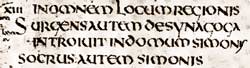 Codex
AMIATINUS.
Codex
AMIATINUS. Now in the Laurentian library at Florence.
This contains the purest known text of the Vulgate.
It was written by Ceolfrid's orders for a gift to the pope, i.e. the see of Rome.
Prefixed to it are some metrical dedicatory
lines which have been found also in an anonymous life of Ceolfrid used by Bede.
But afterwards, in the manuscript, the names
Ceolfrid and the see of Rome were erased, and those of Peter Lombard and Monte Amiata were substituted regardless of the metre.
Two columns to a page.
Contains the whole Bible.
In the Gospels are numbered the Ammonian sections, and in the Acts the second numeration found in א and B (see p. 380).
It belongs to the early eighth century.
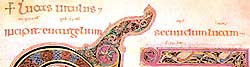 Codex LINDISFARNENSIS
Known as the Lindisfarne Gospels.
In the British Museum.
It was written in honour of St. Cuthbert, who died in 687, and was preserved with his body.
It therefore belongs to the late seventh or early eighth century.
Contains the Gospels, but is valuable only in John.
It belongs to the seventh or eighth century.
At Stonyhurst College, formerly at Durham.
Contains John only.
It belongs to the seventh century.
At Fulda, in Germany.
Contains the whole New Testament.
The text is closely allied to that of the above group, though the manuscript itself is not
Northumbrian.
Apart from its text it
has a value of its own, since it contains not the separate Gospels but the arrangement of them in Tatian's Diatessaron, the
translation of the passages being taken from the Vulgate.
It was written at the order of Victor, Bishop of Capua, in 541-6.
Another group with a fairly good text of a different type is represented by:
British Museum.
Contains the Gospels.
It belongs to the sixth or seventh century.
A similar type of text is seen in the 'Canterbury MSS.', one in the Bodleian Library
at Oxford, and one at Corpus Christi College, Cambridge.
St. Gall.
Belongs to the same class as Harleianus, and if C. H.
Turner was right [The Oldest Manuscript of the Vulgate Gospels, 1931.], it approximates more to Jerome's text than does Wordsworth and White's
reconstructed text.
It contains nearly half the text of the Gospels on
leaves used for binding. It belongs to the sixth century.
A third group is Irish, and includes:
known as the BOOK OF ARMAGH.
Contains the New Testament, and also the apocryphal
Epistle to the Laodiceans.
It belongs to the eighth or ninth century.
 Codex KENANSIS
Known as the BOOK OF KELLS
(Kells is another name of Kennana in Co. Meath).
Famous for its extraordinarily elaborate and beautiful Celtic illuminations, and for being written in the most perfect existing
Irish script.
It belongs to the seventh or eighth century.
There is also a Spanish group, and others with various degrees of mixture.
This version, of which numerous manuscripts remain, a
few as early as the fifth century, was a revision of the Evangelion da-Mepharreshe made by Rabbula, Bishop of Edessa 411-35, soon
after he became bishop, in order to conform its text more closely with the Antioch-Constantinople text that was then current,
though it retains some Old Syriac readings.
[See M. Black, 'Rabbula of Edessa and the
Peshitta', Bulletin of the John Rylands Library, xxi, 1951, pp. 203-10, and A. Voobus, Contributions of the Baltic
University, lix, 1947, cf. ibid. Ixiv and Ixv, 1948.]
The name Peshitta means 'the Simple', and 'was
in use as early as the ninth or tenth century; it has been conjectured that it originally served to distinguish the Syriac
Vulgate of the Old and New Testaments from the Hexaplaric versions of the O.T. and the Harklean [see below] of the N.T.,
editions which were furnished with marginal variants and other critical apparatus'.
[Burkitt, Encycl. Bibl. 4999.]
It is sometimes known as the Syriac Vulgate, because Syriac-speaking
Christians generally accepted it.
A revision of the Peshitta, including the
books that were absent from the latter, and based on the later current Greek text.
It was made by a Chorepiscopos named Polycarp
in 508 for Philoxenus, the Jacobite, or Monophysite, Bishop of Mabbog or Hierapolis in eastern Syria, and used by the
Monophysites.
Philoxenian readings are probably to be found in manuscripts of the subsequent revision that was made (see below),
but the only texts of the original version that are known are that of the four shorter Catholic epistles (2 Pet., 2, 3 Jn., Jude)
now usually printed with the Peshitta, and that of the Apocalypse brought to light by J. Gwynn, of Dublin, in 1897.
[The Apocalypse of St. John in a Syriac Version.]
This may have been a revision of the Philoxenian made
in 616 in Alexandria by another Monophysite bishop of Mabbog named Thomas of Heraclea (Harkel) but the problem of the relation
of the Harklean to the Philoxenian version is extremely complicated (cf. Metzger in Parvis and Wikgren, op. cit., pp. 32 f.).
Thomas adopted the method of extreme literalness, forcing the Syriac into accordance with the Greek.
It is remarkable also for
notes in the margin giving variant readings from two or three Greek manuscripts collated by Thomas at Alexandria.
In the Acts
these are sometimes of considerable importance, the readings being taken from a manuscript with a text akin to that of D.
But the text itself is Byzantine practically
throughout.
Nearly
forty manuscripts of this version are known, and the Apocalypse belongs to it that was published by De Dieu in 1627 and is usually
printed with the Peshitta.
This has nothing to do with Jerusalem, nor is it,
properly speaking, Syriac.
It is a variety of the Western Aramaic almost identical with that of the Galilean Jews.
The better
name for it, therefore, would be 'Jewish Aramaic'.
Three complete Gospel lectionaries of the eleventh to twelfth centuries in this
dialect are known, and fragments of at least two others, and of four continuous Gospel codices.
There are also small fragments
of Acts and Galatians, and much later ones of lections from all parts of the Bible, except the Gospels.
Burkitt [J.T.S. ii, 1901, pp.174-83.] has shown that it may originate
from Antioch, and may have been a product of the time when Justinian, in the sixth century, was trying to abolish the religion of
the Samaritans, and Heraclius, early in the seventh, was harassing the Jews.
M. J. Lagrange rejected this date, preferring one in
the second half of the fifth century {Critique textuelle, pp.233-9).
The text is mixed, being often influenced by the
Peshitta, but in the main following the Greek.
There were Armenian Christians in the middle of the
third century, for Dionysius of Alexandria wrote to them, and their bishop was Meruzanes (Eus. H.E.vi.46).
But their
ecclesiastical language was Syriac, and an Armenian version of the Gospels did not appear till much later.
Tradition ascribed it
to Isaac and Mesrop {fl. 400). Whenever it was made, it may have been translated from Syriac manuscripts, as J. Armitage
Robinson tried to show, [Euthaliana, Texts and Studies, iii. 3, 1895, pp.
72-91.] though this has been disputed.
[By F. Macler, Le
texte arme'nien de I'e'vangile, 1919, S. Lyonnet, in Lagrange's Critique textuelle, pp. 342-75, E. C. Colwell, Anglican
Theological Review, xvi, 1934, pp.113-32, and C. S. C. Williams, J.T.S. xliii, 1942, pp.161-7, cf. xlviii, 1947,
pp.196-200.]
Those opposed to this view think that an original Greek text was akin to the 'Caesarean'
and that 'Syriacisms' are relics of an early translation or of the Diatessaron.
Though most Armenian manuscripts of the Gospels are no
older than the ninth or tenth century, the text is a remarkably 'pure' one, revealing great scribal fidelity, and the language has
sufficient flexibility to reproduce that of the Greek and to earn the title 'Queen of the versions'.
The text of Acts and the
Pauline epistles, to judge from the printed text of Zohrab, seems to compromise between Alexandrian and Western readings in much
the same way as Caesarean manuscripts of the Gospels do.
In the Catholic Epistles, however, the affinity is rather with the
Alexandrian.
The Apocalypse was not accepted as canonical till the fifth century; though the text seems to have been dependent on
the Greek, it was also influenced apparently by an Old Latin version.
[F. C.
Conybeare, The Armenian Version of Revelation, 1907.]
Scholars working on Greek manuscripts
revised it, but despite its history this text is often of value in deciding doubtful readings.
No modern critical edition of the Armenian New Testament is yet available; until it appears and manuscripts can be collated with it, the exact amount of 'Caesarean' support that the Armenian version gives is difficult to assess.
This version is that of the Iberian Church in the
Caucasus and various scholars have supposed it to have been derived from the Syriac and from the Armenian rather than from the
Greek directly.
R. P. Blake [Patrologia Orientalis, xx. 3, 1929,
pp.435-574, xxiv.1, 1933, pp.1-168.] has produced the Georgian text of Mark and of Matthew from the
Adysh MS., dated AD897, compared with the Opiza (AD 913) and the Tbet' (AD 995) MSS.
He has
also produced the Georgian text of John. [R. P. Blake and M. Briere, ibid. xxvi.4,
1950.]
Anyone working through the variants at least of this text will be convinced that the
relationship of the Georgian to that of the Armenian versions is so close as probably to be that of child to parent.
Sometimes
the Georgian witnesses to an Armenian mistranslation, or sometimes to an Armenian variant that has been 'revised away' from the
Armenian text now extant.
A critical edition of the Georgian New Testament, like the Armenian, is still awaited. It too will
probably reveal 'Caesarean' support [Cf. S. Lyonnet in Lagrange's Critique
textuelle, pp.375-86 and 460-3, cf. p.625.], with perhaps the influence of an Armenian Diatessaron
probably based on Tatian's.
For the less important versions, Ethiopic, Arabic,
Sogdian, and Nubian, see B. M. Metzger in Parvis and Wikgren, op. cit., pp.45-51.
The Gothic version deserves
more than mention.
Ulphilas was Bishop of the Goths 348-c. 380.
He invented an alphabet for them, and then translated both the Old
and New Testaments from the Greek.
But the version was influenced from Latin sources, and the manuscripts that we possess
contain a text that dates from the fifth century or later, when the Goths were in Italy and Spain, and appear to belong to north
Italy.
Of the New Testament the Gospels and the Pauline epistles (except Hebrews), with many gaps, remain.
The Gospels are in the
Western order, and the manuscripts contain both Western and Alexandrian readings, but the text is mainly Byzantine.
G. W. S.
Friedrichsen edited their text, 1926.
He also edited the Gothic version of the epistles in 1939.
The writers whose text is known with sufficient accuracy for critical purposes are comparatively few, but the great majority of the earlier Fathers support some form of Western text.
Origen (partly), Athanasius, Cyril.
Aphraates, Ephraem (where their readings are not influenced 'by Tatian's Diatessaron), Origen (partly).
Justin, Tatian, Marcion, Irenaeus, Clement of
Alexandria (predominantly; but his text contains different elements whose sources have not yet been traced), Tertullian, Cyprian,
Hilary, Lucifer, Ambrose, Augustine (where he was not using the Vulgate), Tyconius, Priscillian, Primasius (on the Apocalypse).
top
The following bibliography, which is not complete, may indicate the importance of the text of various Fathers, notably of the text of Tatian's Diatessaron.
Origen: |
E. Hautsch, Die Evangelienytate des Origenes, 1909; K. Lake, R. P. Blake, and S. New, Harvard Theol. Rev., xxi, 1928, pp.259-77; R. V. G. Tasker, J.T.S. xxxviii, 1937. |
Eusebius of Caesarea: |
C. Peters, Oriens Christianus, xi. I, 1936, pp.1-25; R. V. G. Tasker, Harvard Theol. Rev., xxviii, 1935, pp.61-67; D. S. Wallace-Hadrill, J.T.S., m.s., i, 1950, pp.168-75, cf. Lake, Blake, and New, op. cit., pp.277-85. |
Aphraat(es): |
F. C. Burkitt, Evangelion da-Mepharreshe, ii, 1904, pp.80-6. |
Ephraem: |
F. C. Burkitt, Texts and Studies, vii.2, 1901. |
Justin: |
W. Bousset, Die Esangeliencitate Justins des Mdrtyres, 1891; M. J. Lagrange, Critique textuelle, pp.169-74; E. Lippelt, Quae fuerint Justini Martyri ΑΠΟΜΝΗΜΟΝΕΥΜΑΤΑ, 1901. |
Tatian: |
A. Baumstark, Oriens Christianus, 3. 5. 2, 1930, pp.165-74 and ibid. I, pp.1-14; Biblica, xvi, 1935, pp.257-99; Oriens Christi?anus, 3. 10. 2, 1935, pp. 244-52 and 3. 14.1, 1939, pp.19-37; F.C. Burkitt, J.T.S. xxv, 1924, pp.113-30 and xxxvi, 1935, pp.255-9; P. Essabalian, Le Diatessaron de Tatien et la premiere traduction des evangiles armeniennes, 1937; J. R. Harris, The Diatessaron of Tatian, 1890, and Harvard Theol. Rev. xviii, 1925, pp.103-9, and Bulletin of the Bezan Club, ix, 1931, pp.8-10; J. H. Hill, The Earliest Life of Jesus ever compiled, 1894; H.W. Hogg, The Diatessaron ofTatian, 1897; A.Julicher, Journal of Biblical Lit. xliii, 1924, pp.132-71; C. H. Kraeling, 'A Greek Fragment of Tatian's Diatessaron from Dura', Studies and Docs. iii, 1935; S. Lyonnet, Biblica, xix, 1938, pp.121-50; A. S. Marmadji, Diatessaron de Tatien, 1935 (but see D. S. Margoliouth's review, J.T.S. xxxviii, 1937, pp.76-78); A. Merk, Biblica, xvii, 1936, pp.234-41; C. Peters, 'Der Diatessaron Tatians', Orientalia Christiana Analecta, 123, 1939; C. A. Phillips, Bulletin of the Bezan Club, ix, 1931, pp.6-8; D. Plooij, A primitive Text of the Diatessaron, the Liege MS., 1923, cf. Z. N.T.W. x, 1923, pp.1-16, and (with C. A. Phillips) The Liege Diatessaron, 1929-38; O. Stegmuller, Z. N.T.W. xxxvii, 1938, pp.223-9; H. J. Vogels, Neutestamentliche Abhandlungen, viii, 1919; C. S. C. Williams, J.T.S. xliii, 1942, pp.37-42; T. Zahn, Forschungen zur Geschichte des neutestamentlichen Kanons, i, 1881. |
Marcion: |
A. von Harnack, Texte und Untersuchungen, 1921 (2nd ed., 1924), and New Studien zu Marcion, 1923; A. J. B. Higgins, Vigiliae Christianae, 1951, v. i, pp.1-42; M. J. Lagrange, Revue Biblique, xxx, 1921, pp.602-11; A. Pott, Zeitschrift fur Kirchengeschichte, xlii. v, 1923, pp.202-23; H. von Soden, Festschrift fur A. Julicher, 1927, pp.229-81; C. S. C. Williams, Alterations to the Text of the Synoptic Gospels and Acts, 1951, pp.10-18. |
Irenaeus: |
B. Kraft, Die Esangelienzitate des heiligen Irendus, Biblische Studien, xxi. 4, 1924; M. J. Lagrange, Critique textuelle, pp.174-7; W. Liidtke and H. Jordan, Irenaeusfragmente (armenische), Texte und Untersuchungen, xxxvi, 1913; W. Sanday, C. H. Turner, and A. Souter, N.T. Sancti Irenaei Episcopi Lugdunensis, O.L. Bibl. Texts, vii, 1923; H. J. Vogels, Revue Benedictine, xxxvi, 1924, pp.21-33. |
Clement of Alexandria: |
P. M. Barnard, Texts and Studies, v. 5, 1899; M. J. Lagrange, Critique textuelle, pp. 177-81; H. von Soden, Die Schriften des JV.T. i, 1902, pp. 1596-604. |
Tertullian: |
G. J. D. Aalders, Tertullianus' Citaten, 1932; H. Ronsch, dos N.T. Tertullians, 1871; H. von Soden, see on Marcion above; M. C. Tenney, Harvard Studies in Classical Philology, Ivi-lvii, 1947, pp.257-60. |
Cyprian: |
J. Heidenreich, Der N.T. Text bei Cyprian, 1900; H. von Soden, Texte und Untersuchungen, 1909. |
Lucifer of Cagliari: |
A. M. Coleman, The Biblical Text of Lucifer of Cagliari, 1927 (Acts), 1946 (Pastorals), 1947 (Pauline Epistles and Hebrews); H. J. Vogels, Theologische Qyartalschrift, 103, 1922, pp.23-27, 183-200. |
St. Augustine: |
F. C. Burkitt, Texts and Studies, iv, 1896, and J.T.S. xi, 1910, pp.258-68; H.J. Vogels, Biblische Zeitschrift, iv, 1906, pp.267-95. |
Tyconius: |
H. J. Vogels, Untersuchungen zur Geschichte der lateinischen Apoca-lypseiibersetzung, 1920; F. C. Burkitt, Texts and Studies, iii.1, 1894; T. Hahn, Tyconius-Studien, 1900; A. Souter, J.T.S. xiv, 1912-13, pp.338-58. |
Priscillian: |
G. Schapss, C.S.E.L. xviii, 1899. |
Primasius: |
J. Haussleiter, Forschungen zur Geschichte des JV. T.-Kanons, 1891. |