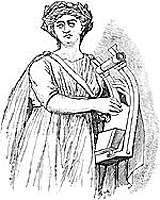
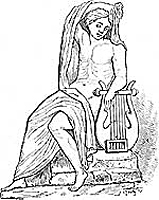
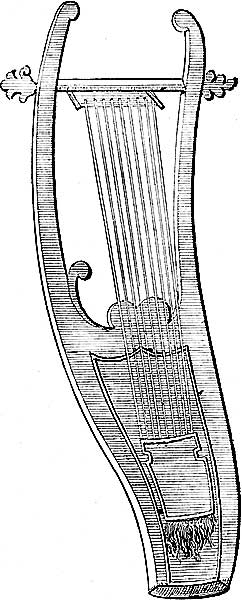
 Figure 38, 39.
KITHROS, cithara (κιθάρα), is one of the instruments mentioned in Dan.iii.5, 7, 10, 15: the Greek form of the name, as before remarked, strengthens the argument that the instrument itself was a foreign importation. In Ezek.xxvii., the prophet, in giving the many sources of luxury and greatness open to Tyre, distinctly alludes to Grecian traffic; and, moreover, in the succeeding age to the fall of Troy Aeolian and Ionian colonies were transplanted into Asia. There is, therefore, more than one channel through which Greek names of musical instruments could become familiar in Asia. From cithara our European word guitar is derived, but this is only one of a large family of words sprung from the same origin. The Arabians have their kuitra ; the Persians, kitar. The Nubian kissar has already been described, but it may be well to add that the Egyptians call the kissar "gytarah barbaryeh," or the Berbers' guitar [See p. 18.]. In Europe the name has undergone many changes; the old French form is guiterne ; the old English, gittern, cithern, cither, cythorn, or gythorn ; Italian, ghiterra or chiterra-(chitarrone, a big cithera, was a long-necked theorbo); German, zither, but this is not the instrument now called by this name, which is becoming very popular. It is remarkable that Sanskrit kafur means four, and that chufara in Persian may mean four strings, and also that the Hindus have a name implying a numerical value, si-tar, " the three-stringed." Is it possible that the instrument was in the earliest times of Asiatic origin, that it was then imported into the civilisation of south-east Europe, and then carried to the Babylonians as a European luxury?
It is difficult to determine when the cithara had so far departed from the form of a lyre as to become a guitar. As a full explanation of the difference between these two has been already given (see page 22), it will be unnecessary to say much more. Only, the transition from the old cithara with its partially-covered strings to the long-necked modern instrument is remarkable, when it is remembered that the Egyptians actually possessed such things ( See Fig. 21, page 28.). But the Greeks and Romans never adopted these instruments. Had they done so, the European guitar would not have been the slow growth of several centuries.
|
Figure 38, 39. |
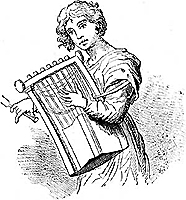
As a lyre and a guitar have been depicted in Figs.17 and 18, pages 21, 22, and the upper part of the neck of a modern European guitar in Fig. 22, page 30, it will be only necessary to give now some illustrations of old citharas, when the only distinction which existed between them and lyres was the sort of box over which the lower ends of the strings stretched (see Figs. 38, 39, 40, 41).
Fig. 41, which was discovered in a painting at Herculaneum, is remarkable, in that there are evidently two strings to each note.
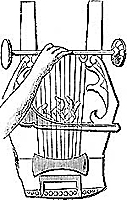 Figure 40, 41.
 |
 |
It would seem that the ancient lyre of the Greeks, the phorminx (φόρμυγξ), had the characteristics of a cithara. The barbiton, the Lesbian lyre, which was a large instrument, is shown in Fig. 42 (below).
Some authors have affirmed that without doubt the Hebrews had citharas of classical form, and appeal in proof of their assertion to the devices on Maccabaean medals shown in Figs. 43, 44, 45. But putting the late date of these medals out of the question, it would be most unsafe to attach so much importance to anything found on coins.
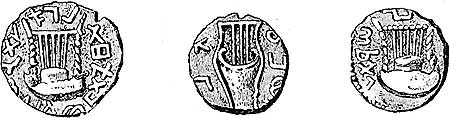
It is true that ancient nations were more in the habit of depicting objects of art from things round about themselves than we are, but on the other hand the lyre had no doubt become established as a common ornament. It has been well remarked that should the statue of Handel, now in Westminster Abbey, survive all around it, and be the happy discovery of remote antiquarians, they will certainly believe that our great composer played on, and wrote for, the lyre, because he holds one in his hands. And should it also happen to be known that he actually did include a part for a theorbo, or arch-lute, in one of his works, the supposed fact will be considered firmly established.
We have now given an account of the string-instruments mentioned in the Bible, and although opinions are still very conflicting as to their exact nature, it is hoped a strong probability has been established that
Before, however, leaving this division of our subject it seems necessary to say a few words on several expressions used in the headings of the Psalms and elsewhere, some of which are thought by learned writers to contain definite directions as to the string-instrument to be used, or to the method of its tuning, &c. ; in any case, they are now generally thought to have contained some musical reference.
Alamoth, one of these obscure words, occurs in the title of Ps.xlvi., and also in Ps.Ixviii.25. But as it is met with in the next quotation, in juxtaposition with sheminith, it will be convenient to consider them together. "So the singers, Heman, Asaph, and Ethan, were appointed to sound with cymbals of brass; and Zechariah, and Aziel, and Shemiramoth, and Jehiel, and Unni, and Eliab, and Maaseiah, and Benaiah, with psalteries on Alamoth; and Mattithiah, and Elipheleh, and Mikneiah, and Obededom, and Jeiel, and Azaziah, with harps on the Sheminith to excel" (i Chron.xv.19—21). Thus we see whilst some were set aside as players of cymbals, others were to play with nebels on alamoth, and others with kinmrs on the sheminith.
Alamoth may mean "hidden things," or "things pertaining to youths" or "virgins." The first is adopted by St. Augustine, who applies it to the mysteries of the Gospel. But many authors, adopting the last meanings, have considered alamoth to mean songs for boys or virgins, or, in fact, for treble voices. But Dr. Jebb, in his learned dissertation on this word ' [A Literal Translation of the Psalms. (Longmans, 1846; 2 vols.) ] points out that the signification of "hidden things," or "mysteries," is inapplicable to its appearance in Ps.Ixviii.25.
First go the sharim (singers), then follow the neginim (kinnors); in the midst are the alamoth,
where our version renders it "the damsels playing with the timbrels." There is also one more reason why "virgins" or "boys" should not be necessarily implied in the term, namely, from a consideration of the passage above quoted (i Chron.xv.19—21), where the names of men are given as players on nebels on alamoth. It may, however, mean of a treble or high pitch, and it has been explained "vox clara et acuta quasi virginum;" but if this explanation refers to the nebel with which alamoth is associated, it will make nebel appear to be of a higher pitch than the kinnor which is associated with sheminith. This is a conclusion to which we should be very unwillingly driven; because the kinnor is the more ancient of the two, being (as has been before stated) the only stringed instrument mentioned in the Pentateuch, while the nebel is not named till we reach i Sam.x.5; and, moreover, the kinnor, as being carried about hither and thither in the wanderings of the early tribes, must necessarily have been light and portable. If the nebel were of a pitch much higher than that of the kinnor, the kinnor must have been considerably larger to have made a suitable bass to it. Is it likely that a nation would succeed in carrying into captivity and preserving large harps? Yet the Israelites hung their kinnors in the willow branches which shadowed Babylon's waters. No; the kinnor was smaller than the nebel. Of course it may be urged that the nebel, even if a larger instrument than the kinnor, might have had so great an upward compass as to enable the performer on it to play above the pitch of the kinnor. But if this were the case, why should sheminith be associated with kinnor?
It is to this relation between sheminith and alamoth that we must look for the meaning of the latter, and as sheminith signifies eighth, it is certainly fair to assume that alamoth, when connected with nebel, suggested also some numerical value, even if all traces of its precise meaning are now lost.
The exact application of the expression "on the eighth" (sheminith) with reference to kinnors is most difficult, or rather impossible to determine. The following seem to be the most important conjectures which have been hazarded— namely, that it refers
to the pitch of an octave; or
to the name of a scale or tune; or
to the number of strings on the instrument.
As to the first of these, it must be admitted that it is ingenious, but a little consideration will show that there are serious objections to its acceptation. For, although it is true that the octave is not only one of the best known intervals in music, as being the distance between the singing-pitch of men and women, but also the most important naturally, being produced by the simplest ratio of vibrations 1:2; yet the name octave could only be given to it by those who possessed a scale in which eight steps led from a note to its octave. Such a sound-ladder is of comparatively modern origin. The Greeks called the interval of an octave diapason (διά παςων); the position of an octave on a string mese (μέση), that is, middle, because half the length of any string will produce the octave above the sound of the whole length; and two sounds forming an octave they called, as to their relation to each other, antiphonoi (αντίφωνοι), as being "over against," or responsive to, each other. But their scale consisted of a series of tetrachords, or groups of four notes in succession, some overlapping, that is, having one note common to two; others being disjunct.
It is true that the Ambrosian chant, in the fourth century, and, two centuries later, the Gregorian modes, were to a certain extent limited, in more than one way, by the octave, but at the same time it was always attempted by teachers of music to graft the new on to the old system, although the former had indeed departed vastly from the principles of the latter. Thus it will be found that a knowledge of ecclesiastical modes, and of the Greek tetrachords and harmonic ratios, formed the material of music-lore until the Guidonian system of hexachords became established in the eleventh century. This system held its own for five or six centuries; in fact, its system of nomenclature seems to have been retained long after modem key-tonality was firmly settled. It may then be safely said that "on the eighth" would not have directed the Levites to play in octaves.
As to the second explanation of sheminith which has been mentioned— namely, that it referred to an eighth mode or scale— all that need be said is, that even if the Hebrews did use various modes known by their numbers, there seems to be no reason for giving general directions that such and such men should play on nebels, in one particular key, and other men on kinnors in some other key; because, if these instruments were always used and intended to be used in particular definite keys, why was it necessary to specify in which key? The fact would be known; but, on the other hand, if these instruments were capable of being tuned to many keys (as certainly was the case), why give command to certain Levites to play upon them only in one key?
To believe that the expression refers to a certain melody is equally impossible, as nothing could be more absurd than to suppose that certain highly practised nebelists or kinnorists would be formally set aside for the purpose of playing one tune. It might be so for one ceremony, but the close of chap.xvi. (i Chron.) distinctly intimates that these Levites were chosen to be before the ark continually, and those were chosen "who were expressed by name to give thanks to the Lord, because his mercy endureth for ever."
If "on the eighth" or "the eighth" refers to the number of the strings of the kinnor, we must be led to the important and valuable conclusion, that these nebels and kinnors were used at different times, or at the will of different players, with various numbers of strings, and that the object of this direction was to procure uniformity in this respect. A little further on an ingenious conjecture as to the meaning of alamoth will be given.
Gittith, or Ha- Gittith, appears over Psalms viii., Ixxxi., and Ixxxiv. As being derived from a root signifying "winepress," it has been translated in the Septuagint by ληνοί, and Vulgate by torailaria, both meaning "wine-presses," and some have thought it shows that the psalm is a vintage-song, or to be sung to some well-known vintage-song. But the word is also connected with Gath, and it may have been an instrument brought from the city of Gath. [See Lange's Commentary on the Bible: Psalms, p. 33, under head Al-haggittith.]
Aijeleth-shahar or Aijeleth-he-shahar, which occurs in Ps.x., signifies "hind of the morning," "dawn of day," or " morning twilight," supposed by many commentators to be the first line of words of a well-known tune to which this psalm was to be sung; just as the Germans now call their chorales by the first line of the original words, even when other sets of words are adapted to them, as in the well-known instances, "O Haupt voll Blut und Wunden," "In allen meinen Thaten."
Alluding to the three words Alamoth, Aijeleth, and Gittith, Dr. Jebb makes such an important suggestion that he will forgive us for quoting his own words :— "It is to be observed that there are three Levitical cities, whose names resemble three designations in the titles (of the Psalms), Alemeth, Ayelon, and Gath-Rimmon. What is there, then, to hinder us from supposing that the designation Alamoth may mean harps that were constructed or improved by some Levite of Alemeth; that Aijeleth-he-shahar means a harp of Ayelon; and Gittith, one of Gath; just as we now speak of a German flute or a Cremona violin?"— (Literal Translation of the Psalms. Dissertations.)
Neginoth occurs over Psalms iv., vi., liv., lv., Ixvii., and Ixxvii., and elsewhere: as the root from which it is derived signifies "to strike a string" (much the same as psallere), it probably is the collective term for stringed instruments. It is often joined with kinnor, though not with nebel. But if not joined with kinnor the root refers to that instrument, as, for example :—
And Saul said unto his servants. Provide me now a man that can play well, and bring him to me. Then answered one of the servants, and said, Behold, I have seen a son of Jesse the Bethlehemite, that is cunning in playing, &c. (i Sam.xvi.17, 18, see also xviii.10, and elsewhere).
Dr. Jebb says neginoth, sheminith, and kinnor all refer to the same instrument: the first, to the mode of playing it; the second, to its compass; the last is its specific designation.
Shushan may mean "change," or more commonly "lily;" the latter, if it contains a musical reference, can only refer to the shape of an instrument— some have thought to cymbals, as being generally circular, with a deep central indentation. But it would be more applicable to the elegant outline of some of the lyres as shown in classical sculptures— such, for instance, as that in the celebrated "Apollo citharoedos." But it also may have a numerical meaning, suggesting the number six. It is often joined with the word eduth, which signified " testimony;" hence shushan eduth has been translated by Schleusner (quoted by Dr. Jebb) "the hexachord of testimony"— a highly poetical rendering, doubtless, but one which does not convey much definite information. As it is recorded in i Chron.xvi.37 —4.2 that part of the Levitical choir was stationed at Gibeon, where the tabernacle was pitched, and another part—the company of Asaph—at Jerusalem, to do honour to the ark of the testimony, it is possible that the shushan eduth meant the harp of six strings played at the latter, its distinctive name being retained after the junction of the two choral divisions.
Higgaion, translated in the Septuagint ωδή, appears in the Bible version of Ps.ix.16—
The Lord is known by the judgment which he executeth: the wicked is snared in the work of his own hands. Higgaion. Selah.
The marginal note translates Higgaion as a "meditation." As the root of the word suggests "meditation," or "murmuring," and as it is used in Lam.iii.62 of the murmurings of malicious enemies, the term can hardly be considered as a musical direction. But, on the other hand, it occurs in Ps.xcii.3, in such an association as to render a musical reference almost necessary :—
Upon the asor, and upon the nebel, upon a higgaion with the kinnor.
The Prayer-book translates higgaion improperly by "a loud instrument." The term may allude to a special and devotional manner of playing on kinnors.
Shiggaion is a word which occurs only in the title of Ps.vii. and in Hab.iii.1. Much discussion has taken place as to its exact meaning; most probably it comes from the root shagah, to extol, and therefore it might be translated a hymn.
The term Selah, which occurs three times in the Book of Habakkuk, and no less than seventy-one times in the Psalms, has been variously interpreted as indicating
a pause;
repetition (like Da Capo) ;
the end of a strophe;
a playing with full power (fortissimo) ;
a bending of the body, an obeisance;
a short recurring symphony (a ritornello ).
Of all these the last seems the most probable. In a lecture on the subject, given by Sir F. Ouseley, a psalm was sung into which such ritornelli on string instruments and trumpets were introduced at every occurrence of the word Selah. The effect was considered imposing and devotional. The fact that twenty-eight of the thirty-nine Psalms in which this word occurs have musical superscriptions, seems to compel belief that it was a direction to the musical performers.
Minnim, which is derived from a root signifying "division," or "distribution," hence strings, seems on all sides to be allowed to be a poetical allusion to stringed instruments generally, and is so translated in the last Psalm :—
Praise him with stringed instruments and organs.
The word also occurs in Ps.xlv.9, which would be better rendered thus :—
Out of the ivory palaces the stringed instruments have made thee glad.
In conclusion, it must be said that although our information is very scanty on the subject of Hebrew string instruments, so scanty as to warn us against entering into elaborate arguments as to the exact number of strings on any particular one, and although the kinnor and nebel seem to have been almost the only instruments consecrated to sacred uses, yet there is no reason for doubting that many other kinds were known or used by the Hebrews. If it seems absurd to us that two families of harps should be the chief, or perhaps only, string-support of their sacred music, let us ask ourselves how many families of stringed instruments we use in our modem orchestra; practically one. We have four sorts, it is true, but they have (at the present time) the same number of strings, and are of similar construction, and have the same generic name, viol. We have the viol, the little viol, the big viol, and the little-big viol (viola, violino, violone, violoncello.) The harp does of course appear occasionally, but it can hardly be called a necessary part of a stringed band, considering that the student may listen to all the symphonies of Beethoven, Mozart, and Mendelssohn, without once hearing its tones. In speaking of the kinnor and nebel it will be noticed that the azor has been just now omitted. It is because we only consider the word azor as explanatory of, or as modifying, the word nebel, to which it is always attached, in which case the nebel-azor becomes the ten-stringed harp. The constant improvements which are always being made in musical instruments renders it no easy task to describe one even of our own time. The answer to the simple question, "What is the compass of a pianoforte?" might be extended to a goodly length, if full particulars were entered into. Minute details cannot be expected when the search is among occasional hints or allusions, which are in themselves accidental, and not intended for the special information of the reader. We have reason to congratulate ourselves that modem writers have learned to distrust a vast amount of statements made by certain writers of the two or perhaps three last centuries. Some, who were for a long period held in much esteem (Kircher, for example), seem to have drawn largely upon their imagination when describing ancient musical instruments, and to have thought that the best argument in favour of any supposititious form of an instrument was to give a good wood-cut of it! top
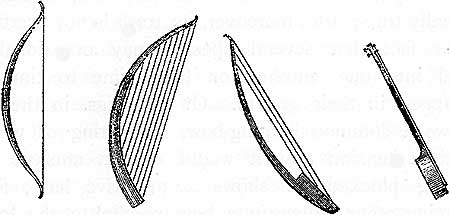
The gradual development of string-instruments into various species is a subject of so great interest, that a Plate is here appended giving the outline of the more important of each group, starting from the primitive hunting-bow, the playful twanging of the strings of which in idle moments most probably led to the construction of all musical instruments of this class. This suggestion is painfully unpoetical, and cannot for one moment hold its own, as far as romance goes, against the pretty stories as to the origin of such instruments handed down from remote times amongst nearly every great race of mankind. But it is, nevertheless, practically true; and, moreover, its truth is not overthrown by the fact that several species may occasionally be merged into one another, or from time to time have over-lapped in their growth.
 |
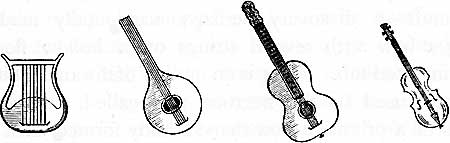 |
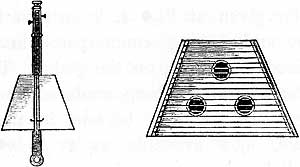
Plate 1. Figs1-10. |
Of the Figs. in the Plate, 1 shows a common hunting-bow, the string of which is at such a tension that it would emit a musical sound on being plucked; 2 shows a primitive harp, formed by placing other strings in a bow, parallel to the longest. It is distinctly the link between the harp and the guitar given at Fig. 4, known to the Egyptians as the nefer, and having counterparts in nearly every nation, civilised or savage, on the globe. It will be well to say at once that the above sketch of the development of musical instruments is not meant to be chronologically true; it is merely intended to illustrate the remarkable co-relation of all string-instruments, ancient and modem. The use of a bow as a means of exciting vibrations of strings is in itself a most interesting fact, and suggests that the rubbing of one simple bow against another may have led to its discovery. Certainly bows are of great antiquity, many savage nations having instruments constructed like a nefer (Fig. 4), but played with a bow.
The thin upper portion of the body of the harp, made somewhat straighter in the nanga (3), has now become in the nefer (4) a veritable neck, and available as a finger-board. But again it must have been found at a very early period, that if the two sides of a bow are drawn very closely together by a rigid material, as in Fig. 5, strings can be drawn at right angles to those in the primitive harp; thus would the first lyre be formed, the circular base being formed into a resonance-box. When once, however, the theory of a resonance-box was understood, the existence of a lute (6), having a much larger resonance-box than a lyre and a much shorter neck than a nefer, became a mere matter of time. The transition from 6 to 7, that is from a lute to a guitar, is so natural as to call for no remark; the indentations in the sides of the guitar, primarily intended to make it lie comfortably on one leg of the player, seem to have suggested the indentations in the side of the violin family (8), so necessary for the free movement of the bow. In Fig. 9 will be seen an early fiddle, the Asiatic rehab, afterwards the rebec, or three-stringed viol of Europe, in which the absence of deep curved indentations is noticeable; also, the shape of the resonance-box is interesting as suggesting that when strings stretched over a resonance-box were hit with hammers the uselessness of the neck would be apparent; such a box, deprived of its head and tail, would form the body of a dulcimer (Fig. 10). When the hammers of a dulcimer are connected with levers called "keys" we call it a pianoforte
A glance at the Plate will show how important a part of the growth of musical string-instruments is due to the resonance-box. In its early state it was merely formed by stretching a membrane of skin (commonly snake-skin) across a rounded open piece of wood or half a dried gourd. In its more elaborate form it was adjusted to the requirements of the compass of sounds to be produced by the strings, to their thickness, tension, and position; also by carefully selecting the finest specimens of wood for use, by giving consideration to its weight, closeness of fibre, &c., and finally, by determining the best model or "shape of the resonance-box." By innumerable experiments in such things, extending perhaps over thousands of years, we at last are in possession of an almost ideal type of violin, as turned out by the great Italian masters (Stradiuarius in particular), who have so perfected the construction of this instrument with relation to its requirements, that the most skilful of modern workmen can make no better effort than to imitate their models, without indulging in a hope of ever surpassing them in general excellence.
The most primitive material used for strings was, probably, twisted grass; next in time, the guts of animals; lastly, wire or silk. String-instruments closely allied to two or more of the family-types depicted in the Plate are both numerous and interesting. The harp- lute, a favourite instrument at the close of the last century, good specimens of which may even now be often found in the shops of instrument-makers, possessed characteristics of both harp and lute, having certain strings passing over a fretted finger-board; while others were open at the back. In the harpsichord, keys acted on little plectra which plucked the strings, what the ancient lyrists were compelled to do with their fingers assisted by a plectrum, is here done by the leverage of keys. In the pianoforte the hammers are no longer left in the hands of the player, but are also placed under the control of levers. The old German Streich-zither was a link between the guitar and fiddle; it was, as its name implies, a bowed-guitar. A similar transition is suggested by the old Italian viola-lyra (lyre-viol) [See Les Instruments a archet, par Antoine Vidal. (Paris, 1876.)], once a favourite instrument in this country [See History of the Violin, by Sandys and Forster. (London, 1864.)]. This transition is also implied by the fact that all early viols had frets like a lute or guitar; the frets were still in use when the instrument was called a violin and no longer a viol [See Playford's Introduction to the Skill of Music, where instructions are given for playing on this "cheerful and sprightly instrument . ... much practised of late." (l4th edition, 1700.)]. Nor have efforts been wanting to combine the effects of keys and bows; several instruments have from time to time been made in shape like a pianoforte, but containing catgut strings, "bowed" by a rotating resined wheel against which the action of the keys forced the strings. The modern zither combines the use of the plectrum of the ancient lyrist with the flat resonance-box and wire strings of the dulcimer. It has also certain strings over frets, thus possessing something in common with the lute family.
It will be plainly seen from what has been said that there are but few original progenitors— perhaps, indeed, only one— of the very large number of string-instruments now in existence.