CHAPTER II. STRING INSTRUMENTS (continued).—THE NEBEL AND NEBEL-AZOR.

CHAPTER II. STRING INSTRUMENTS (continued).—THE NEBEL AND NEBEL-AZOR. |
|
 lyre of megiddo | >> |
THIS instrument will naturally present itself for our consideration after the kinnor, not only because it seems from all accounts to have been an instrument of a more elaborated character, and consequently of greater capabilities than the kinnor, both as to tone and pitch, but also because it appears in the Bible later chronologically. It is not mentioned until i Sam.x.5. This fact seems to add weight to the opinion that it was of Phoenician origin, inasmuch as the intercourse between Phoenicia and Israel was not very close until about that period. It is called Sidonian by the poet quoted by Athenaeus, lib.iv., c.4—
Οὔτε Σιδωνίου ωάβλα λαρυγγύφωνος ἐκκεχορδῶται τύπος.
In the Psalms and Nehemiah it is translated by ψαλτήριον ("psaltery"), with the exception of Ps.Ixxi.22,
I will also praise thee with the psaltery, even thy truth, O my God,
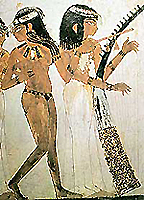
where the word is ψαλμός , in which passage the translation of nebel by psalmos seems to have been a mere error. With regard to the other places in Holy Scripture where it is mentioned, the Septuagint generally has it as ωαβλίον, νάβλα, νάβλη, ναύλα, or νάβλας. As would be expected, the Latin forms are nablium, nablum, or nabla. In speaking of the kinnor, it was stated that that instrument was probably either a lyre or guitar; and those who assumed that the kinnor was the lyre, would imagine the nebel was the harp. Hence certain writers, amongst them Jerome, Cassiodorus, Isidorus, have believed the nebel to be of that simple form of harps, describing a mere a shape, which were given in Figs.1 to 8. But on the other hand it must not be overlooked that the harp, like every other musical instrument, was undoubtedly improved from time to time, and the very fact of the comparative lateness of the allusion to the nebel in the Bible would suggest that it was of a somewhat more highly developed construction than that hinted at above. As regards simple and early forms of harps, some writers have laid great stress on the fact that the hollow resonance-box was held uppermost, and have in this way drawn a contrast between the harp and the guitar family. But this resolves itself into the plain question of the position in which the ancients held their harps when playing. That it was often different to our mode there can be no doubt from such representations as Fig.19, which is copied from a Greek vase in the royal collection at Munich, and which represents a female playing on a harp, having the resonance-box leaning against her shoulder. See also Fig.7, P.13.
 |
 |
 |
 Figures 19-22. |
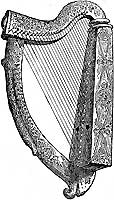
But the most noticeable distinction between ancient and modern harps seems to be the almost universal absence of a third side to the wooden framework of the former. This will be easily observed by glancing at the various illustrations of harps which have been and which will be given. This third side forms a very important feature in more modem instruments, and not only adds to the strength of the instrument, but also allows the strings to be drawn to a greater tension than could otherwise be the case. In fact, it seems difficult to believe how the woodwork, when consisting only of two sides, could stand the strain upon it when the strings were tuned. To those who have not given attention to the subject, this tension seems almost incredible. In the case of a grand pianoforte, which contains more strings than any other instrument in use, the tension, it is calculated, is fifteen or sixteen tons. [To the kindness of Mr. G. T. Rose, of Messrs. Broadwood, I am indebted for the fact that when two pianofortes exhibited by that eminent firm in the Exhibition of 1862 were tested with reference to this point, the tension of one was 15 tons 9 cwt., of the other 16 tons 11cwt., both being tuned to concert pitch. The greater weight representing the tension of the latter instrument is accounted for by its being of a rather larger size; of two strings, equal in other dimensions, but differing in length, the longer will of course require a greater weight than the shorter, in order to raise it to the same pitch.] The third side of a harp is far from spoiling its appearance. The harp shown in Fig.20 is an ancient Irish harp. One preserved in Trinity College, Dublin, is popularly believed to have belonged to the famous Brian Boiroimhe, who ascended his throne AD1001. But this tradition has been ably controverted. [See Stoke's Life of Dr. Petrie, p. 318.] The illustration which we give here was taken, by the kind permission of the authorities of the South Kensington Museum, from the fine plaster cast in their possession. top
 |
 |
 Figs.23, 24 and 25
Egyptian Lyre
'djedjet'. |
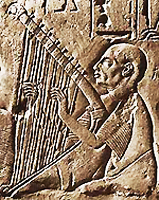
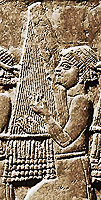
The word nebel is by some traced to a root signifying a "rounded vase," or "leather bottle." If this derivation be correct, we can imagine that the instrument was conspicuous for the shape of one of its sides, if it had two sides; or if it were curvilinear, from the form of the hollow framework. It is quite possible that it might have been like those delineated in Figs.23, 24 and 25.
But it is nearly always dangerous to argue from the derivation of names of instruments. For instance, what could the musical historian of a thousand years hence gather of the construction of a harmonium, seraphine, accordion, or euphonium, from the derivation of their respective names? or, how much from the word "pianoforte," the "soft-loud !" Some have carried this misguiding principle so far as to say that because nebel was derived from "rounded vase" or "leather bottle," that it would therefore answer the description of a bagpipe ! This is, at least, an ingenious theory, but fortunately a well-defined title is given to the bagpipe (on the subject of which more will be said by-and-by), namely, symphonia, which renders this suggestion unworthy of consideration.
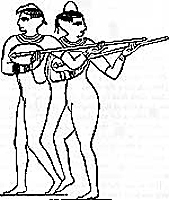
This is not the only theory as to the nature of a nebel which has been hazarded. Although it seems almost certain that it was a harp, some have suggested that it was a, kind of guitar. But there is one very strong argument against this assumption that the nebel belonged to the family of guitars; it is this, that whereas the nebel is not unfrequently mentioned in Roman and Greek authors, instruments with long necks seem to have been unknown to them, or at most, to have been only known to them through actual specimens, or representations of them in sculpture, which had been captured and carried home. [The kithara of the Greeks, it should be remembered, was in its construction a small lyre, not a guitar, although its name is so closely allied to that of the latter.] But there is indisputable proof that the Egyptians possessed such instruments, and Fig. 21 shows two women dancing to their own performance on such long-necked guitars. [This illustration is copied from an original sketch taken near Thebes by Lionel Muirhead, Esq., who kindly presented it to the author.]
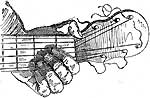
The "necks" seem disproportionately long in these resonance-boxes. But if Italian instruments of this class, the lutes of the sixteenth and seventeenth centuries, be examined, it will be found that this relative proportion is not uncommon. The great importance of these Egyptian lutes or guitars, with reference to the progress of the science as well as the art of music, must be our excuse for a slight digression. It must have been known to the players on these ancient instruments that their fingers had always to squeeze down or "stop" the strings at some definite place, in order to produce certain intervals. [See also the account of the Tamboura, in Engel's Music of the most Ancient Nations, pp. 52—57.] These distances were no doubt measured, and compared with each other, and with the whole length of the string. Thus indeed would the first foundation of the science of acoustics be laid, with all its interesting and important bearing on the art of music. And, in order that the choice of the position of the finger should be found by the performer with greater certainty, frets were invented. Frets were originally pieces of gut (in the Egyptian instruments of camel-gut), tied round the neck, and so forming ridges on the finger-board, at those places where the pressure of the fingers would cut off so much of the strings as should allow the vibrating portions to produce the successive notes of the scale. Thus, no doubt, the primary object of using frets was, to secure a true production of the scale then in use, and at the same time, to shorten and simplify the labour of the young student. But they had, later in their history, when made of ebony or ivory, another important function. If the fingers of a grown man be placed side by side on the strings of a guitar, it will usually happen that they cover more space than the strings, or in other words, that there is not room for them in a straight line, each finger on a string. But the ridge made by a fret enables the performer to draw his fingers a little behind each other and yet play such a chord in tune. This will be understood by noticing the position of the tips of the fingers in Fig. 22. Mr. Chappell states [History of Music, p. 44.] that the remains of frets were distinctly visible on some instruments found in an Egyptian tomb.
With regard to the possible relation of the kinnor to these long-necked instruments, it may unhesitatingly be said that it was probably less long in the neck, but having a somewhat larger resonance-box. The portability of the kinnor, to which its lengthened existence was greatly due, would certainly militate against the idea of its being constructed with three or four feet of fragile neck. Assuming, then, that these interesting instruments were not identical with the kinnor, nor the nebel, in the former case because of their fragile form, in the latter because they were unknown to nations who were familiar with the nebel, we are led to the conclusion that the nebel itself was the veritable harp of the Hebrews. It could not have been large, because, as will be noticed hereafter, it is so frequently mentioned in the Bible as being carried in processions.
The Egyptians and Assyrians had harps of moderate size, as shown in Figs.23, 24, and 25.
Very probably the nebel had a form similar to the harp in Fig.24, but with a somewhat more rapid curve. It would in this way be rendered more portable.
Before noticing some of the most important passages in the Bible in which nebels are mentioned, it is necessary to point out that the English translators render nebel (apparently without any special reason) by no less than four different words:
Psaltery,
Psalm,
Lute,
Viol.
The first of these is by far the most common in the authorised version, and is no doubt the most correct translation if the word be understood in its true sense as a portable harp.
Nebels, like kinnors, were made of fir-wood, and afterwards of almug. [Almug, or algum, perhaps the red sandal-wood of India. See Plants of the Bible, by Sir Joseph Hooker. (Spottiswoode's Sunday School Teachers' Bible.)] Samuel told the newly-anointed king Saul that he would meet
a company of prophets coming down from the high place with a nebel
and other musical instruments. And afterwards
David and all the house of Israel played before the Lord on all manner of instruments made of fir-wood, even on kinnors and on nebels, &c.
On the happy event of the fetching of the ark from Kirjath-jearim,
David and all Israel played before God with all their might
on kinnors, nebels, and timbrels. In i Chron.xv. the names of the players on nebels are carefully recorded. It is evident that David himself was as proficient on the nebel as on the kinnor, and that he set aside special players for special instruments (i Chron.xxv.1, &c.). In the Book of Psalms frequent mention is made of the nebel (Ps.xxi.2; Ivii.8; Ixxi.22; Ixxxi.2; xcii.3; cviii.2; cxliv.9; cl.3). It was not restricted in its use to religious ceremonies: Isaiah complains,
The kinnor, and the nebel, [Here translated viol. ] the tabret, and pipe, are in their feasts (Isa.v.12);
and similarly Amos writes,
Take thou away from me the noise of thy song; for I will not hear the melody of thy nebels (Amos v.23),
and he prophesies woe on those that
lie on beds of ivory, … eat lambs out of the flock, … drink wine in bowls, and … chant to the sounds of the nebel. [Here translated viol ] (Amos vi.5.)
In old English translations of Ps.Ixxxi.2 the nebel is called a "viol." But it must be understood that in these passages the translators used the word carelessly, and not in the least wishing to suggest that the Hebrews had an instrument commonly played with a bow.
It is remarkable that the nebel is frequently mentioned in conjunction with some other musical instrument: for instance, with the toph (tambour), shophar (trumpet), &c. It may not be unfair to argue from this that its tones were deep and heavy, and were best adapted to form the groundwork of other combinations of various qualities and pitch.
 |
 |
 Figures 26-28. |
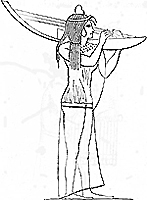
The instrument shown in Fig. 26 seems to have been the link between the harp and guitar family, and as such is interesting.
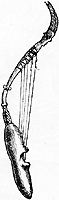
The negro harp, or nanga (Fig. 27), is probably of great antiquity, and to this day retains its original form, midway between a harp and guitar.
This remarkable instrument seems almost to suggest that all string-instruments may have been evolved from one type, namely, strings stretched across a bent stick, as originally suggested to our earliest forefathers by their hunting-bows. But of this we shall speak later on. top
A very peculiar form of small harp is shown in Fig.28; which is copied from an Assyrian stone in the British Museum. Carl Engel, whose opinions are nearly always most trustworthy, seems in this case to have somewhat ventured on a mere speculation when he names this the azor, a word about which we shall next speak. The plectrum in the player's right hand is very evident; and also the curious termination of one of the sides in the form of a hand, perhaps used for holding the music, as is a small brass lyre or other contrivance in our modern military instruments.
With nebel is often associated the word azor, which is traced to a root signifying ten, and which has therefore been rendered in the Septuagint by ἐν δεκαχόρδῳ or as ψαλτήριον δεκάχορδον (psalterium decem chordarum, or, in dechachordo psalterio in the Vulgate). In the Chaldee, Syriac, and Arabic versions also are found words implying the existence of ten strings in the nebel-azor.
The word azor may therefore be considered as qualifying or describing the special kind of nebel to be used, much in the same way as we now speak of a trichord pianoforte. It is in our English version always rendered by the words "ten-stringed." In Ps.cxliv.9 the associated word nebel is wrongly translated !ute instead of harp, in the Prayer-book version.