PART IV.CHAPTER XI. VOCAL MUSIC OF THE HEBREWS.
HOME | Contents | signs of voice ascent/descent | accents | greek church notation | Hebrew accents | neumes | ancient scales | ancient melodies | chants | >>THE absence of monumental records of Hebrew music, some of which, however, may yet be found by the zealous explorers now at work in Palestine, renders the subject of the vocal music of the Jews no less involved in difficulties and mystery than that of their musical instruments. And in offering a few remarks upon it, the course already pursued seems to be the only one open to us— namely, to attempt to give some general idea of what ancient vocal music was, and leave it to the reader to judge how far the Hebrews caught the artistic spirit of their age, or were led by an unusual share of musical ability to excel their neighbours or contemporaries in the practice of this art. If a set of flutes could be found, in good preservation, in each of the centres of ancient civilisation, an approximation might be made to the scales commonly in use; but, alas! when the treasures of European museums have been ransacked, and some of the envied specimens shown, it is found that they are too old and crumbling to bear handling, or, if they may be freely handled, resolutely decline to emit a sound of any kind. So their secrets remain for ever locked up. But, as has been hinted in a previous article, the method of blowing into a flute, or of closing more or less the apertures, has all to do with the reproduction of its scale; so that even if an ancient flute were actually placed in the hands of one of our most expert players, he could produce notes of many different pitches from each position of the hand, and could probably give more valuable information by saying what sounds the instrument was not capable of producing than by attempting to catalogue its capabilities. From ancient instruments of the harp or guitar class which have survived still less information can be gleaned. It is hardly necessary to say that, at the most, only fragments of the strings remain attached to their frame; nor would an intact set tell any tale, as stringed instruments are not in the habit of remaining in tune for several thousands of years.
Of course written music, or the use of signs to represent sounds, must have been, in point of time, far posterior to the use of both vocal and instrumental music. If music had never had a definite scientific growth, it could not have failed to creep into use from a common observance of the different effects produced by altering the pitch of the voice, especially when reading poetry. Whilst reciting the great deeds of ancestors, or traditional hymns on the greatness of the unseen Maker of the universe, the modulation of the voice must have been a most important element of the poet's or minstrel's training. Bearing this fact in mind, it is easy to imagine how, first of all, a solemn monotone, next, occasional changes of pitch, and, lastly, ornaments and graces came to be part of the reciter's art, or, in other words, the poet's music. The Arabs, to this day, recite the Koran to a sort of irregular chant or cantillation. Among many nations musical instruments were used to support the voice of the chanter. That the prophets of Israel sometimes uttered their inspirations in such a manner is suggested in i.Sam.x.5. It is a well-known fact that ancient Greek poets rhapsodised in a sing-song way often to the accompaniment of a lyre or flute [See Donaldson's Theatre of the Greeks, notes to p. xiv.]. The traditions of such accompaniment were probably handed down to the Italian improvisatori, and the troubadours, whose rhymes were often sung to almost chant-like melodies. How to write these modulations of the voice was quite another question. And here we find that ancient musical notation seems to have naturally grown into two branches, the difference between them depending upon the taste or aptitude of different nations for incorporating into their music sounds of fixed pitch, or ornaments and graces which could be used in any pitch according to the reciter's wish or requirements. The fact suggests itself at once to us that flutes or wind instruments would have a tendency to fix definite pitch, while harps and guitars, owing to the ease with which their accordatura or system of tuning can be altered, would be available for a constantly changing normal pitch, or diapason, as we somewhat improperly term it.
Not forgetting this, it is most interesting to find that the tendency of Europeans, from the earliest time, has been in notation to graduate sounds from a known generator, and so to fix pitch; while, on the other hand, the taste for ornament has led Asiatic nations to devise means rather for expressing these ornaments than for securing their immutability in a scale series.
To this day an Asiatic song generally consists of a slight melodic framework, almost hidden beneath a load of extraneous graces. The following fragment of an Arabian tune would puzzle the most devoted lover of fioritura. The notes marked + are not doubly sharpened, as would be implied by our modern notation, but are small intervals lying between the notes of our scale which we have no means of expressing.
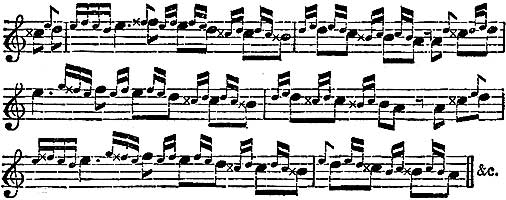
It must not for one moment be supposed that all Asiatic melodies abound in graces, or that all ancient European tunes lack them; quite the contrary. All that is meant is that the tendency of these two branches of music is in the one case to include them, and in the other to exclude them.
Hence we find that the oldest form of known European notation has for its object the giving of a sign for a fixed note; the oldest, or presumably the oldest, of Eastern systems the giving of a sign for the movement of the voice for a certain interval, or this same movement with the addition of an embellishment. The former is exemplified in the Greek notation, as given in ancient treatises; the latter in the so-called accents of the Hebrews, of which more must be said soon. Hence, ancient notations are of two kinds: those founded on the use of the letters of the alphabet; and those in which conventional signs described conventional ornaments. These two, however, though distinct in principle, often overlap each other. The ancient notation of the Eastern Church, which was tabulated by St. John of Damascus, who was to the Eastern Church, musically, what Gregory was to the Western, consisted of signs which must be considered as indications of the form of the movement of the musical-director's hand. Much can be said in favour of this theory, as a system of chironomy has been associated with music from the earliest times [See Anthologia Graeca Carminum Christianorum, Christ et Parariikas.]. A few are here given :—

Ison is the key-note or tonic, a movable do. The other signs represent the vocalisation of various intervals above; namely, the second, third, fourth, fifth, and sixth.
If such distinctive signs as these were used only for the expression of definite intervals, the translation of such music into modem notes would be comparatively easy; but, unfortunately, the Hebrew accents were intended in all probability to describe often not only an interval, but a succession of notes and an embellishment. The reading of the sacred scriptures was, says De Sola,
De Sola then goes on to quote R. Simeon bar Zemach Duran, to the effect that of the accents, which are sorts of melodies, three have remained, one appropriated to the reading of the Pentateuch; the second for that of the Prophets (the portion used on sabbaths and festivals differing from the rest); the third for the reading of the Psalms, the Proverbs, and Book of Job. [The Sephardim have also melodies for the Books of Esther, Ruth, Song of Solomon, and Lamentations of Jeremiah. Not only the canonical books of Scripture, but the Mishna and probably the Jemarah, were recited to cantillation; an edition of the former as late as 1553 was printed with musical accents. (De Sola, p. 12.)] Some of these signs are placed over words, some under; some over the last letter of a word, last but one, or in other positions, the musical value varying accordingly. The following is a list of them as given by Fetis:—
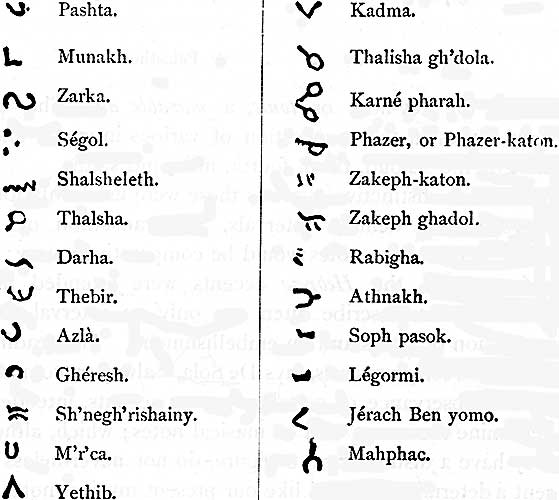
The form of several of the above will be found to differ from that given to them in other works, because copied from manuscripts [See Appendix IV.]. They have probably varied slightly from time to time. Old Kircher (in his Musurgia) exhibits their position above or below a word by using a short line as an imaginary word. Some of the vowel-accents of Hebrew become tonal-accents if placed in a particular place with regard to the letters forming the word. This adds to the difficulties of this already difficult subject. The following are some of Kircher's explanations of the accents:—
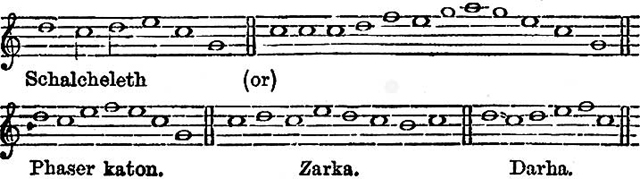
A careful examination of Kircher's complete list will, however, raise some doubts as to his trustworthiness. Exactly similar musical phrases are in more than one instance given for two different accents, and the explanation of some of them resolves itself into the repetition of a single note.
The questions which arise as to the meaning of these signs would pass from the consideration of the musician to that of the scholar, were it not for the fact that complete musical transcriptions of them, such as those above, have been given by several authors. On comparing these, however, their difference is found to be so great, that the conclusion is unwillingly forced upon us that practically the musical rendering of the accents varies in character according to the nature of music in use in whatever country the Jews have settled down. Thus Eastern Jews give them in music which bears a close likeness to that of modern Asiatics. Their interpretation in Spain is palpably Moorish; in Germany different to both of these, and so on. The few following examples will point out the discrepancies which exist in their explanation.
Schalsheleth, which has already been quoted from Kircher, is traditionally rendered in the Egyptian synagogues
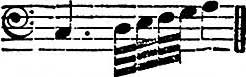
by the English Jews, according to Nathan (Essay on History of Music),
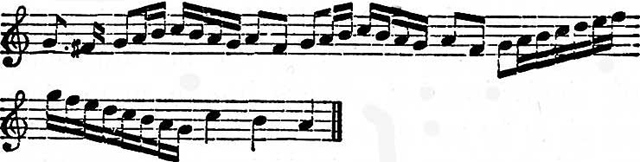
by the Spanish Jews according to Bartolocci (Bibliotheca Magria Rabbinica).
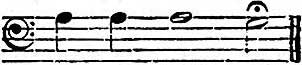
Any translations more divergent in character than these can scarcely be conceived. In comparing traditional tunes, it is generally, or at least often found that the different versions begin and end in the same key-tonality; but in comparing the above four traditional explanations of schalsheleth not even this similarity of construction is observable.
It should be remarked that the musical renderings of the accents, as given by Egyptian and Syrian Jews, bear a striking resemblance to each other. For instance, thalsha is thus sung by the Egyptian Jews (according to Fetis):—

The Syrian use is practically identical:—
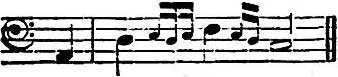
It has also been found that two sects of Jews in Egypt, though opposed to each other in ceremonial and doctrine, have a very similar system of singing the accents.
As the primary use of accents is to point out the usual elevation of the voice, as shown by the Greek accents, which were a comparatively late addition to their written language, for the benefit of foreign students; so also it is quite possible that these complicated Hebrew accents gradually grew out of what were originally simple signs directing a slight elevation of the voice when reading or perhaps monotoning. That monotone, when used from century to century in the mouth of devout readers, will grow into a cantillation, or rude sort of chant, can be proved by the history of our early Church plain-song. Why should not the Hebrews have passed in their days through the same phase of musical development which other nations have done? If there is any truth in this thought, it would be futile to attempt to stereotype, as it were, the actual meanings of their tonal accents. In the most primitive times, what would now strike us as a simple cadence of the voice, must have added dignity to the solemn recitation of the revered words of the treasured rolls. As art grew around, these improvised ornaments would naturally become more complicated, until, as we actually find to be the case, they would rival the most ambitious modern roulade. In the authors already quoted, the reader who is specially interested in this subject will find much information. A quotation (from Naumbourg) of a fragment of Genesis x. will show the result of strictly applying the meaning of the accents attached to the text of the Pentateuch, as interpreted or taken down from tradition by him.
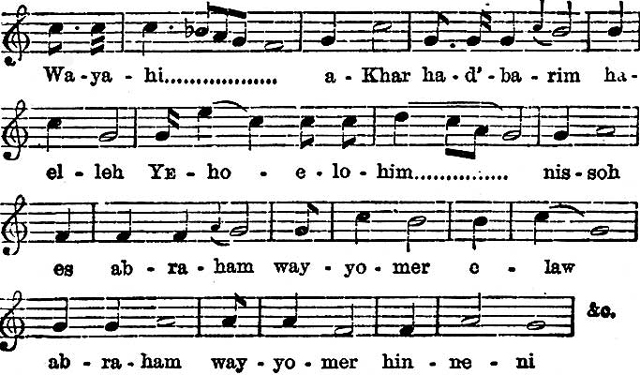
The final close of the passage of which the above is part is on the note F.
It is curious that one of the earliest attempts at musical notation among Western Christians should have consisted of signs, such as the following, placed over words:—
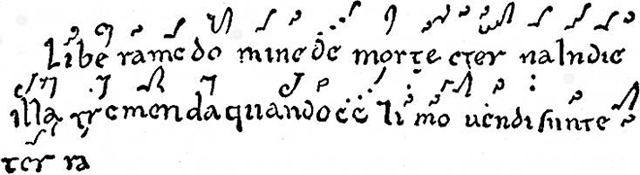
The above, which comes from a work of the eleventh century, has been copied from Coussemaker's admirable History of Harmony in the Middle Ages. [Histoire de I'Harmonic au Moyen Age, pai E. de Coussemaker; Paris, 1852.] As a class these signs were called neumes, but sometimes also accents. They laboured under precisely the same disadvantages as their prototypes among the Hebrews, namely, the probability of a diversity of translation. Modern musicians do not perhaps know how grateful they ought to be to those who first used lines, or a staff of lines, to represent the exact interval between ascending and descending sounds. Attempts were probably made to introduce them about the same date ascribed to the above signs, after which their use rapidly spread. Until such a system came into existence music was chained up within the narrowest limits. By enabling composers to express in a simple form the relation or position of two or more parts placed over one another, it doubtless paved the way for that wonderful expansion of harmony, or polyphony, into a separate branch of the art, which has achieved such wonders in our own day. For although early composers of part-music, it is presumed in accordance with fashion, rarely published scores of their works, it cannot be doubted that in the quietude of their study they took the simple course of sketching a score before copying out separate parts. This growth of harmony must be looked upon as the distinctive feature of modern music. By "harmony" must of course be understood that independence of movement in the component parts of music, which make some of our finest music, practically, into a number of beautiful melodies heard simultaneously. This, it is almost a certainty, was unknown to all ancient nations. In the more limited sense of the word—"a combination of consonant, or properly regulated dissonant, sounds," or, in short, chords—the ancients, no doubt, may be said to have had harmony, that is to say, certain notes of their scales were very probably accompanied by chords, according to certain rules. But yet they had only one melody at a time, whereas we can and do listen to many conjointly. And who can describe the pleasure which accrues to a trained musician when he grasps in his mind many threads of delicious melody, and traces the composer's genius in interlacing them? now drawing them close together, now spreading them out until the ear is taxed to gather in high and deep tones; and still further, while thus interweaving the several threads, is spreading to the ear at each combination, whether the parts move concordantly or are discordantly jostling one another, chords which are in themselves complete and beautiful sets of sweet sounds. Such harmony— to be found in the works of a Bach, Handel, Mozart, Beethoven, and Mendelssohn— did not exist for the Hebrews, Egyptians, or even Greeks. It places modern music on a pinnacle of glory. Chords, and a regulated use of chords, the Hebrews very probably used; but they did not possess the full gift which we term harmony. top
As regards the form of early Hebrew melodies, it is probable that they are reflected in modern Asiatic music, and would, if we could hear them now, strike us as being in a sort of minor mode. It is possible that they might at one time have had an enharmonic scale (that is, a scale having intervals less than a semitone), and that this was in time superseded by a simpler form; but there are some grounds for supposing that they used some form of scale consisting of tones and semitones. From some of the music now sung by Egyptian Jews such scales as the following might be formed : —
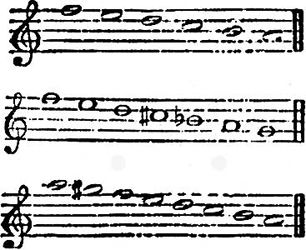
In all attempts to construct scales from traditional songs, the great difficulty which presents itself is to discover what was the key-note or starting-point of the scale. If ancient melodies began or ended on the keynote or tonic, the knot could be at once unravelled; but this no one can venture to assume. The key-note of the Greeks was at first, unquestionably, in the middle of their scale. The reader must bear in mind that the question is not of what sounds any tune is made up, but in what order did these sounds occur to form a scale. Engel has shown his appreciation of this difficulty when discussing the pentatonic scale, to which he justly attributes great antiquity. It consists of what we should call the first, second, third, fifth, and sixth degrees of our modern scale, e.g.,

In some of the oldest known tunes made up of these notes, the lowest note is not the tonic. But if it be written thus,

it presents a very different appearance to the eye, and produces a very different effect on the ear. Yet, without doubt, any musical instrument tuned to a series of notes corresponding to the above might with justice be described as possessing a pentatonic scale. Some interesting remarks on the almost universal use of this pentatonic, or pentaphonic, scale will be found in Gevaert [Histoire et Théorie de la Musique de l'Antiquite; Gand, 1875.]. The minor tonality of Eastern melodies has before been alluded to. The following beautiful tune is Syrian. Simple harmonies have been added to it for the assistance of those who cannot harmonise it for themselves.
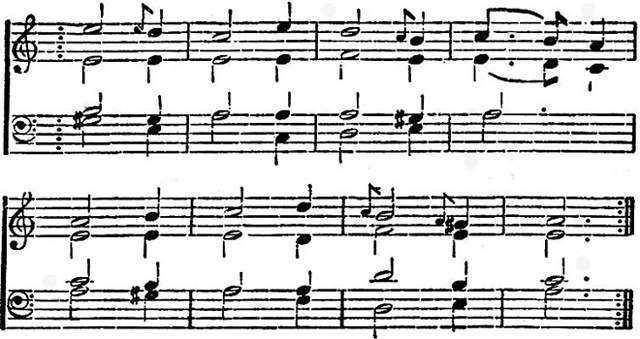
The rhythm of this tune is so symmetrical that it might well be used as a hymn tune. In this respect it is perhaps different to many of its class. It will be noticed that its compass is a minor sixth, a compass within which old melodies are often contained, and which had been remarked by Villoteau as a feature in some of the Egyptian-Jewish music.
The following melody was sent to M. Fetis, whose account of the vocal music of the Jews is perhaps the most interesting and reliable portion of his Histoire Generale de la Musique (and to whom we are indebted for much of the music that has been given), by a resident of Egypt, as being traditional in the synagogue of Alexandria:—
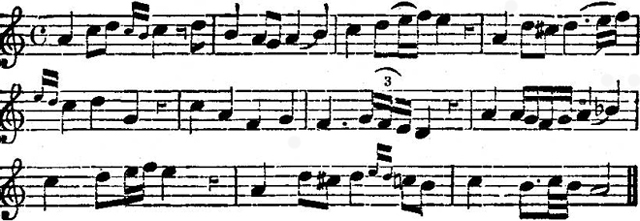
The quaint and wild beauty of this tune will be appreciated by the most unmusical reader. As an example of ancient Hebrew music, the tune which follows is given with a simple pianoforte accompaniment. It is called the "Song of Moses." De Sola says that a very ancient Spanish work affirms that it was the veritable melody sung by Miriam and her companions. Such a legend goes to prove that the melody probably belongs to a period anterior to the regular settlement of the Jews in Spain.
-
"Here in the lone waste..." (Music notation...jpg. 123kb)
-
"God in the cloud of Glory..." (Music notation...jpg. 81kb)
-
Verses 2 & 3. (Music notation...jpg. 112kb)
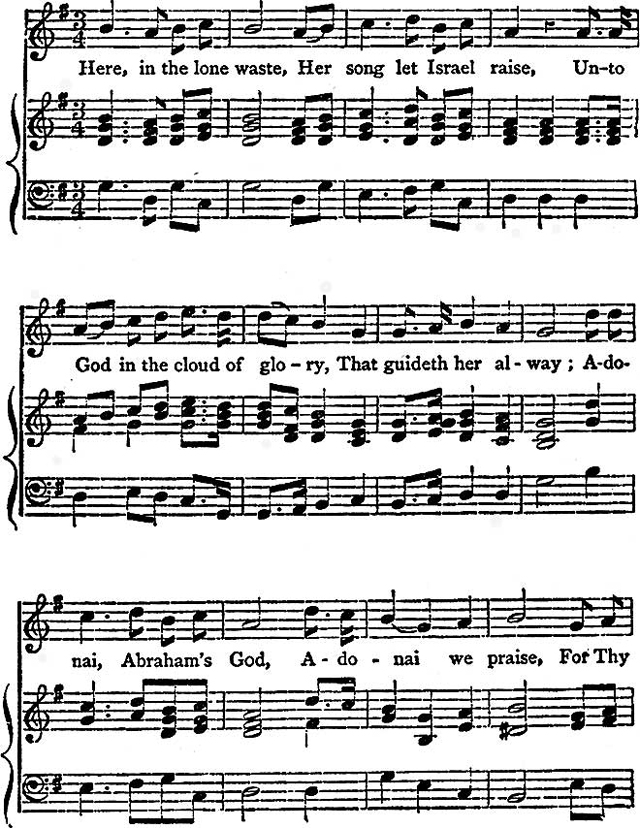
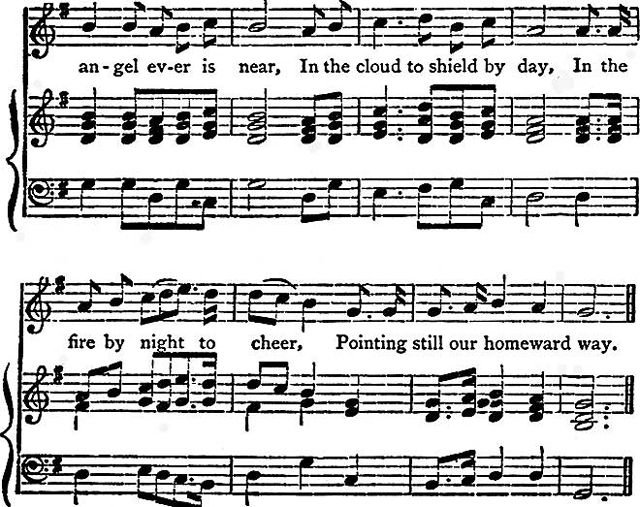
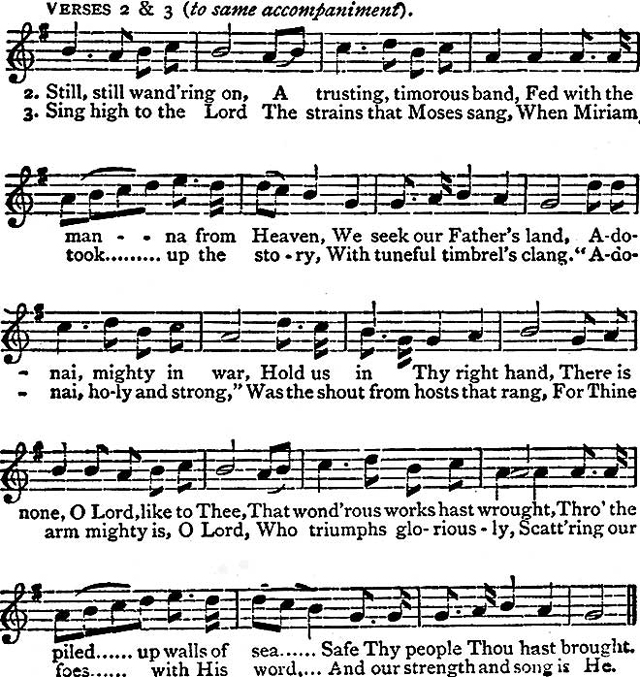
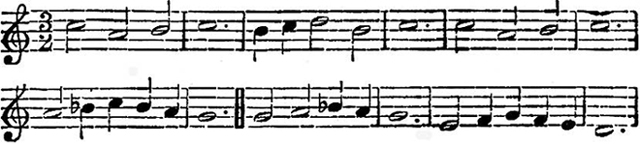
In cantillation, which has above been described as a rude kind of chant, all the defects which are attached to irregularity and uncertainty showed themselves. Its character varied from time to time and in different places. But the very irregularity of this sort of chant renders it singularly appropriate for use to poems of a complicated or constantly changing rhythm, such as the Psalms. The rigidity of the form of the single or double chants to which we sing the beautiful Prayer-book translation of the Psalms is really their great fault, for although it gives a congregation of hearers every opportunity of quickly learning its unvarying tune, yet it must remain exactly of the same length and cadence, whether the verses be short or long, or whether the parallelisms of the poetry run in half verses, whole verses, or in sets of two verses. The unequal length of the meditations and endings of Gregorian tones has been urged in their behalf, as giving greater elasticity to the musical recitation of the Psalms. It must be allowed that this is true, but, on the other hand, this advantage is often thrown away by using one particular tone for a whole psalm, or, what is still worse, for several consecutive psalms at one service. We moderns, it must be confessed, stand greatly in need of some easy form of cantillation for psalm-singing, which shall, owing to its elastic character, be capable of being moulded to suit irregularly-constructed poems. The following chant is used to the 18th Psalm by the Spanish Jews. As will be seen, it has lost much of the rhythmical irregularity of cantillation, but yet is not tied up in a strait-jacket like a modern chant.
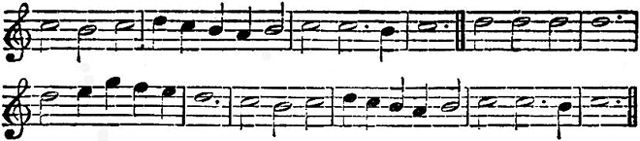
As to the manner in which the Psalms of David were rendered at the time of the first Temple, little can be said with certainty, unless it be that the instruments we have enumerated were used in whole or in portions, and that dancing of a solemn character formed an accompaniment to the rhythm of the music. Of the psalm-singing of the second Temple, clearly-defined traditions are to be found in the Talmud [Lange. Commentary, Psalms.], according to which, on a sign being given on cymbals, twelve Levites, standing upon the broad step of the stairway leading from the place of the congregation' to the outer court of the priests, playing upon nine lyres, two harps, and one cymbal, began the singing of the Psalm, while the officiating priests poured out the wine offering. Younger Levites played other instruments, but did not sing; while the Levitical boys strengthened the treble part by singing and not playing. The pauses of the Psalm, or its divisions, were indicated by blasts of trumpets by priests at the right and left of the cymbalists [See page 68, under "Selah."].
It will not be difficult to form an opinion of the general effect of Temple music on solemn occasions if we know the grand musical results of harps, trumpets, cymbals, and other simple instruments, when used in large numbers simultaneously or in alternating masses. It is easy to describe it in an off-hand way as barbarous. Barbarous in one sense, no doubt, it was; so, too, was the frequent gash of the uplift sacrificial knife in the throat of helpless victims on reeking altars. Yet the great Jehovah himself condescended to consecrate by His visible presence ceremonials of such sort, and why may we not believe that the sacred fire touched the singers' lips and urged on the cunning fingers of harpists, when songs of praise, mixing with the wreathing smoke of incense, found their way to His throne, the outpourings of true reverence and holy joy? If one of us could now be transported into the midst of such a scene, an overpowering sense of awe and sublimity would be inevitable. But how much more must the devout Israelites themselves have been affected, who felt that their little band — a mere handful in the midst of mighty heathen nations— was, as it were, the very casket permitted to hold the revelation of God to man, of Creator to His creatures; and could sing in Psalmist's words which now stir the heart and draw forth the song, how from time to time His mighty hand had strengthened and His loving arm had fenced them? Let us try and enter into their inmost feelings, when the softest music of their harps wafted the story of His kindness and guidance from side to side of their noble Temple, or a burst of trumpet-sound heralded the recital of His crushing defeat of their enemies, soon again to give place to the chorus leaping from every heart,
Give thanks unto the Lord,
His mercy endureth for ever.
When next, in time to come, such sounds wake the desolation of the now ruined and half-buried Holy City, the ancient music will have passed for ever away with the ancient hardness of heart and disbelief, and nothing in Art shall be too new for those who will then understand how old and new dispensations have been bound together in one by Him who has brought His erring children once more into His fold, from the east and from the west. What a new, what an unfathomable depth of meaning will then be found in their oft-repeated song,
His mercy endureth for ever!