THE MUSIC OF THE BIBLE - With an account of the Development of Modern Musical
Instruments from Ancient Types. By
John Stainer, M.A., MUS. DOC.MAGD,
COLL., OXON. New Edition. - Cassell, Petter, Galpin & Co.: LONDON,
PARIS & NEW YORK. 1882. (ALL RIGHTS RESERVED.) - Prepared for katapi by Paul Ingram, 2005.
CHAPTER
X.
MANGHANGHIM,
OR MENAANEIM; SHALISH; TOPH.
HOME | Contents | manghanhim | sistra
- rattles | toph - tambour | tambours | >>
ONCE only
is this word met with in Holy Scripture—in 2 Sam.vi.5;
And David and all the house of Israel played
before the Lord on all manner of instruments made of fir-wood,
even on harps,
and on psalteries, and on timbrels, and on cornets, and on manghanghim.
top
Although translated here "cymbals," the root of the word
in Hebrew points to the old Latin root nuo, whence nuto, "to
sway to and fro, to vibrate."
Now, the word sistrum (σειστρον) comes from a Greek verb σείω, having an almost identical meaning.
There is, therefore, a very
good reason for believing that the word manghanghim refers to an
instrument which vibrated when shaken or rattled.
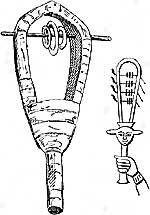 One of the two classes of sistrums exactly answers to this description.
Through an upright frame of
metal, supported on a handle,
several metal rods are passed and fixed in their
position, generally by bending the extremities.
On them are placed loose
metallic rings.
Fig. 90
shows two examples of this instrument which are preserved in the
Berlin Museum. The position of the
rings in this illustration may perhaps lead to the supposition that they are
fixed by the centre;
this is not the case.
They, of course, should lie loosely
on the bars.
One of the two classes of sistrums exactly answers to this description.
Through an upright frame of
metal, supported on a handle,
several metal rods are passed and fixed in their
position, generally by bending the extremities.
On them are placed loose
metallic rings.
Fig. 90
shows two examples of this instrument which are preserved in the
Berlin Museum. The position of the
rings in this illustration may perhaps lead to the supposition that they are
fixed by the centre;
this is not the case.
They, of course, should lie loosely
on the bars.
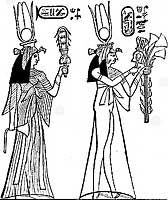 Figure 91, 91a.
 |
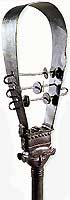 |
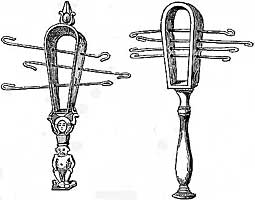 Figure 92.
 |
Fig. 91
shows Egyptian priestesses in the act of playing on this kind of
sistrum at a religious ceremony.
The second kind of sistrum, above mentioned,
had metallic bars, without rings. Hence, it has been thought by some
that the bars were of graduated length, and gave a series of musical
sounds when struck by some hard substance held in the other hand of the player.
Fig. 92 represents two of these. Their Egyptian name is doubtful, but the word kem-kem is thought to apply to them, although the Coptic version translates the "
sounding brass" of i Cor.i.1 by kem-kem.
Others think it applies
to the tambour.
Rosellini has deciphered the word sescesch, and
interprets it as "sistrum."
If the rods were really in proportional
lengths, and were struck, the tones of a sistrum of this class would be more
determinate than those of cymbals.
The Romans used it, or at least were aware
of its existence and uses;
fairly true representations of it being found on
some of their medals.
This may have
been the aerum crepitaculum of their poets.
As the sistrum often, among
the Egyptians, accompanied rites of a very wanton and lascivious character,
there is something intensely sarcastic in Virgil's description of Cleopatra
leading her forces to battle to the sound of the sistrum—
Regina in mediis patrio vocat agmina
sistro. (Virgil, AEneld, viii. 696.)
The
close connection between musical instruments of apparently very divergent
species has been often before remarked;
it is not surprising, therefore, to
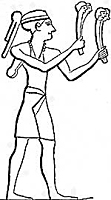
find a link between cymbals and the sistrum. Fig. 93
shows two such ornamental bars of metal held,
one in each hand of
the performer,
which, when struck together, produce a loud clanging sound to
mark the rhythm of a dancer. The fact
that they are clashed together gives them a relation to cymbals, while their
form —
that of vibrating rods—
renders it difficult to place them otherwise than
under the head "sistrum."
The
word shalish occurs only in i Sam.xviii.6.
It has been variously
described as a triangle, a sistrum, and by some—a fiddle!
The root implies the
numerical value of three.
And it came to pass as they came,
when David
was returned from the slaughter of the Philistine,
that the women came out of
all cities of Israel,
singing and dancing, to meet King Saul,
with tabrets,
with joy, and with shalishim
(margin, "three-stringed instruments").
Whatever
may be the antiquity of the viol family, it is difficult to believe that an
instrument, which must have been in very common use—
as the people flocked
together who could play it, "from
all cities of Israel"—
should be only incidentally
mentioned once in the whole course of Jewish chronicle. The notion that all the women of Israel
were experts on a three-stringed fiddle is certainly novel, but, to say the
least, very absurd.
A triangle it might have been, but it is more probable that
it was a sistrum, either with three rings on each bar, as in Fig. 90, or with three
vibrating bars, as in Fig. 92.
top
Fortunately there is but little doubt as to the nature of the toph. It was a tambour, timbrel, or
hand-drum. All nations seem to have
possessed drums of various kinds, but always of a comparatively small size. It remained for modern Europeans to produce
the gigantic specimens which are to be found in our orchestras. Few, who have been present, can forget the
huge upright drum, far exceeding the height of its upstanding player, that adds
its deep rolling bass note to the mass of sounds which are heard at the Handel Festivals
in the Crystal Palace. Such drums were
never dreamt of by the ancients. The
necessity for having portable instruments would have excluded them from use,
even if their presence had been thought desirable. Modern tambours, or
tambourines, as we more usually term them, are invariably round in
shape;
those of the ancients, especially of the Egyptians, were sometimes oblong or square.
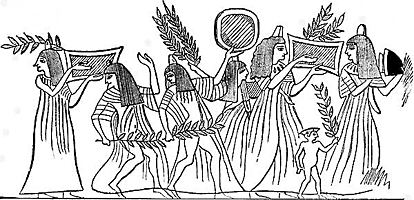 Fig. 94 exhibits both kinds in use.
They were one of the chief ingredients
of their funeral lamentations,
which seem to us to have been strangely
prolonged. It is said that such
ceremonies, when a prince died,
lasted as many as seventy days.
They then sang,
or uttered their mournful cries,
to a tambour accompaniment.
Fig. 94 exhibits both kinds in use.
They were one of the chief ingredients
of their funeral lamentations,
which seem to us to have been strangely
prolonged. It is said that such
ceremonies, when a prince died,
lasted as many as seventy days.
They then sang,
or uttered their mournful cries,
to a tambour accompaniment.
But the Egyptians also had drums of two
other kinds. One consisted of a wood or
copper cylinder covered at both ends with parchment;
which was beaten at both
ends with the hands, just as the tom-tom of India is played.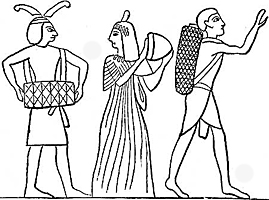
The Egyptian "long-drum," as it
may be called, was, both as to size and shape, very similar to this tom-tom,
which is not unfrequently to be seen in the hand of some poor wanderer from our
distant empire, who is begging about the streets of London.
Fig. 95 shows the manner in which it was carried and
beaten.
The other instrument of this class is peculiarly interesting, as being
evidently the prototype of our modern kettle-drum.
It was called darabooka, and was formed by stretching
parchment over the open end of a basin of metal or earthenware.
When, as was
the case in ancient times, this kind of drum was small and easily carried, the
termination of the hollow bowl by a handle was ingenious and useful.
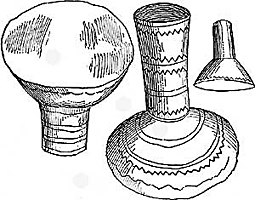
But as their size increased, the handle
had to give place to three feet, and the metal bowl could be rounded—a form
greatly to the advantage of free vibration.
Our kettledrum is therefore little else
than a very large darabooka, standing on a tripod, instead of
terminating with a handle.
The darabooka is shown in Fig. 96.
top
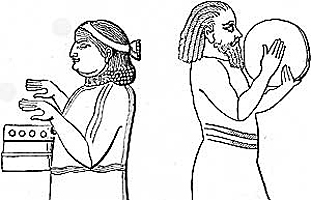
The Assyrians appear to have used the tambour,
and also a drum,
suspended by a cord round the neck
(see Figs. 97 and 98).
But the
instrument they thus carried seems not to have been beaten, like the Egyptian
long-drum and the Indian tom-tom, at both ends,
but only at its upper surface.
Two
questions arise with regard to ancient drums and tambours.
Was the parchment or
head of the drum rigidly fixed,
or was it capable of being tuned? The reader is no doubt well aware that to
the edges of the head of a modern drum is attached, in the case of a side-drum,
a series of cords, and in the kettledrum a metal ring, by means of which the
parchment can be tightened or loosened, and consequently a power of regulating
the pitch is obtained.
Probably the head was fixed, and the ancient drums and
tambours could not be tuned.
The lines which cross the long-drum of the
Egyptians in Fig. 95 look very much like the cords which cross the cylinders of
our side-drums, but these cross-bars are evidently only a rude attempt at ornamentation. The second question is,
had the ancient
tambours little bells, plates of metal,
or castanets inserted in the rim, as we
have in our tambourines?
Probably they had.
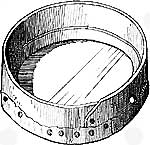
Fig. 99 shows an Arabian tambour called bendyr.
There are holes in
the rim of this which unmistakably suggest the probable insertion of some sort
of pulsatile contrivance or other. Moreover, it is known that such appendages were not strange to the
Greeks.
The bendyr also contains five strings stretched across the inner
surface of the head, as seen in the illustration, for the purpose of
reinforcing its tone. Such a
construction seems to have been introduced in comparatively late times. Stretched strings were formerly used for a
like purpose in instruments of several other kinds, notably in the stringed
instrument called viola d' amore, in which metal strings were stretched under
those of catgut, passing under the finger-board and through the middle of the
bridge, which was pierced to receive them.
The Arabs have three varieties of
tambour, besides that called bendyr. One of them, the mazhar, smaller than the bendyr, has no
reverberating strings, and has metal rings instead of castanets.
Another, the tar, has, like the mazhar, no stretched strings, but has four copper
castanets. The fourth kind has only two
castanets. Goat skins generally form
the head of these Arabian tambours, which are chiefly played by women, as was
the case among the ancient Egyptians.
The Arabians have drums, not unlike kettledrums,
and they may be seen
playing them on horse-back or camel-back,
just as the kettledrums are carried
and played by the bands of our cavalry regiments.
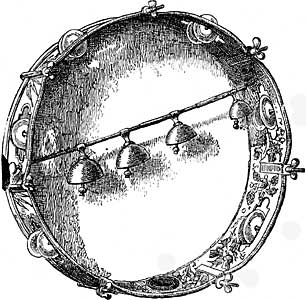
Fig. 100
shows a very beautiful
specimen of an old tambour,
exhibited in the Kensington Museum,
which has not
only castanets in the rim,
but bells suspended in the interior.
It is
impossible to say whether the Hebrews used the drum as well as the tambour.
Most probably the latter only was known to them.
Its antiquity is proved by the
fact that mention is made of it in conjunction with the kinnor, in the
passage once before quoted (Gen.xxxi.27),
where Laban rebukes Jacob for having
left him stealthily,
whereas an honourable departure would have been
accompanied with songs, toph, and kinnor.
It
was a toph which Miriam took in her hand when she led the song and dance
on that wondrous day when Israel saw the "great work" which God had
done, and thankfulness burst forth from side to side as they answered one
another—
Sing ye to the Lord,
for He hath triumphed gloriously
(Exod. xv. i).
Very
different were the feelings which filled the breast of Jephthah when his only
child came forth with toph in hand to welcome his victorious return from
unequal fight with Ammon.
Among
the instruments which the company of prophets bare, who met the future King
Saul,
was a toph (i Sam.x.5), and the same instrument was ere long to be
a source of jealousy and chagrin to him when the women of Israel praised the
youthful hero David on his return from slaying the giant;
and it was part of
the music which graced the return of the ark from Kirjath-jearim.
That the use
of the timbrel was not limited to religious ceremonies, is plain from the
allusion in Isa.v.12.
It seems not to have been carried in warfare.
On the
contrary, in the following passage from Isaiah (xxx.32) its mention is
apparently intended to show the cheerful peace which should everywhere follow
on the smiting of the Assyrian —
And in every place where the grounded staff
shall pass,
which the Lord shall lay upon him,
it shall be with tabrets and harps.
The
tabret has now been excluded from sacred buildings, having given place to the
more solemn and imposing drum.
It
may perhaps be said that in speaking of the probable nature of the kinnor and nebel, too much reliance has been placed on the argument that people
have a tendency to use light portable instruments when travelling, and larger
instruments in religious and civil ceremonies.
If,
however, we consider the habits of the present day in this respect, we shall
find more support of the argument than might at first be supposed. For example, street-singers, who travel from
place to place over long distances, have more or less adopted the portable banjo as an accompaniment to the voice, leaving the full-sized guitar and the
large harp either to the concert-room or to street-musicians who remain in
large cities. Then, again, although the
two once well-defined classes of portative and positive organs
have merged or died out, there still remains the positive organ in our
churches and halls, and the portative barrel-organ whose existence can
be verified by the sad experience of all lovers of quiet.
As
regards drums, we certainly possess the light tambourine, and the large kettle-drums of concert use. The portable violin, called kit in England, has nearly become
obsolete, but its French name pochette fully points out the fact that
its popularity was owing to its convenience as a pocket-fiddle.
The same
remark may be applied to the pianoforte, for although large instruments
mechanically played are now wheeled about our great cities, there was formerly
a marked distinction between the portative pianoforte played by gipsy women
and the heavy instrument placed in drawing-rooms.
It
would seem justifiable, therefore, to assume that nomadic tribes would use
small, simple types of instruments, while the inhabitants of great cities would
also use instruments of more elaborate construction and of greater capabilities
in their worship or court-ceremonies.
top