
 eli jenkins' prayer (troyte's chant) | >>
With the establishment at the Restoration of the Anglican chant as the sole solution for providing music for the psalms a long period of stagnation set in: from 1660 to 1900 there is little or no development or change of method, Wesley alone betraying some dissatisfaction, though his work bore little fruit. During the eighteenth century the methods of singing the metrical psalm and the chanted prose psalm had become much alike. It is quite as easy to sing the prose psalm to a psalm-tune (by using the first note of each line as the reciting note) as it is to sing the metrical version of a psalm to an Anglican chant. The latter method was certainly tried as the following extract from a nineteenth century manuscript choir-book copied by the writer at Wheddon Cross on Exmoor will show; the chant is the familiar one by R. Langdon, the text by Charles Wesley:

Compare also the tune 'Troyte's Chant'—a specially written short chant of a type used later for some special psalms in The Parish Psalter—found in Hymns A. & M. to Abide with me, which, like Example 50 above is quite a successful if dull method of singing the hymn: it might also, of course, be sung to an ordinary double chant repeated.
There are no certain means of knowing how the chanting of the prose psalms was done; in many books the only pointing given was the Prayer Book colon halfway through each verse, and presumably the choirmaster pointed the difficult verses in ink or pencil and left the others to luck and custom. Wesley's psalter, produced for his choir at Leeds Parish Church, inserts marks to correspond with the bar-lines of the chant, which by his time was almost invariably barred as it is normally today. The chanting by his day had possibly become formal and stiff but there is reason to suppose that though it was done at a deliberate pace it was more elastic than the sort of chanting heard everywhere in 1900. It is, indeed, true to say that the extremely stiff chanting still sometimes heard in churches is no older than Stainer's Cathedral Prayer Book. [Which used the pointing and methods of the old Cathedral Psalter.] The new parish church choirs formed as a result of the Oxford Movement were often composed of persons with very little literary feeling; indeed, one may suppose that before the advent of compulsory education in 1876 many of them had received only elementary instruction in the art of reading the printed word. In his book, therefore, Stainer, who took much interest in these new choirs, felt obliged to give them all the help he could and provided the psalter with plenty of marking based on the musical notation of the chant. To such un-literary minded choirs the appeal of the music was stronger than that of the text which was made to fit willy-nilly into a preconceived chant-rhythm. Absurdities of sense, 'church' pronunciations, false quantities, queer accentuations of words and phrases began to abound. By 1900 the educated man could listen to the psalms sung in church only by leaving his common sense in the porch with his umbrella.
Inevitable reaction followed. The feeling after freer rhythms in chanting was but one of the many signs that the clear-cut, four-square rhythmic outlines of the Victorians were slowly being replaced. As early as 1870 or so Wagner was writing his music dramas in a kind of free recitative which caused consternation among his aria-loving prime donne. Research into folk-music and plainsong, each in its own way rhythmically unfettered, quickened the minds of composers into new notions of rhythmic balance where two-plus-two did not always bring the inevitable four. Men of liberal education, men with a love and understanding of language, were being attracted to the cloth and organ loft: Robert Bridges, who did much research into the more unusual poetic metres, proved himself as interested in religious verse as he was in secular. It is thus no wonder that in the matter of chanting—with which Bridges also concerned himself—dissatisfaction grew and experiments were made. A spate of newly pointed psalters followed and much study was undertaken on the principles involved in good chanting.
It soon became clear that the laws underlying true speech had to be reinstated: the ideal must be rather to fit chant to words than words to chant. The norm of good speech was that heard in good reading, not that in casual conversation. The details began to be clear: words must have their correct tonic accent (our FOREfathers, not as hitherto, OUR foreFAThers) and vowels should have their true length (no long or double notes on short vowels like yet, spirit, thanksgiving). In the sentence words must take their stress from the sense (for THIS God is OUR God for Ever and EVer: in the old pointing the second God took length and stress in defiance of vowel length and sense accent). Certain difficulties soon became apparent, notably the very short verses in some psalms. In Thou art the king of glory: O Christ, the O in the second half is long but unstressed and Christ is long but stressed, and the whole phrase which contains but one accent has to be fitted to a musical phrase of four accents.
Not only the words presented problems. Attention was directed to the chant which up to now had been thought of as a melody with seven accents in alia breve (two-two) time. Research, however, showed that it was possible to think of the chant in other rhythms:
in the chant books of the eighteenth and early nineteenth centuries the chants were set out in many different forms. It was noticed, too, that by barring the chant in the Sapphic rhythm (that of Monk's well-known tune to Abide with me which makes a simple quadruple chant when thought of in this way) more even results were got for certain verses of the psalms. Here, then, are the two versions of the Anglican chant which seem to suit most verses of the psalms: [See Collected Essays XXI-XXVI by Robert Bridges, published Oxford University Press, 1955, where by repeating the reciting note after the first bar-line or repeating melody notes of the chant interesting rhythmic variants are suggested. The book also gives examples of the various barrings used in early chant books.]
Example 51: chant by Doctor William Turner


As for the last two hundred years all chants have been composed on the alia breve system it is not always possible to convert them satisfactorily to Sapphics; where it is possible the accents are reduced from seven to four, an obvious advantage for verses whose words contain fewer accents than seven. [Examples are given later (page 205) of fitting the words to the two schemes.] Both the above methods treat the chant as a hymn-tune, i.e. a melody with fixed accents. It has, however, been suggested that the chant can be thought of as containing only two fixed accents—the final note of each half [That is in a single chant. For the purpose of this expose the double chant is considered as merely two single chants.] - the other notes taking accent or not at will as in a plainsong tone. This is a questionable procedure as there is no doubt that harmony tends to create its own accents (the less notes two consecutive chords have in common the stronger the accent), but it works for some difficult verses as will be shown.
the highway code (psalm chant)We have, then, two systems, the first which we may call the hymn-tune method giving the chant a fixed number of stresses (seven in alia abreve, four in Sapphic) and the other, the free-chant method presupposing only two fixed accents. In both systems the final word-stress is taken normally on the last musical accent. To find the principles involved in fitting the words to the chant we may take a few verses and fit them to the chant in various ways. In the verse:
Let us come before his PREsence with THANKSgiving: and shew ourselves GLAD in him with PSALMS.
we have (neglecting the recited portion which presents no difficulties because there is no melody) four word-accents and shall get the best result by treating the chant as a Sapphic:

The notation used does not, of course, mean that the beat is strictly regular: unstressed words, especially those with short vowels, should be sung quickly and lightly exactly as a good reader would speak them. The example is sung, as far as notation can render it, somewhat as follows:
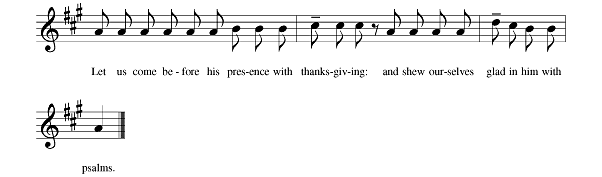
The Sapphic structure of the chant is felt under the ordinary reading stresses like a theme hidden in a variation; the effect, in fact, is something different from reading pure and simple. Treating this verse with the alia breve chant we get:

The result is not so good, with its unnecessary stress on and and him. The New Cathedral Psalter. [The New Cathedral Psalter, ed. Lang, Scott Holland, Lloyd and Martin. Published by Novello.] points the first half of the verse thus: Example 55:

showing the poor effect of not making final accents coincide. In The English Psalter [The English Psalter, ed. Macpherson, Bairstow and Buck. Novello, 1925.] which, like the New Cathedral, works with the seven accent chant, the pointing always manages to get the word-stresses to coincide with the musical accents. The pointing of the second half of another verse taken from some modern psalters is instructive, the verse chosen could hardly be called a controversial one, yet there are many variants. They are all successful and any choice would be entirely personal:
Example 56a: Pointing for New Cathedral Psalter

Example 56b: Pointed to the Sapphic Chant

Example 56c: Pointing from English and Oxford Psalter

Example 56d: Pointing from Parish Psalter

Further study would show that modern pointed psalters tend to use each of the rhythmic systems of barring chants as occasion dictates, awkward verses usually requiring a departure from the norm: the New Cathedral and English psalters, however, use the alia breve chant more or less exclusively, the latter relying on other methods to ease difficult situations, as will be shown. The Parish Psalter [The Parish Psalter, ed. Nicholson. Faith Press.] uses the alia breve or the Sapphic freely alternating, while The Oxford Psalter [The Oxford Psalter. Oxford University Press.] is freer still, the pointing often presupposing the free chant, more often the Sapphic and seldom the alia breve. Pointing can be judged only in performance. The mere possession of a well pointed psalter will not ensure a good rendering: one choir will attain excellent results from a psalter which in the hands of another produces nonsense. Choirs who are fortunate enough to contain members with a sense of literary values can soon be made keen on solving the fascinating problems of pointing; with other choirs ideals must be restricted, though much can be done with the use at rehearsals of gramophone recordings. [Those interested would do well to apply the principles described above to the other published psalters not mentioned here.]
The numerous short half-verses in the psalms cause much difficulty and it is interesting to note the various solutions offered by modern pointings. In Psalm 115 which abounds in such verses we find:
eyes have they and see not. noses have they and smell not.
Both phrases occur in the second half of the verse where the chant in alia breve has four accents. In reading there are but two accents, on eyes, see, and noses, smell with a subsidiary stress (rhetorical, not a sense accent, though the point is one of personal predilection) on have, so that have they and forms a dactyl or musical triplet. Eyes, though monosyllabic, has a long vowel. Each phrase contains two (or three) accents only. Such are the data of the problem. The New Cathedral pointing cannot be considered a very satisfactory solution:
Example 57: Pointing from New Cathedral Psalter

It lengthens the short vowel of have and gives unwarrantable stress to they. A slightly better result is got in The Psalter Newly Pointed [The Psalter Newly Pointed (S.P.C.K. 1925).] by treating the chant as a Sapphic thus:
Example 58: Pointing from Newly Pointed Psalter

This gives two notes to the word and (short vowel) though, sung lightly and quickly, the two notes on the short vowel are not distressing. By clamping verses together and thus hiding the parallel structure of the text— very obvious and dramatic here—the English psalter achieves with the alia breve chant an otherwise good result by neglecting the reciting note (it is made to carry the first half of the verse) from the first phrase and by taking the second phrase on the first half of the chant, thus:
Here the second phrase also uses a device suggested by Bridges, that of repeating the reciting note after the first bar-line, making at that place a bar of three-two time. The result is quite good. [There is much to be said for using chants of varying structure, chiefly for psalms of special difficulty. Little has been done in this direction. See Free Chant Canticles by S. H. Nicholson (Faith Press) for the method applied to the canticles which in these particular settings come off remarkably well in performance. It is also possible that the notation used in this book (the words are placed under the chant in their correct positions) would solve many singers' problems if applied in pointed psalters to difficult psalms.] The Parish psalter cuts the Gordian knot by singing the whole psalm to a shortened chant having only three accents in the second half instead of the usual four—a successful solution. In the Oxford psalter still another solution is found by presupposing a free chant with only two final accents. Written out as sung it goes thus:
Example 60: Pointing from the Oxford Psalter

As an alternative suggestion, the Parish psalter uses a device also suggested by Bridges, that of shifting the colon: the result is novel and interesting:
Example 61: Alternative Pointing from Parish Psalter

Or perhaps it is better noted as a Sapphic:
In both notations the semibreves on speak not, hear not are, of course, sung as short notes copying the natural reading of the words.
In chanting the pointing of the text is only one of the difficulties. The psalms sung solo would present few problems. The actual result at performance is as much the choirmaster's problem as that of the editor. Cathedral choirs, because of their daily singing, can quickly achieve excellent results. In parish church choirs the problem is harder since they sing together only two or three times a week. There is an easy solution to their difficulties which requires only courage and patience on the part of the clergy and congregation: it is that of restricting the psalm repertory until the psalms sung are known by heart. A start can be made with the canticles and about six psalms. When they are working well gradual additions can be made. It is difficult to define the congregation's part in chanting the psalms—either its actual part or its ideal part. History shows that the congregation has seldom been able to tackle the psalms except in metrical translations. Experience shows, however, that the congregation can, in the course of a year or two, get to know the pointing by heart when the repertory of psalms is temporarily restricted. By long familiarity they learnt—some of them— the old pointings: by similar means they will learn the new. But if it takes a choir many months of hard but fascinating labour to achieve a good result in chanting, a congregation of sensible and enthusiastic people will not expect to acquire proficiency without a similar expenditure of effort and patience.
Modern psalters can be judged at the bar of the principles mentioned above. If it is ever produced, the ideal psalter will not restrict itself to any one method; the psalms vary too much for that. Some psalms will need specially written chants, short verses will need their own treatment—which need not be uniform—alternate 'proper' chants should undoubtedly be provided which suit their own psalm, and the chants themselves should have most of their passing-notes eliminated. As for the text of the psalms, it is high time that it was paragraphed and expurgated of pre-Christian cursings. It is a pity that the short verses cannot be retranslated; it would be easy to do but impossible to popularise.

