Chapter 18 - CHOIR MUSIC
1. THE NEW TECHNIQUE
HOME | contents | << | emergence of the solo | transitional caroline composers | bar line & word-accent | form & key | length | the solution | verse-anthem | harmody & melody | recitative in tempo | restoration style | psalm 8: o lord how excellent ... (henry laws) | >>
EMERGENCE OF THE SOLO
The story of the protestant outlook between the Prayer Books of 1559 and 1662 might be summed up as the establishment of man's opinion as the final arbiter in religious matters. With a queer disregard for the personal, unreliable emotional complexes which fashion a man's opinion, the protestant substituted for the authority of the church that of himself. The humanism of Erasmus had resulted in an out-break of individualism; personal opinion was raised to the rank of a philosophy and science believed in the authority of nothing but the five senses. In music, which includes church music, a breakdown of the community spirit of counterpoint gave place to the emergence of the solo; already in Dowland, the sweet singer, we see the beginnings of a new form, the solo art song with accompaniment, and the finest composer at the end of the century, Purcell, was also an accomplished singer.
THE TRANSITIONAL CAROLINE COMPOSERS
In church music the composers working between 1625 and 1650 were unknowingly bridging the gap between the experimental verse-anthems of Gibbons and those of Purcell. [Verse-anthems: Gibbons, page 95; Purcell, page 127.] These transitional Caroline composers whose actual works matter more to the historian than to the choirmaster are rather interesting than vital or usable. Christopher, the son of Orlando Gibbons, never secures release from the tentacle clutch of his father's style and vacillates between the old and new idioms. Child, who can write moving Latin motets of the old type, tries by perpetrating rather foolish experiments in harmony to keep up with the times; he lives in fact to a ripe old age, old enough to mimic the gay demeanours of the restored court, but none of his more ambitious work is anything but an exercise in the declamatory style rounded off with a few quasi-joyous hallelujahs. [For his services see page 135.] Henry Lawes is so keen on the just accenting of his words, over praised by Milton in a famous but rather undiscriminating sonnet [Beginning:
Harry, whose tuneful and well measur'd song First taught our English music how to span Words with just accent...
an unsuspecting slight on Byrd and Gibbons, one presumes.], that he forgets to write music: in justice to him, however, for he was a competent musician living in an unfortunate age, one should add that he sometimes forgets his accent and dissolves into real music. Matthew Locke, more famous in operatic efforts, can be effective and show good command of feeling, but he lacks the urge of genius that is needed to solve the problems by a few master-pieces. Benjamin Rogers manages a successful but unremarkable fusion of the old and the new.
Christopher Gibbons (1615-1676). Born at Westminster, became a chorister at the Chapel Royal. 1658, organist of Winchester. 1660, organist of Chapel Royal and Westminster Abbey, and private organist to Charles. Buried in the cloisters at the Abbey. Very little church music.
William Child (1606-1697). Taught by Bevin, organist of Bristol. 1632, organist of St George's, Windsor and Chapel Royal. 1643, retired to a farm near Windsor and composed church music. 1660, chanter of Chapel Royal and private musician to Charles. Buried at St George's. Publications: 1639, First Set of psalms, later renamed 'Choise Musick' and often called Choice Psalms, consisting of twenty anthems. Undated: Divine Anthems. Many services and anthems in MS. He gave £20 towards the new town hall at Windsor and paved the choir of St George's.
Henry Lawes (1595-1662). Gentleman of the Chapel Royal and Clerk of the Cheque. Wrote a few anthems including Zadok the priest for the coronation of Charles II. His church music, except the fine hymn-tunes to Sandys' version of the psalms, is not so important as that written for masques, especially that for 'Comus'. Publications: 1637, A Paraphrase upon the Psalms, the Sandys tunes. 1648, Choice Psalms, William and Henry Lawes' joint work.
Matthew Locke (1630-1677). Chorister of Exeter. 1661, Composer in Ordinary to the King. A convert, possibly, to Rome, he was appointed organist to the queen. Wrote anthems for the Chapel Royal, of which Lord, let me know mine end was given in Boyce and so presumably remained in the repertory. Publications: 1666, Modern Church Music, a kyrie and creed composed for the Chapel but 'Obstructed in its Performance before His Majesty, April 1, 1666' and in this publication 'Vindicated by the Author'. Other anthems and some Latin hymns appeared in published collections of the time, while some were given in Tudway's MS. collection.
Benjamin Rogers (1614-1698). Chorister of St George's, Windsor. 1639, Christ Church, Dublin; 1641, lay-clerk at Windsor. During the Interregnum taught in Windsor, being re-appointed as lay-clerk in 1662. 1664-1685, organist of Magdalen College, Oxford. Many services and anthems, some printed in collections, including Boyce. His Hymnus Eucharisticus is sung each year on May 1st from the top of Magdalen tower. top
THE BAR LINE AND WORD-ACCENT
The problem was new in the history of music, and history waited in vain for a genius big enough to resolve it. And so the matter had to run its course, a course lasting a hundred years from 1600. A new tyranny had arisen - the bar-line. Just as churchmen had rejected the unmanageable prose versions of the psalms, replacing them by metrical translations, so now they insisted on a regularly recurring accent in their music. In the previous century the lighter effusions like ballets and folk songs had shown a regular beat, but in serious music (madrigals, motets, anthems, plainsong) such a practice was eschewed. After 1600 the regular accentual system spread like a plague and for three hundred years music went on hammering out its tom-tom beat.
FORM AND KEY
If the introduction of the bar-line had been the only innovation, however, progress in the new music would have been rapid and easy; but other new elements confused the issue. The rejection of contrapuntal methods - perhaps because they were played out, perhaps because choirs were depleted, perhaps because of the growing worship of 'personalities' and achievement - created an accompanying difficulty, that of form. Knit as it was with the contrapuntal texture, the form of the sixteenth century motet was clear enough. Now new ways of giving shape to the music had to be invented and two other elements made that the more difficult: they were the chosen text which had a form of its own and key which, when the music consisted mostly of a solo and accompaniment, became too easy to handle (the possibilities of modulation became theoretically limitless when the accompaniment could be relied on to help the singer through a difficult passage). To us the system where a key with its attendant relative keys helps to define the form by giving point to contrasting sections and restatements seems a simple notion; we are used to whole sections of a symphony in C-minor being in any key but C-minor. In a seventeenth-century composer the old modal idea of a centre of gravity to which one was always returning after certain permitted cadences - not, be it noted, sections in a related mode - was too strong to be overcome quickly. He therefore tends to vacillate between too much modulation, as in some of the secular works, and no modulation at all, as often in the verse-anthems. One has to remember that the contemporary composer seldom knows even what he is trying to discover: in music as in scientific work the story of Rontgen finding X-ray phenomena during the process of looking for something else is often repeated.
LENGTH
If form and key both gave trouble, length added to it. The anthem was gaining in importance as the appeal of the liturgical part of the service diminished. If today evensong seems but a dull ante-room vigil for a sermon, it became in seventeenth-century musical establishments but the prelude to the anthem. Pepys' attitude to the anthem was typical of the end of the century: he regarded it as the tastiest morsel of a social banquet. Anthems grew in length as they grew in importance; few Tudor motets take more than five minutes to perform but the composer after 1650 was increasingly faced with filling out effectively his quarter of an hour.
THE SOLUTION
Small wonder is it, then, that little lasting music was produced between the death of Gibbons, 1625, and the birth of Purcell, 1659, or that still less is sung in our churches. This triple problem of form, key and length was solved at the keyboard and in the orchestra where there were no words to embroil the already complicated issue; for the question of word-accent in conjunction with regular bar-lines was no small problem in itself. At the keyboard it was solved only when composers ceased trying to imitate vocal counterpoint and frankly fashioned their pieces on the dance with its clear-cut sections. Byrd had written music of both types for the virginals, but one could hardly expect instrumental composers to see at once which type to use as their model, so that the fifty years after 1625 are really a melting-pot period. By taking up the story again in 1680 or so we can examine what has been evolved.
THE VERSE-ANTHEM
In a typical Purcell verse-anthem like Rejoice in the Lord alway, which we take because it is familiar, we find the work preceded by a short instrumental prelude for strings (here on the composer's favourite ground-bass device which gives the work its nickname of The bell, anthem) and thereafter divided into sections by further instrumental ritornellos; in the usual editions these are either not given or shortened down to a few bars, though Purcell Certainly meant them to be there. The work is thus a kind of suite of movements all in the same key or in keys with nearly related tonics. Usually the alternations are between major and minor - sharp and flat keys as Purcell would have called them - rather than between tonic and dominant, which is used only in see-saw fashion as yet during fugal entries. Here the alternations are C-major and A-minor; the more usual alternation, between C-major and C-minor, is seen in Thy word is a lantern. Contrast is obtained by changes of time-signature, entry of the chorus in two places, both similarly containing the verse interjections and again, and by the string interludes. A plain restatement of the first verse section is placed before the final entry of the chorus, and by repeating the same section piano at the start of the work the composer drives it home to the listener so that it is easily recognised on its return. It must not be supposed from this instance, however, that such restatements are normal; perhaps in this slight but pleasing work Purcell was frankly out to please 'the town', and hoped the town would go away humming his tune - as it still does. No attempt is made at spiritual subtleties and the general effect is secular and 'jolly', and therefore typical of the more cheerful Restoration anthems.
HARMONY AND MELODY
Coming to the details, we may note that the counterpoint runs smoothly in a preconceived harmonic mould where the harmonies are very much in our familiar C-major and the cadences are frequent and already stereotyped. Asperities in the counterpoint remind us, always politely, of the Elizabethans, as at the words let your requests be made known unto God. The words are deftly placed over a metric basis, except at the word alway where the music has its own swing rather than the word.
RECITATIVE IN TEMPO
But we need to search a more serious type of anthem, or a work containing recitative: to see how careful Purcell is over this matter of syllable-accent; one needs to remember that he was a trained singer as well as a composer. In recitative, as seen in the anthems produced after 1660, we find a fully developed technique which is entirely never compared to Elizabethan methods and just as effective; it is indeed at times-capable of a deep human pathos. Unlike recitative on the continent English recitative is meant to be sung in strict time. Purcell's
Example 39. Bass verse from Purcell's Behold I bring you glad tidings 
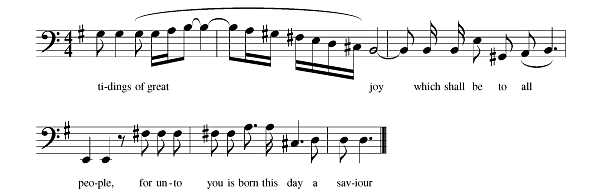
is the forerunner of Wesley's
Example 40. Men's recitative from Wesley's Blessed be the God

both the true metrical descendants of Merbecke's semi-metrical
Example 41. From Merbecke's Creed

though modern choirmasters sometimes allow their singers to take too much liberty with note-lengths. Purcell learnt his word setting from Locke via Humphrey and from his own experience as a singer; he improved on his models by making his work not only a good and careful setting of the words but also vital as music.
THE RESTORATION STYLE
The music of the Restoration composers had thus settled into two main types, the verse-anthem, and the full anthem, which was the child of the Tudor motet. The verse-anthem was essentially a suite of movements for varying ensembles of solo voices with or without instrumental interludes, interspersed often with choruses for the full choir or entire sections for one solo voice. In the light of later developments it seems to us as a form to lack any real organic growth, being held together more by the connecting ideas in the text than by any musical magnetic force. But that was a defect of all the music of the time, including for example the Bach cantatas of twenty years later, and must be looked at with a blind eye. Within that flimsy framework a new method of expressive solo song has been evolved, recitative in tempo. Purcell at least has succeeded in writing good tunes that do not mangle the words and musicians in general have submitted to the tyranny of the bar-line. Of the old tradition little seems left: the noble impersonality of Byrd has been for the most part replaced by a more homely expressiveness which, though always effective in its pathos, is yet the expression of an individual. The old English roughnesses in the counterpoint and a few echoes of the modal system give evidence of the continuity of the tradition. But a more deep-rooted change is noticeable in the texture: the invention of the lazy methods of figured-bass show that the composer thought of his chords first and his melody second, at least in the solos. Metrically considered the music began to move in balanced phrases instead of in the easy alternation of two- and three-rhythms of the previous century. The church had been fighting against regular metre ever since the days of Augustine: it had at last succumbed.