CHAPTER VI. WIND INSTRUMENTS (continued). - GHUGGAB, OUGAB, OR UGAB.
HOME | Contents | ghubab | syrinx | magrepha | organs: growth | construction… | hydraulic… | Chinese… | mashrokitha | early organs | >>
HAVING spoken of the pipe, and of the possibility that the Hebrews knew of the double-pipe, we naturally come to those instruments which place a number of pipes under the control of the performer. And first it should be remarked that there is an essential difference between the flûte à bec, or flute with a beak, and the flauto traverso, which it was unnecessary to point out when these instruments were previously mentioned. It is this. In the former class, the performer has only to blow into the end, and the sound is produced by the air being led by the form of the interior against a sharp edge of wood termed the upper lip. In the flauto traverso (now the common flute), the player has himself, by adjusting the form of his lips, to force the air against the edge of one of the holes, which he thus temporarily makes into an upper lip. By comparing a penny whistle with a common bandsman's fife this difference of their construction will be very apparent. In the former, a piece of wood placed in the mouth-piece guides the column of air to the opening, where it is compelled to pass the under lip (the lower edge of the opening), so as to strike against the upper lip; but in the latter nothing of the sort is provided, the player making his mouth the under lip, and, as before said, the side of the hole the upper lip. It is plain, therefore, that two classes of "manifold-pipes" can exist, the one corresponding to a collection of flauti traversi, the other to a collection of flûtes à bec.
Now, if we take any piece of a tube open at both ends, and blow against the sharp edge until a musical sound is produced, we are acting exactly on the same principle as does the player on the flauto traverse. And if now we place our hand so as to close the other end of the tube, the pitch will immediately fall to an octave lower than it was before, for physical reasons which need not be entered into here. In both cases, whether the tube is open or closed, we are blowing and producing the sound on the same principle. top
A collection of tubes of different sizes stopped at one end, and blown into at the other as above described, forms the musical instrument known as Pan's-pipes, in the Greek syrinx (σῦρυγξ), Lat. fistula. Whereas a collection of flutes a bee of different sizes placed in a series of holes in a box, through which the air can be mechanically forced, constitutes what has for centuries been distinctively called the organ. This difference between these two instruments is of the more importance, because it is a commonly received notion that the syrinx is the parent of the organ. Unquestionably, as regards antiquity, the former instrument must be allowed to have priority, but this does not necessarily prove any connection between the two.
From what has been said, it will be easily imagined that a Pan's-pipe blown by mechanical means would really be a very scientific instrument; but on the other hand, when flutes d. bee were once commonly used, it would not require any special ingenuity or invention to suggest that several should be placed in a row over a box, and be blown one after another from the same supply of wind. Of course, as each organ-pipe was only required to give one sound, there would be no necessity for finger-holes being made in it. Again, it must have been very soon discovered that pipes containing reeds could be as easily made to speak over a wind-box as flue-pipes.
The universality of the Pan's-pipe is as remarkable as its antiquity. To find a nation where it is not in use is to find a remarkable exception.
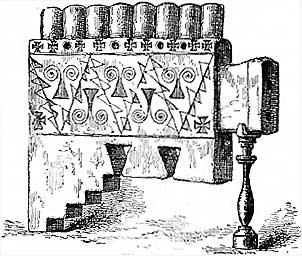
In an ancient Peruvian tomb a syrinx was discovered and procured by General Paroissen. A plaster cast of this interesting relic was lent for exhibition at South Kensington Museum in 1872, by Professor Oakeley of Edinburgh, by whose kind permission the engraving ( Fig. 57) is given.
The description of the original, as given in the catalogue, is as follows :— "It is made of a greenish stone, which is a species of talc. Four of its tubes have small lateral finger-holes, which, when closed, lower the pitch a semitone." The Inca Peruvians called the syrinx huayrapuhura. The British Museum possesses one of these, consisting of fourteen pipes.
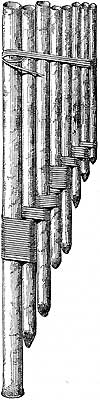
Was the ugab a syrinx or an organ? As the former seems to have been the more ancient of the two, and as ugab is included in the very first allusion to musical instruments in the Bible, it would seem reasonable to say at once that it was a syrinx, especially as this instrument was, and is to this day, commonly met with in various parts of Asia. Yet it would indeed be strange if such an instrument were selected for use in Divine worship; and that the ugab was so used is proved beyond a doubt by its mention in Ps.cl.:
Praise Him with the minnim and ugab.
Its mention here in antithesis to a collective name for stringed instruments surely points to the fact of its being a more important instrument than a few river-reeds fixed together with wax.
Let us not forget that we have but one and the same name for the single row of about fifty pipes, placed, perhaps, in a little room, and the mighty instrument of 5,000 pipes, occupying as much space as an ordinary dwelling-house, and requiring the daily attention of a qualified workman to keep its marvellous complications properly adjusted. Each is an organ. May it not have been the case that the ugab, which in Gen.iv.21 is mentioned as the simply-constructed wind-instrument, in contrast to the simple stringed-instrument, the kinnor, was a greatly inferior instrument to that which in Ps.cl. (before quoted) is thought worthy of mention by the side of a term for the whole string-power?
Even if it be insisted that the first-mentioned ugab was nothing more than a syrinx, are we, therefore, forbidden to believe that the mere name might have been retained while the instrument itself was gradually undergoing such alterations and improvements as to render it in time a veritable organ? That men's minds have from the earliest time striven to find out in what way many pipes could be brought under the control of a single player, there are indubitable proofs. A passage in the Talmud [Mishna, Tr. Erachin., Ch. II., sections 3, 5, 6.], describing an instrument called magrepha, which was said to be used in the Temple, is exceedingly interesting. The word magrepha, signifies "a fork," and the instrument was so named because of the similarity of the outline of its upright pipes to the prongs of a fork. This organ, for it is entitled to the name, had a wind-chest containing ten holes, each communicating with ten pipes; it therefore was capable of producing 100 sounds. These were brought under the control of the player by means of a clavier, or key-board. Its tones were said to be audible at a very great distance.
Supposing that the whole of this account is apocryphal, it still shows that in the second century such an instrument was not only considered possible, but believed, rightly or wrongly, to have actually existed at some previous period. top
Let us now trace the various stages through which the organ has passed, while developing from what we should now consider a toy, to that noble instrument which makes our beautiful cathedrals and churches ring again with sweet sounds, and whose duty it is to guide and support the combined voices of many hundreds, or it may be thousands, of hearty hymn-singers.
Assuming that a series of wood or metal flûtes à bec had been constructed so as to give in succession the notes of a scale, and also that the wind-chest was pierced with holes to receive them, the first thing required by the player would be a contrivance for allowing him to make any one he wished speak separately. As might be supposed, the simplest method of doing this is to place little slips of wood in such a position that they can either be pushed under the foot of the pipe, and so stop the current of air from passing into it, or be pulled out so as to admit the air.
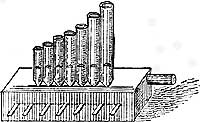
Fig. 59 exhibits this most simple piece of mechanism, and very possibly shows what the ugab might have been at some period of its existence. A pipe at the side of the wind chest points out the fact that the commonest bellows of the period was considered capable of supplying the required current of air.

While one bellows is being replenished, the other is still able to support the sounds, so there is no awkward pause while the instrument is taking breath.
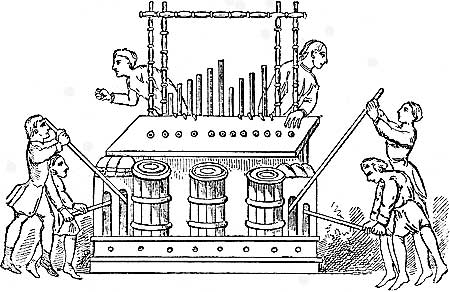
In the next illustration (Fig. 61), which is from a MS. Psalter of Eadwine, in the library of Trinity College, Cambridge, the organ has begun to assume a more dignified form. There is an attempt at an ornamental case, and judging from the number of blowers required, the music must have been rapid, or the sounds powerful. As soon as these instruments became large and not easily movable, the terms positive and portative organ came into existence— the former being an instrument which, owing to its size, had to remain stationary; the latter, one that could be carried about. In the sixteenth century, these portable organs were called regals, the exact derivation of which is somewhat uncertain. They formed a very important element in ecclesiastical processions, as their cases were frequently elegantly decorated.
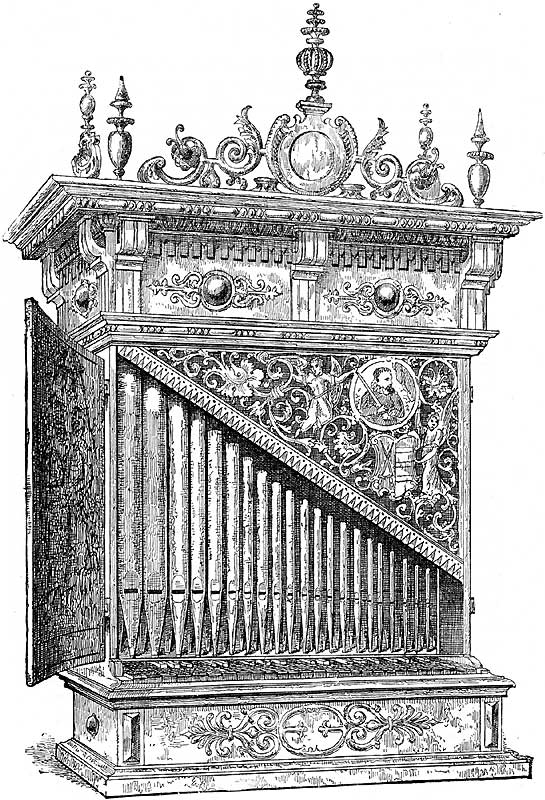
In attempting to form some opinion as to the degree of excellence reached by builders of ancient (not mediaeval) organs, it is very necessary to bear in mind that the principles on which instruments of this class are constructed have not undergone any radical change since the earliest times. Indeed, one of our huge modern organs exhibits an ingenious expansion of old ideas, rather than the invention of new.
Let us suppose, for example, that we have two rows of pipes (i.e., two stops), one set of metal, the other of wood, standing in holes in the top of a box, which is supplied with air (more or less compressed) from a bellows. Only two problems present themselves: first, how is the player to make any particular pipe speak while its neighbours stand silent; next, how is the player to have power to play on whichever of the two sets of pipes he may wish. When these questions are answered we shall have discovered the two important principles on which all organs have been and are constructed. The modern names for the two pieces of mechanism which bring about these results are, respectively, the pallet and the slider. In Fig. 59 the simplest method of placing particular pipes under the player's control was shown. Slips were pulled in and out from under the foot of the pipes. The utter impossibility of obtaining from such a system a rapid succession of sounds, or the simultaneous movement of several slips so as to produce a chord, will be at once evident. In modern organs there lies under the foot of the pipe, some little distance below it, a small flat piece of wood covered with leather, which is hinged at one end and kept in position by a spring.
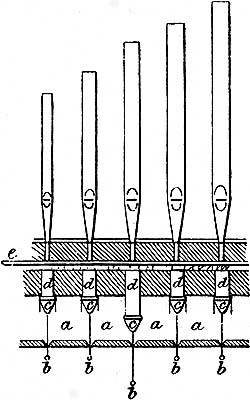
Fig. 63. (a) Chest of compressed air. (b) Pull-downs of pallet connected with the keys. (c) Pallets which admit air into groove; steadied by moving between two wires, (d) Grooves running from back to front under pipes. (e) Slider with holes corresponding to pipes, pulled from right to left, so as to admit or prevent admission of air to pipes; connected with the stop-handles.
This is the pallet. A stroke on one of the keys pulls down the free end of the pallet and allows air to rush into the pipe. When the finger releases the key, the spring immediately holds the pallet tightly against the orifice.
But to have a pallet under every pipe in a large organ would be an absurdity; therefore, in arranging two sets of pipes, those giving the same note (or likely to be required for simultaneous use) are placed behind one another over the groove into which the pallet admits the air. If now a key is struck, the pipes which give the same note in both our stops will be sounding at once. Hence the necessity for our slider-action, which is constructed thus.
A strip of wood runs continuously under each row of pipes, having holes at distances exactly corresponding to the distances between the feet of the pipes. If we push this strip, which is called the slider, into such a position that its perforations and the openings leading to the feet of the pipes exactly coincide, then air can pass into the pipes when the pallet opens.
If, on the contrary, we push this strip of wood so that none of its perforations coincide with the entrances to the feet of the pipes, no air can reach a pipe, even if the pallet be opened. In the former case we say a stop is out, in the latter that it is in. The diagram (Fig. 63) will make all this easily understood.
How simple are these two great constructive principles of the organ! And yet, when once known to the ancients, there remained no obstacle to their building organs of any magnitude, for the modern organ with its three or four manuals in tiers, and its pedal-organ, is nothing more or less than a collection of as many organs all built on these two principles; and, as before remarked, the ability and ingenuity of modem organ builders has been directed more to the easiest means of bringing these manifold organs under one performer's control than to the discovery of a radical alteration in the principles of their construction.
Who can venture to say that these simple principles were never mastered by the ancients? If the reader will turn back to our mention of the magrepha, he will find that such contrivances must have been known at least as early as the second century; and there seems little reason to believe that any sudden and unexpected discovery led to their adoption. In the case of all other musical instruments, a gradual but very perceptible growth in the ingenuity of their construction is to be traced. Why not so with the ugab. The only conclusion to be drawn from all this is, that the ugab must be considered as an instrument of importance and magnitude in direct proportion to the period of its existence. To some this may seem a very contemptible conclusion, but it is not so. The use of the word extends over a vast period, and those writers, therefore, who describe it as one unvaried, unchanging instrument are, judging from what the history of music teaches us, treading on untenable ground.
It is remarkable that the latest improvements in the construction of the organ should have been in its bellows. One would have supposed that so important an element in its existence would have been perfected early in its use. Such, however, is not the case. It must be generally known that as the top of a common bellows, such as a blacksmith's, descends, if left to itself, the pressure on the air contained inside it increases, because the weight of the top and sides is resting upon a constantly diminishing quantity and therefore surface of air. It is also a well-known fact that organ-pipes change in their pitch to a considerable extent, according to the pressure of the air which is passing through them. The ancients, then, if they had only one such simply-formed bellows, could have produced no sounds at all while the top of the bellows was being raised by the blower, as this process took off the pressure on the inside air; and even supposing that several such bellows were adapted to one organ in such a manner that while the contents of some were being utilised by the organist the others were being re-filled, even then the pressure of the air must have been far from constant, unless the ingenuity of the blowers counteracted the influence of natural laws. A glance at Fig. 60, on page 100, will show this plainly. These old-fashioned bellows were called diagonal. The bellows of modern organs, called horizontal, practically consist of the old kind of bellows (now called the feeders) and a reservoir just above them, which, owing to valves at its under-side, cannot drop while the feeders are being replenished. And in order to still further equalise the pressure, the ribs of our bellows are so arranged that while one set meet inwardly the others meet outwardly. It seems almost surprising that horizontal bellows were not made until the sixteenth century. Some ascribe their introduction to Lobinger, of Nuremberg, in 1570.
The weight of the human body was very soon utilised by blowers for the purpose of inflating their bellows, in preference to the muscles of the arm. top
The Saxon name for a bellows was bilig or blast-belg, and like it is the old German Blasebalg. Hence a bellows-blower was called a bellows-treader (Balgentreter).
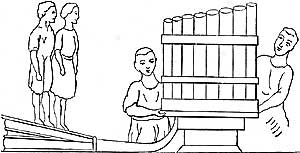
Fig. 64 in which this process is rather amusingly illustrated, is given by Dr. Rimbault, from Coussemaker's article in Didron's Annales Archeologiques. The awkward pause which must have taken place when the weight of the treaders had emptied the bellows, and before it was refilled, can be imagined. The diagonal bellows and their treaders remained in existence quite up to the end of last century.
The organ in the comparatively modem cathedral of St. Paul's, London, was blown after this fashion. It possessed four such bellows, each measuring 8 feet by 4. But other large organs had as many as eight, ten, twelve, and even fourteen. The bellows-treader used to walk leisurely along, and throw his weight upon them in rotation. To this day many of the German organs are blown by the weight of the blower's body, although the bellows themselves are of a modern form of construction. top
It would be quite unfair to the reader to leave the subject of ancient organs without saying a few words on the much discussed water-organ or hydraulic-organ, which is carefully described by Vitruvius Pollio, the celebrated architect of the Augustan aera. As explanatory drawings were not fashionable in those days, it is quite impossible to discover what his elaborate and lengthy description really describes. But there can be no doubt that the lasting popularity of water-organs was owing to the fact that, by some agency of water, the pressure of the air was equalised, and the defects just noticed as incidental to diagonal bellows remedied. Considering the natural dread which a modern organ-builder has to the approach of water to his instrument, although he is content to work a hydraulic-engine and fill his bellows at a distance, the reader may well wonder how and why ancient organ-builders courted the use of this hostile element. Assuming that the builders of water-organs were aware of that property of water which makes it, if enclosed in a small tube passing downwards and into the base of a vessel of any given area, able to exert on every portion of that area equal to itself any weight equal to that added to itself, we can, perhaps, offer some such explanation of their mechanism as the following:— Suppose two oblong reservoirs of air to be made with their tops fixed, but with movable bottoms, and joined together with a cross-bar in such a manner that the bottom of one must rise as the bottom of the other falls. Suppose also that ordinary valves are placed in the top of each, so that as the bottom rises the valves close, and the air can only escape through a passage into the box on which stand the pipes; while, on the other hand, as the bottom falls the valves drop too, and admit a fresh supply of air through their openings. Now, if enclosed water were to be admitted below the bottoms of the reservoirs with a mechanical arrangement which should not only stop the supply of compressed water when the bottom of each reservoir had reached its highest point, but also let the water escape through a waste-valve at the same time, it is not difficult to conceive of a very equal and strong supply of air being sent to the pipes as the two reservoirs were filled and emptied in turn. As long as the water continued to be pumped to the higher level, so long would the supply of air last. There is much in the account of the instrument, as given by Vitruvius, which carries out this view, but parts of his description are unquestionably somewhat figurative. In opposition to the explanation of water-organs here attempted, it may be urged that had the Romans been aware of the peculiar properties consequent on the gravity of liquids, they would never have taken the trouble to build, as they did, massive and beautiful aqueducts when a closed pipe or tube would not only have brought the water safely down into the valley, but up the other hill-side to the same level. Also, that a hydraulic-organ is sometimes spoken of as playing by itself, and how can this be made consistent with the account here given, unless the organ-blower used to be considered the real player, while the man at the pipes was looked upon as a mere nonentity? And, again, it is occasionally mentioned that these instruments were worked by hot water, and if the water were simply used to obtain a force from its special laws of gravity, why in the world need it first be boiled ?
Another explanation of the structure of a water-organ may be hazarded. If into a perfectly closed chamber of air a water-pipe is introduced, the air will, of course, be compressed in proportion to the quantity of water forced in. If pipes were placed over such a chamber, with a slider under each pipe, under the control of the player, the admission of the air from the chamber would unquestionably cause them to speak, and with two such chambers a tolerably constant supply of compressed air could be obtained, one providing this while the other was being emptied of its water.
This digression on the hydraulic organ is not altogether out of place here, as enthusiasts are not wanting who would make us believe that this instrument was among those known and used by the Jews in their Temple worship. [Chappell states that it was invented in the third century BC. See his History of Music, p. 326.] Several authors have attempted to give pictures of them, and, it is not too much to say, have seriously taxed their inventive powers in so doing. Among them may be quoted Kircher, Isaac Vossius, Perrault (Commentary on Vitruvius), and Optantianus. A rude representation of one is also to be seen on a coin of the time of Nero, preserved in the Vatican. That here given (Fig. 65) is from Hauser's Kirchen Musik, and is to be found, with much more valuable information, including the text of Vitruvius' account, in Rimbault's well-known History of the Organ. It is probably purely fanciful; the reader is therefore likely to be, after studying it carefully, as wise as he was before. top
If we turn to that nation whose careful preservation of old traditions in art renders their present customs unusually valuable —the Chinese—we are struck by a remarkable fact, namely, that the organ they use is constructed on a totally different principle to that which has grown up in Europe. It is blown by being placed against the mouth of the performer, a truly primitive method, and one which, if adhered to, must have utterly prevented any great improvements in the instrument. The player finds room to pass his hand round into the back of the instrument, and so reaches the pipes which he has to stop, for by stopping the holes, the pipes are made to speak.
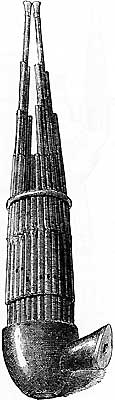
Fig.
66 represents a cheng or Chinese organ, 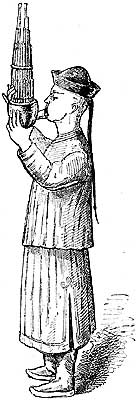 and in Fig. 67 is shown the
position in which it is held when in use.
The most important difference between
the cheng and our organ is that its sounds are produced by free reeds.
The method by which sound is produced in an ordinary reed-stop on the
organ is this: the metal tongue of the reed is rather larger than the
orifice through which the air is forced, and is slightly curved at its
extremity.
and in Fig. 67 is shown the
position in which it is held when in use.
The most important difference between
the cheng and our organ is that its sounds are produced by free reeds.
The method by which sound is produced in an ordinary reed-stop on the
organ is this: the metal tongue of the reed is rather larger than the
orifice through which the air is forced, and is slightly curved at its
extremity.
When, therefore, the current of air is directed to it the tongue is forced down over the orifice, but its own elasticity causes it to return, when the air again forces it down, and so on; the number of these backward and forward motions being of course the number of vibrations necessary to produce the particular sound required. But in the case of the free reed, the tongue is not so large as the orifice through which the air is forced; when, therefore, the current of air is directed against it, it bends, and passes through the opening, but is immediately restored to its position, as in the ordinary reed, by its own elasticity. That is to say, the tongue of the common reed beats against the opening, that of the free reed passes in and out of it.
It is almost incredible that such a simple source of obtaining sweet sounds should have remained so long unused in Europe. It is said that an organ-builder, by name Kratzenstein, of St. Petersburg, saw a cheng, and made some organ stops on this principle, about the middle of the last century. But the real value of free reeds does not seem to have been appreciated until Grenie, of Paris, in 1810, discarded the pipes and used the reeds alone, thus inventing the harmonium. Perhaps few of the many thousands who play upon this cheap and (now) sweet-toned instrument are aware that it is a true descendant of a cheng. Accordions and concertinas form the connecting link between the cheng and harmonium, as they combine the portability and free reeds of the former, with the bellows-system of the latter. The cheng contains from thirteen to twenty-one pipes, and is probably one of the oldest wind-instruments now in use. Some have gone so far as to call it "Jubal's organ," but had it been in use among the jews, it is difficult to believe that all traces of it would be lost among the nations which were in close contact and inter-communication with them, especially as it is exceedingly light and easily carried, and would therefore in all probability have been preserved by them in their wanderings and captivities. It is improbable, therefore, that the cheng, ancient as is its origin, is allied to the Hebrew ugab, and the latter was probably at the earliest times a collection of pipes of the very simplest character, but growing into more importance as from time to time improvements were made in its construction. We have seen that the Jews were not unwilling to adopt the improved form of stringed instruments which they sometimes found in neighbouring nations, and there is no special reason for supposing that in the case of the ugab no attempts were made to improve upon the form invented by Jubal. An organ, in our modern sense of the name, it hardly could have been, unless keys were invented by the ancients; but a collection of pipes it certainly was, which could be made to sound at the-will of the player, albeit, perhaps, by clumsy mechanism. In the Septuagint the word ugab has three distinct renderings— κιθάρα (cithara) in Gen.iv.21; ψαλμός (psalmus) in Job xxi.12, and xxx.31; and ὄργανον (organuum) in Ps.cl.4. That learned scholars should have ventured to translate one Hebrew word by three names of such totally different significations as "guitar," "psaltery," "organ," is a sufficient warning as to the danger of trusting to translations. In our Authorised Version it is uniformly rendered as "organ"—
Such as handle the harp and organ (Gen.iv.21); Rejoice at the sound of the organ (Job xxi.12); My harp (kinnor) also is turned to mourning, and my organ (ugab) into the voice of them that weep (Job xxx.31); Praise Him with the timbrel and organ (Ps.cl.4).
But in the Prayer-book version it is in this last passage rendered by "pipes:"
Praise Him in the strings (minnim) and pipes (ugab).
Here the word is perhaps used to express wind-instruments generally:
Praise Him with stringed instruments and wind instruments.
The German version of the Bible translates ugab in every case by "pipes" (Pfeifen).
As organs form, in our days, such an important element in the musical part of Christian worship, a few words on the probable date of their dedication to this sacred function may not be unwelcome. It is generally said that they were introduced into Church services by Pope Vitalianus in the seventh century. But on the other hand, mention is found of an organ which belonged to a church of nuns at Grado, before the year 580. This instrument has even been minutely described as having been two feet long by six inches deep, and as possessing thirty pipes, acted upon by fifteen keys or slides. It is very doubtful if they were familiar to the Romans, although an epigram of Julian the Apostate alludes to them. It seems, however, to be tolerably authenticated that one was sent by Constantine in 766 as a present to Pepin, King of France. Improvements in their construction are attributed to Pope Sylvester, who died 1003. When we reach the time of Chaucer their use must have been common, for he thus speaks in his Nonnes Preestes Tale (Nun Priest's Tale) of a crowing cock "highte chaunticlere."
His vois was merier than the mery orgon On masse dales that in the chirches gon.
The very existence of organs was imperilled in the troublous times of the Rebellion, and Puritans were no friends to their re-introduction.
Opinions differ as to the derivation of the word ugab. Buxtorf traces it to a root agabh, which signifies "to love," and therefore defines it as "instrumentum musicum, quasi amabile dictum." By another author it is derived from an Arabic root akab, "to blow." The only passages in Holy Scripture in which the ugab is mentioned are those above quoted. top
Mashrokitha or mishrokitha is the name of a musical instrument mentioned only in verses 5, 7, 10, and 15 of the 3rd chapter of Daniel. It has been described by different writers as a double flute, pan-pipes, and also an organ. As an example of the thoughtless manner in which illustrations are appended to supposed descriptions of ancient musical instruments, it may be mentioned that the figure of a magrepha, as given by Gaspar Printz (1690) has been given in a well-known work on Biblical literature as an illustration of a mishrokitha. Considering that these instruments had not only no claim to similarity of construction, but also were used by two distinct nations at an interval of about 600 years, the appropriateness of the figure of one (which by the way was in the first instance purely imaginary) as an illustration of the form of the other is, to say the least, somewhat remote. The word mashrokitha is traced to a root sharak, "to hiss" (sibilare), and as a certain amount of hissing necessarily accompanies the use of pan-pipes, the mishrokitha has been generally thought to be an instrument of that class. It is indeed rendered in the Greek by σῦρυγξ (syrinx). The fact that the Hebrew translation of mashrokitha was ugab does not go to prove that the ugab was a syrinx, as we have had sufficient doubt thrown on the trustworthiness of translators by the manifold renderings of ugab itself.