Conclusion
| HOME | contents | << | conclusion | the establishment of NT chronology |Now we have reached the end of our introduction to the New Testament. We have tried to follow a method, which in our opinion, is likely to produce relatively verifiable conclusions in relation to the documents we actually possess. This method is not the only one there is, nor is it the only one that can be applied to the materials. Its principal virtue is that it proceeds from the known to the unknown, beginning with the texts we have and proceeding to a literary analysis of them, then to historical analyses and syntheses. In the last section we come close to New Testament theology, which in our judgement is a branch of historical theology - that study of the historical manifestations of the Church's faith that lies on the borderline between church history and systematic theology. We have dealt only indirectly with New Testament theology because our aim has been primarily historical, and because to deal with the subject would require another volume.
We should perhaps set forth somewhat more fully how we regard our conclusions. This book is incomplete, as already stated, because it does not contain a full treatment of New Testament theology. It is also incomplete because the history to which it has led does not continue into the writings of the Apostolic Fathers and the Apologists and Irenaeus, to mention no others. The Christian tradition looks back to the life, death and resurrection of Jesus - the period of the Incarnation - and to the missionary work of Peter and Paul and the other disciples - the apostolic age. But the tradition, which provides the essential subject matter of church history, does not end with the deaths of the apostles. It continues into the second century, and beyond. For the Christian religion the time of Jesus and his apostles is always primary; it was then that Christianity came into existence; and the records related to this time are therefore also primary. But the records point beyond themselves
- back to Jesus and his disciples and what they did and said, and
- forward to the living communities of believers in and for which the records were written and preserved.
The records are less important than that which they record and reflect. Of them may be used the Pauline expression,
"We have this treasure in earthen vessels, to show that the transcendent power belongs to God and not to us" (II Cor.4:7, RSV).
By analogy the treasure is the gospel; the earthen vessels are the gospels and the rest of the New Testament literature.
Moreover, if the conclusions of Helmut Koester are correct - that the earlier Apostolic Fathers made use of oral tradition, not of the written gospels - these Fathers are just as reliable witnesses to the early tradition as the synoptic evangelists are. This is to say that the distinction between scripture and tradition is an artificial one. The gospels represent the crystallization of tradition in various forms; the earliest Fathers reflect the same kind of process either at the same time or only a little later. Not only can one not draw too sharp a distinction between scripture and tradition, but also one cannot differentiate too distinctly the writings of the New Testament and the writings of the Fathers, at least the earlier ones. Naturally it is possible for the tradition to become corrupted, but the criteria of corruption are more easily stated than applied. If one supposes that the "Hellenization" of Christianity involved its corruption, then one must ask what the difference is between corruption and meaningful proclamation, and one must also ask what Paul meant when he said,
"I have become all things to all men, that I might by all means save some" (I Cor.9:22).
This is to say that we regard New Testament literature as the beginning of Christian literature, New Testament history as the beginning of church history, and New Testament theology as the beginning of Christian theology. The New Testament cannot be separated from the life and thought of the Church. It reflects the beginning of the Church's existence, but this existence is a continuous one which did not come to an end with the apostolic age. It has a classical significance, but there is no reason to suppose that God's revelation is limited to the pages of the Old and New Testament or even to the events therein described. There are New Testament passages, as E. Stauffer has pointed out, which look beyond the time of the New Testament itself and speak of the continuing revelation of and by the Holy Spirit. There is more to write of Jesus than is contained in the gospels; Jesus has more to say to his disciples than they can hear now; and therefore Jesus has entrusted the Spirit to the Church, and he will lead Christians into all the truth of Christ.
Additional Note
The Establishment of New Testament Chronology
In dealing with historical method we have already insisted upon the importance of chronology as the backbone of historical understanding. But when we try to discover the chronology of the New Testament we encounter considerable difficulties. The New Testament writers were not as much concerned with chronology as we are, or as Christian writers since the middle of the second century have been. Indeed, the only real date provided in the New Testament is that which Luke gives for the coming of the Word of God to John the Baptist (Luke 3:1-2).
"In the fifteenth year of the reign of Tiberius Caesar, when Pontius Pilate was governing Judaea, Herod was tetrarch of Galilee, his brother Philip was tetrarch of the Ituraean and Trachonitic region, and Lysanias was tetrarch of Abilene, under the high priest Annas and Caiaphas. ... "
The reign of Tiberius began at the death of his predecessor Augustus on August 19th, AD 14, and his fifteenth year therefore ran from August, AD28, to August, AD29. This year fell in the period when Pontius Pilate was procurator of Judaea (AD26-36), Herod Antipas was tetrarch of Galilee and Peraca (4BC-AD39), and Herod Philip was tetrarch to the northeast (4BC - AD34). The period of Lysanias' rule is not precisely dateable, but it is irrelevant for the chronological scheme. Annas had been high priest from AD 6 to 18, when he was succeeded by his son-in-law Caiaphas (18-17); both are mentioned because Annas, whose five sons also held the office of high priest, remained extremely influential (cf. Acts 4:6; John 18:13).
The year 28-29 is therefore probably the year in which John's mission began.
Other dates are less well established. According to Matthew 2:1, Jesus was born "in the days of king Herod", and Herod's order for the killing of children at Bethlehem who were two years old or less (2:16) suggests that Matthew regards the birth as having taken place at least two years before Herod's death (4 BC.). Luke too mentions "the days of king Herod" (1:5) but associates the birth of Jesus with the taking of a census in the Roman empire.
"This census first took place when Quirinius was governing Syria" (2:2),
at the time when Judas of Galilee led an insurrection (Acts 5:37). Such a census, as Josephus makes plain, was made necessary when Judaea was placed under Roman procurators in AD 6. While Quirinius was in Syria during the period 10-7BC, he was not then governor of Syria and there is no record of a census at that time. It is possible that there was an earlier census, but unlikely that Roman tax officials could have taken one in Herod's kingdom. Apparently Luke has combined two traditions, one that, as in Matthew, placed the birth of Jesus before 4BC, the other which placed his birth in AD 6. His statement that at the beginning of Jesus' ministry he was "about thirty years old" (3:23), suggests that he favoured the former view.
The precise length of Jesus? ministry cannot be determined from the gospel materials, though the role of Pontius Pilate in the crucifixion proves that Jesus was crucified before AD 36. Moreover, the chronology of Paul's life suggests that the crucifixion took place before AD 32. It is remarkable, but true, that we encounter no attempt to give a precise date for the crucifixion before the end of the second century. Justin Martyr, writing about AD 150, says that Jesus' ministry took place about 150 years earlier. This date does not give us much help.
One of the most important dates in the first century, and one which we might hope would be of assistance in determining the dates of various New Testament materials, is that of the destruction of the temple, AD 70. Unfortunately this date does not provide as much help as we should wish to have.
(1) In the past, some gospel materials (and therefore the gospels containing the materials) have been related to the destruction of the temple in the belief that they look back to it.
- Luke 21:20-4 speaks rather precisely about a siege of Jerusalem, which will be surrounded by troops and captured. The passage seems to be a later development based on Mark 13:14-18, and scholars have therefore sometimes regarded it as a prophecy based on the event. C. H. Dodd, however, has argued that while details of the prediction in Mark are based on the book of Daniel, those in Luke are based on prophetic descriptions of the capture of Jerusalem in 586BC; the differences are due to variations in apocalyptic style, not necessarily to chronological considerations. The passage in Luke, therefore, was not necessarily written after 70.
- In John 4:21 Jesus says to the Samaritan woman, "The hour is coming when neither on this mountain nor in Jerusalem will you worship the Father." It has been supposed that this prediction is based upon the destruction of the temple; but the point of the statement is not that the temple will be destroyed but that true worship is not a matter of location. True worship is that conducted "in spirit and truth" (4:23). Therefore this passage does not necessarily have anything to do with the events of AD 70. The considerations involved are theological, not chronological.
(2) An effort has also been made to show that the Epistle to the Hebrews must have been written while the temple was still standing, for its author speaks of the work of the earthly high priest as still being performed (e.g. 5:1; 8:3; especially 10:1-2). This argument too encounters difficulties.
- Writers discussing the temple and its rites use the present tense even though they are writing long after AD 70. As examples we may cite (1) Josephus, (2) the author of I Clement, and (3) the collectors of the traditions contained in the Mishnah.
It is not absolutely certain that the temple was completely destroyed or that the rites came to an end. K. W. Clark has assembled evidence to show that the ceremonies continued to be performed well after AD 70. Therefore the use of the present tense in references to the existence of the temple or to its rites does not prove that the document in which such references occur was written either before or after 70.
On the other hand, there are some chronological anchors in the apostolic age, three of which may be mentioned here.
According to Josephus, Herod Agrippa I was made ruler of all Palestine by Claudius early in AD 41, and reigned for three more years. His death, described in Acts, therefore took place in 44.
- The famine in Claudius's reign mentioned in Acts 11:28 took place when Tiberius Alexander was procurator of Judaea, towards the end of the period 44-48; Egyptian papyri showing that the price of wheat was very high suggest that the famine began in 46 (K. S. Gapp in Harvard Theological Review, 1935).
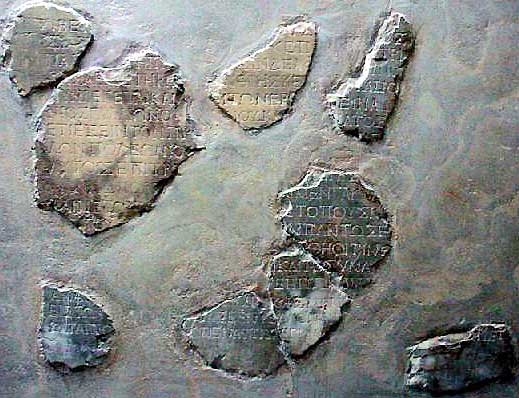
- An inscription found at Delphi gives a date for Gallio, proconsul
of Achaea when Paul was at Corinth.
It mentions his proconsulship and correlates
it with
"Claudius being Imperator for the twenty-sixth time."
Claudius was hailed as Imperator for the twenty-third and twenty-fourth times in the year 51 and for the twenty-seventh time not later than August 1st, 52. The twenty-sixth time, and Gallio's term of office (probably a year), are therefore to be dated either in 51 or in 52.