A HISTORICAL INTRODUCTION TO THE NEW TESTAMENT - Robert M. Grant - Collins ST James's Place London 1963 - Copyright: Robert M. Grant 1963 - Printed in Great Britain by Cox & Wyman Limited London, Fakenham and Reading - This edition prepared for katapi by Paul Ingram 2003 (updated 2013).
Part One: Prolegomena
Chapter 4. Literary Criticism
HOME | contents | << | literary criticism | the sentence | the paragraph | special paragraph structures| words | the question of interpolations | questions of authorship | sources
| >> |
Since the New Testament is a collection of books, these books are subject to literary analysis. Books do not just grow, but are composed by authors who have certain goals in view and follow certain methods in arranging and composing their materials. Presumably their goals can be discovered, to some extent, by considering the circumstances under which they wrote, but since (in our opinion) this kind of consideration belongs to historical criticism we refrain from discussing it at this point. Literary criticism is properly concerned with analysing the author's purposes and achievements by means of a detailed examination of the works themselves. We thus agree with what Allen Tate says of poets:
Poets, in their way, are practical men; they are interested in results. What is the poem, after it is written? That is the question. Not where it came from, or why. The Why and Where can never get beyond the guessing stage because, in the language of those who think it can, poetry cannot be brought to laboratory conditions.
To Tate's What, however, we must add (as he himself would) the question of How. In attempting to understand a literary work, we cannot simply read it; we must analyse its structure as a whole and in relation to the various parts, since the structure is an indispensable part of the author's achievement.
But we cannot begin with the work as a whole. The whole cannot be understood - even though its structure can sometimes be outlined - before the sentence units are analysed. Generally speaking, the structure of an entire New Testament book is less easily grasped than the constituent sentences are.
It may be asked why, in our search for units that can be readily understood, we do not begin with individual words. The reason for beginning with sentences lies in our understanding of the nature of New Testament language. In dealing with translations we have already pointed to a number of ways in which the meanings of individual words can be and have been illuminated. But it is our opinion that individual words, no matter how carefully investigated, cannot be understood as exactly or precisely as can the structure of a sentence, especially in an articulated language like Greek. We should claim that the proper approach to a New Testament document, while necessarily involving at least an approximation to the translation of individual words, begins with the diagramming of the sentences in such a way as to bring out the interrelations of words, phrases and clauses.
Greek writers did not simply choose to write in a patterned manner; they had to write in a patterned manner because of the nature of their language, and in order to understand them we must understand the structure within which their thought moved.
It is of course possible that by diagramming in this way one may get an over-precise interpretation of thoughts that somehow transcended the limitations of language. But it is surprising how often such writings as the Pauline epistles actually do conform to the rules of Greek sentence-structure.
top
The Sentence
There are certain features about New Testament sentences, which immediately strike the reader's eye, at least the eye that sees them diagrammed. For instance, it is obvious that many of the sayings of Jesus as reported in the synoptic gospels contain PARALLELISM, a feature also characteristic of much of the poetic language of the Old Testament. Sometimes this parallelism is SYMONYMOUS. Approximately the same meaning is expressed in two slightly different ways.
Is it lawful on the Sabbath to do good or to do harm?
to save a life or to kill?
(Mark 3:4)
If a kingdom be divided against itself,
that kingdom cannot stand;
and if a house be divided against itself,
that house cannot stand
(Mark 3:24-5).
There is nothing hid but that it should be revealed,
nor was anything made secret but that it should come to light
(Mark 4.22)
Sometimes the parallelism is ANTITHETICAL.
He who has,
it will be given to him;
and he who has not,
from him it will be taken away
(Mark 4.25).
And sometimes it is CHIASTIC (from the Greek letter chi, which looks like a cross or X).
You know that
(a) those who are thought to rule over the gentiles
lord it over them, and
(b) their great men exercise authority over them.
But it is not so among you. But
(b) whoever wishes to be great among you
shall be your servant, and
(a) whoever wishes to be first among you shall be the slave of all
(Mark 10:2-4).
The words but it is not so among you indicate that the parallel is also antithetical.
It is perhaps worth noting at this point that in the synoptic gospels such parallelism occurs only in sayings, not in comments made by the authors themselves. On the other hand, in the Gospel of John it is to be found not only in sayings of Jesus but also in what the evangelist says. Indeed, at some points it is impossible to determine whether it is the evangelist or Jesus who is speaking.
God so loved the world
that he gave his only Son
that whoever believes in him should not perish
but have eternal life.
For God sent his Son into the world
not to judge the world
but that the world should be saved through him
(John 3:16-17).
Parallelism is also common in the letters of the apostle Paul. From among the many examples we cite only a few.
He who sows sparingly
shall also reap sparingly;
and he who sows bountifully
shall also reap bountifully
(2 Cor.9.6).
All things are lawful, but not all things are expedient;
all things are lawful, but not all things edify
(1 Cor.10.23).
There are diversities of gifts,
but the same Spirit;
and there are diversities of ministrations,
yet the same Lord;
and there are diversities of operations,
but the same God ...
(1Cor.12:4-6).
Naturally Paul's style does not consist of parallelisms alone, even though he is very fond of them. In Greek, more than in Hebrew, the structure of a sentence is often controlled by the PREPOSITIONS which indicate the relations between the various nouns and verbs. By considering the sentence-structure in relation to the prepositions, the precise meaning of the sentence often becomes clear.
For us there is one God the Father
OF whom are all things and
UNTO whom are we;
and one Lord Jesus Christ,
THROUGH whom are all things and
THROUGH whom are we
(I Cor.8.6).
Who is the image of the invisible God, the firstborn of all creation; for IN him were created all things ...;
all things were created THROUGH him and UNTO him;
and he is BEFORE all things,
and all things hold together IN him
(Col.1.15-17).
Sometimes the precise relationship of the prepositions is not so clear.
Whom God set forth as an expiation
THROUGH faith
BY his blood
FOR the demonstration of his righteousness
THROUGH the remission of past sins
IN the forbearance of God;
FOR the demonstration of his righteousness
AT the present time. ...
(Rom.3:25-6).
The words translated by his blood may mean in his blood; in that case, the meaning of the sentence would be somewhat different.
top
The Paragraph
After we have looked at individual sentences we are in a position to proceed to the paragraph. Sometimes, indeed often, Paul constructs his paragraphs with great care. For example, when he is giving exact instructions to the Corinthians about eating meat he uses a structure almost legal in form.
- EAT EVERYTHING sold in the meat-market,
MAKING NO DISTINCTIONS FOR CONSCIENCE' SAKE;
for the earth is the Lord's, and the fullness thereof
(Ps.24:1).
- If any unbeliever invites you (and you wish to go),
EAT EVERYTHING set before you,
MAKING NO DISTINCTIONS FOR CONSCIENCE' SAKE.
- But if anyone says to you, 'This has been sacrificed',
do not eat,
for the sake of him who warned you and of conscience
- I mean not your own but that of your neighbour.
(1 Cor.10:25-8).
An example of a longer paragraph carefully put together occurs in 1 Corinthians 2, where a similar arrangement by sense-lines can be provided; but the most famous example is to be found in 1 Corinthians 13. Here there is a magnificent combination of repetition and variety. The passage begins with a contrast between various gifts and virtues and the supreme gift of love.
If I — and have not love, I have become —.
And if I — and — and —,
and if I —,
and have not love, I am —.
And if I — ,
and if I —, and have not love, I am —.
The second section is based primarily on verbs that indicate love's nature. First come two positive verbal statements; then a verb with a negative is followed once by the noun love, five times by negative verbal statements. A transition to the positive is made by means of an antithetical parallel, and the section ends with four verbs whose object is all things.
| (positive) | Love — , — love; |
| (negative) |
it does not — ;
love does not — (six verbs) |
| (transition) |
it does not rejoice over unrighteousness,
but it rejoices with the truth; |
| (positive) |
all things it — (four times). |
The third section describes the finality of love by means of a series of contrasts, which recall the themes of the first section.
| (contrasts) | Love never fails;
if there are — , they will be — ;
if there are — , they will — ;
if there is — , it will be — . |
| (transition) |
For we — in part and we — in part;
but when the perfect comes, the partial will be — . |
| |
|
| (an example) |
When I was a child,
I — as a child (three examples),
but when I became a man,
I put away the things of a child. |
| |
|
| (eschatological conclusion) |
Thus far we see —,
but then, — .
Thus far I know in part,
but then, — . |
| |
|
| (summary) |
Faith, hope, and love last, these three;
but the greatest of these is love. |
Some of the points can be arranged differently, but it is clear that a carefully planned arrangement does exist. To discover such structures in the New Testament writings is the primary task of exegesis. If we can understand them, we can at least begin to understand what the writers intended to say.
top
Special Paragraph Structures
In addition to the general problem of understanding sentences and paragraphs, there is also the question of particular literary forms, which Paul and others may employ. One obvious example is the salutation that we should expect to find in a letter. Less obvious is the thanksgiving, which occurs not only in the Pauline epistles (except Galatians) but also in other letters of Hellenistic, and Roman times. Such thanksgivings often set forth themes that are later taken up in the body of the letter itself. (This subject is fully discussed by Paul Schubert in his Form and Function of the Pauline Thanksgivings, 1939.) In addition, Graeco-Roman writers were well aware of the possibilities provided by the ecthesis, or carefully planned digression (1 Corinthians 13 is an example).
Sometimes literary and oral style overlap, as in the instances where Paul addresses his readers as individuals (e.g. Rom. 2:1 ff.; cf. also James 2:18 ff.) or quotes from what some of them have said or written, as in 1 Corinthians (6:12-13; perhaps 6:18b; 8:1, 4, 8; 10:23). This manner of writing, reflected also in the question, Don't you know that ... ?, is characteristic of the descriptions of the DIATRIBE or popular philosophical address developed by Cynics and Stoics. (Lists of virtues and vices, as well as brief descriptions of family duties, were also common among Graeco-Roman writers.)
A fascinating example of a special kind of paragraph occurs in 2 Corinthians 1:23-33, where Paul is reluctantly boasting to the Corinthians. As Anton Fridrichsen pointed out, this catalogue of crises finds remarkably close stylistic similarities in the descriptions of the careers of kings and other potentates which were engraved on stone or related in Graeco-Roman biographies. These descriptions, like Paul's, make use of many times and of precise numbers as well; sometimes, like Paul's, they contain brief accounts of significant episodes. The difference, of course, lies in the content. Kings list their achievements; Paul lists examples of his sufferings on behalf of Christ.
Another special kind of paragraph structure, which should be mentioned at this point, is the PARABLE, characteristic of the teaching of Jesus and that of his rabbinical contemporaries. This structure deserves notice especially because of the dogmatic assumptions associated primarily with the work of Adolf Jülicher (Die Gleichnisreden Jesu). Jülicher was trying to free the parables of Jesus from the over-interpretation that had frequently been given them in patristic and medieval exegesis. He therefore sharply differentiated allegory from parable. According to his definitions, an allegory was an artificial story intended to convey a variety of meanings; a parable was a realistic story that made one, and only one, point. Unfortunately, while his general idea is correct, not all the parables of Jesus are realistic and not all of them convey only one point. Sometimes, as also among the rabbis, allegory and parable overlap, and we are not in a position to reject those parables that seem to convey more than one meaning or, for that matter, the explanations of the parables that occur in the gospels themselves.
top
Words
We have seen that to understand the New Testament writings we must examine the literary form of sentences and paragraphs. Only after doing so can we turn to the smallest units of expression, the words. But we must remember that the meanings of words depend primarily on the function the words perform within the sentences. One might suppose that the simple connective 'kai' ordinarily translated 'and', would be easy enough to translate, or that 'kai ... kai' could always be rendered as 'both ... and'. Such is not the case. 'Kai' obviously means two different things in the following sentence. 'And ('kai') passing by the Sea of Galilee, he saw Simon and ('kai') Peter.'
(Mark 1:16) The first refers to a temporal sequence; the second, to the association of two objects of vision. Sometimes the word can bear an adversative sense ('and yet'); sometimes it is 'otiose', conveys practically no meaning, and should not be translated.
When we pass beyond this kind of word to the more difficult terms such as prepositions, we encounter the fact that both in popular Greek and in ordinary English, prepositions are fairly fluid in meaning. The Greek word 'en' can mean 'in'; it can also mean 'with', 'by', or 'to'. Its precise meaning depends on the context. And when we go on to key words like justification, redemption, salvation, grace (and others) we confront the problem of finding English equivalents (see Chapter III) and, more important, of trying to delimit the range of meanings. We have already seen some of the ways in which scholars have tried to make use of papyri and of the Septuagint, not to mention Hellenistic literature in general. Such dictionaries as those of Walter Bauer and Gerhard Kittel provide indispensable help. But they cannot give us precise definitions of any of these words. They can tell us what meanings the words seem to possess in various writings; we cannot be sure that Paul, for example, always intended to convey any of these meanings in his letters.
Often the best analogies for the meanings of words and the overtones which an author intended to convey are provided in the author's own writings. Thus Bultmann has pointed out that for Paul the verb 'pisteuo' often bears the meaning 'obey' as well as 'believe'. The author's own usage must be decisive. He was (ordinarily) the master of his own language.
top
The Question of Interpolations
Thus far we have been assuming that the documents we possess are the documents the New Testament authors wrote, in spite of the presence of a few textual difficulties. Such cases as Mark 16:9-20 and John 7:33-8:11 are exceptional. But literary critics often attempt to go beyond textual evidence and discover interpolations by using literary criteria alone. We must therefore discuss these criteria and attempt to assess the results of applying them.
Obviously the evidence provided by ancient manuscripts is of primary importance. Passages omitted by early scribes often deserve to have been omitted. On the other hand, if various manuscripts present essentially the same content but with variations in expression we cannot be certain that the passage involved is to be deleted. Probably one or another of the manuscripts has preserved the original version.
After textual criticism comes literary analysis as such. Three questions can be raised. Does the passage in question contain words or phrases alien to the rest of the author's known work? If it does, we may regard it as suspect - though we must remember that vocabularies change and that, even at one time, an author does not use all the words he knows. Closely related to this is the question as to whether or not words in the suspect passage are used in senses different from those in which the author elsewhere employs them - though this question too must be raised with caution, since authors can, after all, use one word to mean several things and several words to convey one meaning.
(1) Does the passage in question reflect the style used in other parts of the author's work? If it does not, we may suspect the presence of interpolation. On the other hand, it must be remembered that one author can write in several styles and that in antiquity those who were trained in writing were taught to imitate the styles of various models. Sometimes scholars have listed criteria for finding interpolations by criticizing the style of certain passages. They assume that such an author as John could write well, and therefore interpolations may exist where there are (a) compositional difficulties ('when, then, the Lord knew that the Pharisees had heard that Jesus was making and baptizing more disciples than John,' John 4:1), (b) contradictions ('yet Jesus himself was not baptizing; his disciples were,' 4:2), and (c) obscurities. An excellent example of obscurity occurs in John 4:43-5.
After two days he went forth from there into Galilee. For Jesus himself testified that a prophet has no honour in his own country. When, then, he came into Galilee the Galileans received him, having seen everything that he had done in Jerusalem at the feast; for they themselves had gone to the feast.
What is the sequence of ideas in this passage? Origen found it so difficult that he was sure it was meant allegorically; and he may have been right. The difficulty with these three criteria lies in the assumption that an author (a) never has compositional difficulties, (b) never contradicts himself, and (c) always writes, and intends to write, clearly. This assumption is not necessarily correct.
Literary critics sometimes pass beyond these criteria in the direction of historical criticism. They analyse documents in relation to (1) the presumed author's life and thought, (2) the known course of historical events, and (3) the assumed development of early Christian life and thought. The first of these methods can be regarded as still within the limits of literary criticism. Passages that are inconsistent with what is definitely known about an author's life or thought (as reflected in his writings) may well be regarded as interpolations. In most instances in the New Testament, however, not enough is known about these phenomena for us to be able to say with certainty what is inconsistent with them. The second and third of the methods go well beyond literary criticism. The fact that something seems unhistorical to us does not imply that it seemed unhistorical to a New Testament writer or that, for that matter, he was writing what we should regard as history. For example, it has often been assumed that the description of the last times in Mark 13 was written either before or after the fall of Jerusalem in 70 but, in any event, with closer attention to the book of Daniel than to historical events. On the other hand, the precise reference to the devastation of Jerusalem by a hostile army in Luke 21:20-4 has suggested that Luke is writing after the fall of the city. C. H. Dodd has pointed out, however, that Luke's reference may well be derived from Old Testament passages that speak of the fall of Jerusalem in 586 BC. Mark, then, is close to Daniel; Luke is close to earlier prophets, and the passage is of no use in dating his book.
As for the third method, it cannot be discussed until we have considered the idea of development as applied to early Christian history (Chapter V).
top
Questions of Authorship
In antiquity, as we have already seen when discussing the canon, questions were raised about the authorship of various New Testament books. When such questions arose, they were treated primarily in relation to the vocabulary, style and ideas of the authors involved. Thus it was claimed that Paul did not write Hebrews (Origen), that the author of I Peter did not write II Peter (Jerome), and that the author of the Fourth Gospel did not write Revelation (Dionysius of Alexandria). At this point it is enough to say that all these claims are almost certainly correct.
In modern times the range of questioning has widened, and many scholars have held that Paul did not write either Ephesians or the Pastoral Epistles, while not one of the Catholic Epistles was written by the author assigned to it. Some have also questioned the authenticity of Colossians and II Thessalonians. In addition, doubts have been vigorously expressed about the authorship of the four gospels, and of the book of Revelation as well. Interestingly enough, if we ask what remains unchallenged we find that it consists of seven Pauline epistles and (probably) of a true tradition behind the gospels. Such a view is almost the same as that advocated by Marcion in the second century. But to suggest that the view is like Marcion's does not relieve us from the responsibility of examining it.
We must therefore consider the criteria for judging authorship. They are much the same as those used in dealing with interpolations, except that the areas of investigation are wider and there is even more use of something like historical criticism.
(1) Textual criticism is not especially relevant in so far as the authorship of the document is concerned. More important is the question whether or not old and. valuable witnesses contain it. 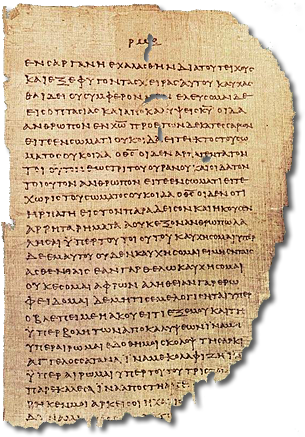 For example, the third-century Beatty papyri are fragmentary at the beginning and the end of the Pauline epistles. From what is missing at the beginning we can calculate the number of pages missing at the end, since the papyrus leaves were simply laid on top of one another and folded. There is not enough space for all the Pastoral Epistles; therefore they were not to be found in this manuscript. But an American scholar noticed that as the scribe got closer to the end of his manuscript his writing became smaller and more cramped. This point suggests that like us he was aware that he had miscalculated the number of pages he needed, and that he may well have intended to include the Pastorals. If his error was too conspicuous, he could have glued on a few additional pages.
(2) By means of literary criticism we can compare the vocabulary and style of a questioned document with similar phenomena in unquestioned documents. Thus I Peter has only a hundred words in common with II Peter, while 369 in I Peter are not in II Peter and 230 in II Peter are not in I Peter. This kind of analysis seems fairly conclusive. One author did not write the two documents. On the other hand, when we consider the relation of the Pastorals and Ephesians to the major Pauline epistles we find an anomalous situation. About a third of the words in the Pastorals do not occur in the other Pauline letters; about a sixth of those in Ephesians are similarly lacking. Admittedly the proportion of 'new' words in the Pastorals seems rather high, especially when compared with that in Ephesians. Two questions arise, however. (a) To what extent are we able to judge authenticity on this basis, when we have so few materials with which to deal? It may be that the statistical foundation is absent. (b) What proportion of 'new' words is to be regarded as acceptable? In Romans, as compared with earlier Pauline letters, about a quarter of the words are 'new'. Should we say that a quarter is just right, while a third is too much and a sixth is too little? To ask this question is to indicate the absurdity of claiming that this method gives precise results. Stylistic differences may be more significant, though it is difficult to assess their importance exactly. As we have already seen in looking at Paul, he uses different styles on different occasions. Similarly the style of Luke 1:1-4 is very different from that of the two chapters which follow, and in the book of Acts the style becomes more polished as the apostle Paul goes out into the Graeco-Roman world. Presumably the author intended to create this variation.
(3) Historical criticism has a special role to play in questions of authorship, for these questions would probably not arise were there not ancient traditions, which have come to be doubted. Historical and literary criticism thus overlap when the tradition about authorship is being examined. For instance, what Papias tells us about the literary activities of Mark and Matthew has to be considered, as well as what Justin says about the evangelists and the author of Revelation and what Irenaeus relates about the gospels, Acts and the Pauline epistles, and Revelation. Modern scholars have often been highly suspicious of these early Fathers' remarks, and have argued that they reflect inferences from the New Testament books rather than trustworthy traditions. It may be suggested, however, that even if this is the case the Fathers were not necessarily wrong; and it seems hard to deny that they could have possessed reliable information.
We conclude that while some New Testament books may have been ascribed to authors who did not write them, each case has to be considered with great care and caution. Unless highly convincing evidence can be produced against the tradition, there is no reason not to accept it.
top
Sources
Another function of literary criticism is that of determining the sources used by an author in composing his work. Admittedly this function is less important than that of analysing the meaning of the work itself. But by comparing the author's work with the source or sources he used, it is often useful to note what changes he has made, and what he has added or deleted. The discovery of sources is a more difficult process than might be supposed, for in antiquity, as H. J. Cadbury has observed, authors are accustomed not to name the sources they use, and to name sources they do not use.
There are two obvious examples of the use of sources in the New Testament. The first is provided when we find in the second chapter of II Peter a slightly revised version of the Epistle of Jude. Here the stylistic improvements suggest that II Peter is using Jude, not vice versa. The second occurs in Ephesians, much of which is so close to Colossians in content and in vocabulary as to indicate that the author of Ephesians, whether Paul or someone else, was producing a revised version of the earlier epistle. It is likely that Ephesians follows Colossians because the specific situation and specific persons involved in Colossians are lacking.
More significant source-relations are involved in the three synoptic gospels. At many points their wording is so closely similar that we must assume that one or another of the following possibilities is a probability: (1) Mark and Luke followed Matthew; (2) Matthew and Mark followed Luke; (3) Matthew and Luke followed Mark; (4) Matthew followed Mark and Luke; (5) Luke followed Matthew and Mark; or (6) Mark followed Matthew and Luke. All these solutions are possible; we shall later argue that only one of them is probable (Chapter VIII).
In this chapter we have said nothing about the matters, often regarded as belonging to literary criticism, which concern the date and the place of writing of particular documents. In our opinion these matters do not belong to literary criticism. They are concerned with temporal and spatial correlations and therefore belong to historical criticism. Literary criticism is concerned with a document as a document, with the structure of a book rather than with its historical setting or purpose. Obviously we do not intend to exclude historical understanding from our analysis. We claim, however, that literary interpretation comes first.
The primary function of literary criticism, then, is the understanding of the structure of a document and the reflection of the author's purpose as expressed by means of this structure. In the course of performing this primary function a secondary function arises. Do certain passages, or even certain books, reflect the structural procedures of a particular author? It may be necessary to exclude them as interpolations or additions if we are to understand the author's literary purpose. A similar question arises when we deal with his sources, actual and potential. Something of the structure he provides may be due to the necessity for coming to terms with his sources. The secondary function performed by interpolation-theories and source-criticism may therefore assist the critic in achieving his primary goal: the literary understanding of his materials.
top