Part Two: New Testament Literature
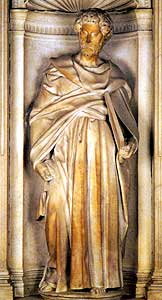
Chapter 13. The Pauline Epistles
| HOME | contents | << | the pauline epistles | the thessalonian letters | the corinthian correspondence | galatians | romans | the imprisonment epistles | was paul ever in prison at ephesus? | philippians | colossians | philemon | ephesians | additional note: gnosticism | 'gnostics' at corinth | 'gnostics' at colossae | gnosticism in the gospel of john | >> |The earliest explicit references we have to a collection of letters by Paul are to be found in other early Christian letter-collections. II Peter 3:15-16 refers to "all" Paul's letters, perhaps including the Pastorals. Ignatius of Antioch tells the Ephesians that Paul mentions them in every letter. Polycarp of Smyrna, collector of the letters of Ignatius, refers to those of Paul. Somewhat earlier, Clement of Rome certainly knows I Corinthians, and he probably knows other letters as well. We may assume that soon after Paul's death, or perhaps even in his lifetime, some of his letters were collected. One theory about this collection is that when Acts was published an admirer of Paul who had Colossians and Philemon (Colossae is not mentioned in Acts) visited the areas mentioned in Acts and found various letters which he then assembled, writing Ephesians (based on Colossians and on the other letters in the collection) to accompany them. This theory is ingenious, but it may very well be the case that small collections existed in the principal cities from which Paul wrote, such as Ephesus and Corinth, and that a larger collection was gradually built up out of these. Since Paul dictated his letters, it is perfectly possible that the recipients preserved copies at the points of origin.
The order in which, the letters stand in most of our manuscripts is not chronological but based on the length of the documents, from longest to shortest - first to communities, second to individuals. Another sequence was provided by Marcion (c. 140), who arranged the letters thus:
- Galatians,
- I-II Corinthians,
- Romans,
- I-II Thessalonians,
- Colossians,
- Philemon, Philippians,
- "Laodiceans" (Ephesians).
This sequence too is non-chronological; it seems to be based largely on the importance of the letters for Marcion's theology. Origen attempted to date the letters in relation to Paul's growing consciousness of his own perfection, but this criterion is not dependable.
The only way to give a chronological arrangement to the letters is to correlate them with the EVENTS DESCRIBED IN ACTS. On this basis, the earliest letters are I Thessalonians and II Thessalonians (perhaps addressed to Philippi), written from Corinth about AD 50. The next extant letters are I and II Corinthians, the former written from Ephesus between 52 and 55, the latter probably from Macedonia (II Cor.2.12-13) within the same period. Galatians was probably written shortly after II Corinthians, and Romans from Corinth or Ephesus a few years later. The dates assigned to Philippians, Colossians, Philemon and Ephesians depend on the place from which Paul, a prisoner, wrote them. Traditionally all four have been regarded as written from Rome, perhaps between 58 and 62. Colossians and Philemon are closely related by the mention of Onesimus, Epaphras, Mark, Aristarchus and Luke in both. The content of Ephesians is strikingly similar to that of Colossians; if genuine, it almost certainly was written at about the same time. Now according to Philemon 22, Paul hopes to be released from prison and to visit Colossae. It has therefore been suggested that the prison is not necessarily at Rome, since Paul was often imprisoned (II Cor.11.23); Acts describes a lengthy imprisonment at Caesarea, and it has been claimed that he was also a prisoner at Ephesus (II Cor.1:8-11? I Cor.15.32?). If he intended to go from Rome to Spain (Rom.15.24, 28) it is hard to see how he could plan to visit Colossae too; therefore the letters, it is claimed, were not written from Rome. Unfortunately we do not know whether or not Paul's plans to visit Spain remained fixed; he had a way of changing travel plans, as we learn from II Cor.1.15-2.13; and probably the mention of Mark and Luke (Col.4.10, 14; Philemon) means that Paul was a prisoner at Rome.
As for Philippians, the mention of the "praetorium" or "praetorian guard" in 1:13 and of "Caesar's household" in 4:22 seems at first glance to point towards Rome, but there were non-Roman Praetoria - "Herod's" at Caesarea is mentioned in Acts 23:35 - and members of Caesar's household (officials and/or slaves) were to be found in various parts of the empire. The retrospective look towards "the beginning of the gospel" (4:15) does not necessarily mean that a great deal of time has passed. Paul hopes to come to Philippi (1:26-7, 2.24); as we have already said, such a hope does not necessarily mean that Rome is excluded. Our conclusion about the origin of Philippians must be even less certain than about the other imprisonment letters. But if one has to assign a place to it, Rome is as likely as anywhere else.
Apart from simple curiosity, we may wonder why it is important to try to determine the historical sequence of the Pauline epistles. The main reason for this concern is probably to be found in the desire to reconstruct the life of Paul, thus supplementing the rather meagre data given in Acts and gaining some insight into the development, if any, of his thought. Elaborate attempts have been made to ascertain the nature of this development, especially in relation to a more or less psychological interpretation of Paul's conflicts. It has been thought that if one could trace the development, at least in the major epistles, one could then use the results in order to date the imprisonment epistles and then to trace further development. Probably, however, in view of our ignorance about Paul's early life and the occasional nature of his letters we cannot say much about such a development. If we confine our speculations to what can be said with certainty, we know only that Paul wrote to the Thessalonians from Corinth about 50, to the Corinthians from Ephesus about 52, and to the Romans, probably from Corinth, about 55.
On the other hand, consideration of Paul's style and thought can lead us to see a certain development in the ways in which various topics are handled. Subjects may be treated only briefly or incidentally in one letter and receive greater elaboration in a later one, or subjects discussed in full in one letter can be touched on only briefly when they are taken up again. Unfortunately it is often difficult to determine which way the sequence goes, since both kinds of processes are at work. Moreover, the fact that Paul seems to mention a subject for the first time in such-and-such a letter does not mean that he thought of it for the first time as he wrote the letter.
In other words, the question of development in Paul's letters and in his theology must remain a question. We can probably assume that like other human beings he did develop to some extent. But, as in the case of other human beings, the precise extent, and to some degree the direction, of this development escapes us. We can describe what Paul said with some measure of confidence. The same confidence must be lacking when we try to state why he said it.
Therefore in looking at his letters we shall probably do better to try to ascertain
- what the gospel was which he preached and
- what the nature of the controversies was in which he was engaged.
Each of these points is important. The former is the more important, for the controversies can be understood only on the basis of what Paul allusively says about them. When we try to fill in the other side of the conversation, we have the testimony only of Paul himself; and he is hardly an unprejudiced witness. Indeed, he is not really a witness. He refers to the opinions of his opponents only in order to refute them. The background of his letters in such controversies has often been studied in order to relativize the meaning of what Paul says. He presented his gospel as he did, it is argued, because of the peculiar circumstances in which he wrote. The environment therefore conditioned the response, and we who live in a different environment can now reinterpret the response, setting it free from this conditioning. But in view of our limited understanding of his environment and his opponents it is difficult to apply this principle; furthermore, he did write what he wrote, not something else. For example, he made use of the Graeco-Roman "diatribe" form in his letters. This fact does not mean that what he wrote in diatribe form is any the less his. The most important question remains, as we have said, what his gospel was and what he believed it meant for his hearers.
In attempting to discover what Paul was saying to his churches, the question of the authenticity of his letters arises. At various times, driven by a yearning for consistency, scholars have doubted the authenticity of nearly every letter, as a whole or in part. One of the principal criteria employed in dealing with this problem has been that of Pauline vocabulary. Though we admit the possibility of using this criterion, we must recognize the severe difficulties involved.
Statistics often look impressive. Thus it may seem significant that the letters of Paul, apart from the Pastorals, contain 29,000 words, of which 2,170 are different (the ratio of vocabulary to total is thus 7.5 per cent), while the Pastorals contain about 3,500 words, 900 of them different (a ratio of 25.7 per cent). The difference between the ratios is not so surprising, however, when one recalls that the longer a document is the lower the ratio will be.
Again, there are very wide variations in Paul's use of words. His usage depends primarily on his subject matter, not on some ideal norm. This fact can easily be demonstrated.
| Word | Pauline Epistles (not Pastorals) | Pastorals | Principal use | Non-use |
|---|---|---|---|---|
| Agathos (good) | 37 | 10 | Romans (21) | I Cor. |
| Hamartia (sin) | 61 | 3 | Romans (48) | II Thess., Phil. |
| Dikaiosyn (righteousness, justification) | 52 | 5 | Romans (33) | I-II Thess, Col. |
| Thanatos (death) | 47 | 0 | Romans (22) | I-II Thess., Gal., Eph. |
| Kauchasthai (boast) | 35 | 0 | II Cor. (20) | I-II Thess., Col. |
| Nomos (law) | 117 | 2 | Romans (72) | I-II Thess., II Cor.,Col. |
| Peritome (circumcision) | 29 | 1 | Romans (14) | I-II Thess., II Cor. |
| Pistos (faithful) | 16 | 17 | - | Rom., Phil. |
| Sarx (flesh) | 90 | 1 | - | - |
These examples suggest that word counting provides no adequate index to an author's total vocabulary and that this vocabulary depends, as one might expect, on the purpose or purposes for which he writes. (It might also be observed that Paul could and did write letters without mentioning sin, flesh, death, the law, and circumcision; one danger in interpreting Paul's thought arises from treating Romans, in which these terms appear, as normative.)
As for Paul's style, we have already discussed several aspects of it in Chapter III. Perhaps the single most important feature of it is its personal element. Paul uses the ordinary Greek of the Hellenistic world, with many allusions to and borrowings from the Septuagint; but he makes everything his own. He can vary his words where repetition would produce greater clarity; he can repeat where repetition results in monotony. He can work out studied sentences almost worthy of a rhetorician, or he can pile up clauses and synonyms in a completely unrhetorical way. Sometimes he breaks off the flow of a sentence intentionally; sometimes, it would appear, unintentionally. According to his own testimony, some of his correspondents found his letters "weighty and powerful" (II Cor.10.10), but others misunderstood them (I Cor.5.9-13; cf. II Peter 3:16).
The Thessalonian Letters
The two letters, which Paul wrote to his converts at Thessalonica about the year 51, are probably the earliest extant Christian documents. Marcion included both of them in his collection of Pauline epistles; their lack of definite attestation in the writings of the Apostolic Fathers and the earlier Apologists can be explained as due to these authors' lack of interest in the subjects discussed in the letters. Irenaeus quotes from both of them, sometimes as if they constituted only one letter (Adv. haer. 4, 27, 4), but sometimes clearly recognizing that there are two (3,7,2; see also the Muratorian list). No one in antiquity seems to have questioned their canonicity or authenticity, although when Origen laid emphasis on the role of Silvanus in their composition he may have been suggesting that the apocalyptic eschatology was not due to Paul.
The style of these letters is characteristic of the Pauline epistles as a whole, as B. Rigaux has shown. Paul is fond of parallelism, often chiastic, and frequently employs antithesis (eighteen times in the two short letters). He makes plays on words. He likes to use long phrases, bound together by participles or prepositions.
Because of the brevity of the letters and the special nature of their subject matter, it is difficult to lay much emphasis on the peculiarities of the vocabulary of the letters. It is worth noting, however, that the following words are absent from both I and II Thessalonians: "dikaiosyne", "thanatos", "kauchasthai", "nomos", "peritome" and "sarx"; "hamartia" is also absent from II Thessalonians. The two letters were addressed by Paul, Silvanus and Timothy to the Christian community at Thessalonica in Macedonia, the second church founded by the apostle after he crossed from Troas on his mission journey after the apostolic council (Acts 17: 1-9). I Thessalonians was written after Paul had visited Athens alone (3.1; Acts 17:14-16) and had then been joined at Corinth (Acts 18:5) by Timothy and Silvanus (I Thess.3.6, Timothy). Paul reminds the Thessalonians of their conversion (1:9-10):
"how you turned to God from idols, to serve a living and true God, and to wait for his Son from heaven, whom he raised from the dead, Jesus who delivers us from the wrath to come."
In these words we find a summary of the apostolic message to gentiles. It corresponds with the fragmentary sermons in Acts 14:15-17 and 17:22-31 (cf. also Rom.1.18-2.24) and supplements the description of Paul's argument in the synagogue at Thessalonica.
(Acts 17:3: "It was necessary for the Christ to suffer and to rise from the dead; this Jesus, whom I proclaim to you, is the Christ").
The community seems to be largely gentile, for Paul tells its members that they have suffered the same things from their own countrymen as the churches in Judaea have suffered from the Jews (2:14). He finds it necessary to remind them to avoid fornication and, instead, to marry (4:3-8); they must not be idle but must work (4:9-12). They must not worry about the fate of believers who die, for when the Lord descends from heaven both the dead and the living will rise to meet him in the air, "and so we shall always be with the Lord" (4:13-18). The precise time of his coming cannot be predicted, but he will come
"May the God of peace himself sanctify you wholly; and may your spirit and soul and body be kept sound and blameless at the coming of our Lord Jesus Christ" (5:23).
It is not absolutely certain that all of Paul's counsel is based on what he knows about the Thessalonian church. Generally speaking, he seems well pleased with the Thessalonian Christians (1:2-10; 2:13-20; 3:6-10; 4:1, 9-12 5:1, 11). And some of the passages, which might suggest the presence of problems, can be explained as reflections of real problems, which Paul was facing not in relation to Thessalonica, but in relation to Corinth. It was there that difficulties arose over fornication (I Cor.6.12-20) and marriage (7:1-7). On the other hand, his urging the Thessalonians to work with their hands (4:11) seems to be related to their preoccupation with eschatological matters (4:13-5:11). This was not, as far as we know, a problem at Corinth. The central concern of I Thessalonians, then, arises from the acceptance of Paul's proclamation of the imminent coming of the Lord. The Thessalonians were waiting for the coming of Jesus, who delivers us from the wrath to come, and not all of them were devoting enough attention to the matter of their sanctification in the time before his coming (3:13-4:12; 4:5-24).
II Thessalonians deals with a subject closely related to this. The Lord Jesus will be
"revealed from heaven with his mighty angels in flaming fire, inflicting vengeance upon those who do not know God and upon those who do not obey the gospel of our Lord Jesus" (1:7-8);
at that time
"the lawless one will be revealed, and the Lord Jesus will slay him with the breath of his mouth and destroy him by his appearing and his coming" (2:8).
But these events will not take place in the immediate future. Something (the law and order provided by the Roman empire, according to some patristic commentators) is holding back the eschatological clock; for before the Lord?s coming
"the man of lawlessness, the son of perdition"
must be revealed and must take his seat in the temple of God, proclaiming himself to be God (2:3-4). If Paul is relying on Jewish apocalyptic ideas, they may have been shaped by events in Palestine a decade earlier, when Caligula's attempt to place his own statue in the temple at Jerusalem was thwarted by the Roman governor of Syria and by other Roman officials.
One problem mentioned in I Thessalonians, has become even more acute. Here Paul explicitly points out that Christians ought to imitate his example by hard work.
"Even when we were with you, we gave you this command: If any one will not work, let him not eat" (3:6-13).
Once more, the Thessalonians' idleness seems to be related to their misunderstanding of eschatology.
They have learned, "either by spirit or by word, or by letter purporting to be from us", that "the day of the Lord has already come" (2:2).
Perhaps because of the existence of forged letters, Paul concludes the letter in his own handwriting.
"This is the mark in every letter of mine; it is the way I write" (3:17; cf. I Cor.16.21; Gal.6.11).
Critics have sometimes argued that II Thessalonians was not written by Paul, chiefly because of the detailed eschatological time-table which is absent from other letters but also because it is difficult to see why Paul was writing two letters, with much the same content, to the same community (perhaps to Jewish members) in approximately the same situation. These difficulties do not seem insuperable. The function of historical analysis is not to show why a document should not be regarded as genuine but to accept it and try to understand its situation. Paul may have wished to reiterate what he had said before; II Thessalonians may have preceded I Thessalonians, in any event. Another possibility, suggested by E. Schweizer, is that II Thessalonians was not originally addressed to the Thessalonians. Polycarp, writing to the Philippians early in the second century, refers to letters (plural), which Paul had written them (Phil. 3:2) and, in alluding to this correspondence, seems to quote some words from II Thess.1.4 (11:3).
The Corinthian Correspondence
In our canon, as in all the ancient manuscripts of the New Testament, there are two letters from Paul to the Corinthian church. I Corinthians is better attested than II Corinthians, presumably because it is the more practical of the two; Clement of Rome refers to it and uses it, while allusions in the letters of Ignatius prove that he knew it. In later times there was no question about either letter; both were in Marcion's collection; allusions to both occur in Theophilus of Antioch, and quotations from both in Irenaeus. Most of Irenaeus's quotations are made in a manner that suggests that he knew the two as one, but this point is not especially significant when we recall that he sometimes treats the Thessalonian letters in the same way. The contemporary Muratorian fragment clearly recognizes two letters.
It is sometimes supposed, however, that the two letters we have are the result of an editing process, which produced two letters out of a number considerably larger.
The primary grounds for this view are to be found in II Corinthians. II Corinthians 6:14-7: 1 has nothing to do with its context (and indeed is close to the thought world of Qumran ; it might well come from the "previous letter" to which reference is made in I Corinthians 5:9. It is psychologically difficult to regard Paul's violent "boasting" in II Corinthians 10-13 as coming directly after his emphasis on reconciliation and joy in II Corinthians 1-9.
It is strange that after speaking about the collection for the saints in II Corinthians 8, Paul should go on to state that he need not mention it to his correspondents (9:1).
For these reasons and other subsidiary ones J. Weiss and others have proposed to split up not only II Corinthians but also I Corinthians into different units. Thus Weiss argued that one letter consisted of II Cor.6.14-7.1 and I Cor.9.24-10.22; 6.12-20; 11.2-34; 15; and 16.13-24. Another was made up of I Cor.1.1-6.11; 7.1- 9.23; 10.23-11.1; 12-14; and 16.1-12. Before letting ourselves be overcome by enthusiasm for this kind of procedure, we might recall that in his youth Weiss gave the same kind of treatment to the letter of Barnabas (1888). Among students of the Apostolic Fathers, perhaps less receptive to novelty than New Testament critics, his theory met with no endorsement. Removing inconsistencies by slicing up documents is a fascinating task, but it rarely produces convincing results, especially in dealing with an author whose correspondents regarded him as inconsistent. It may be worth noting that an inconsistency remains in Weiss's second letter. In I Corinthians 4:19 Paul says that he is coming to Corinth very soon. In 16:5-9 he is planning to linger at Ephesus. He has taken care of one real difficulty, for in I Corinthians 11, women may pray or prophesy if they wear veils, whereas in 14:33-5 they are not to speak in church at all. But the inconsistency would remain in any case, if the Corinthians took Paul's letters seriously enough to preserve them.
As for the breaking up of II Corinthians, it is fashionable to deride "psychological explanations" of the transition from 1-9 to 10:13 - as if the rearrangement of these chapters, with 1-9 following 10-13, were not also based on psychological grounds! It seems perfectly reasonable to maintain that there is a break between the two sections, and that after the receipt of bad news from Corinth the bitter tone of 10-13 is due precisely to reaction from the warmth and friendliness of 1-9.
For these reasons we prefer to treat the letters as they now stand, regarding only II Cor.6.14-7.1 as a possible interpolation. It is undeniable that these two are only a part of the complete correspondence between Paul and the Corinthian church. First, there was a letter, now lost, from Paul to the Corinthians (I Cor.5.9); then there was a letter from them to him (7:1); his reply is I Corinthians. In II Corinthians 2:3 and 7:8 we find references to an earlier letter, identical with none of those already mentioned; finally there is II Corinthians itself. (The apocryphal correspondence between Paul and the Corinthians, published in 1958 from a Greek papyrus of the third century, has no claim to authenticity.)
Some interesting conclusions can be drawn from the vocabulary of the Corinthian letters. The conclusions are more negative than positive. For if one takes the words of which Paul is generally fondest and examines instances in which they occur more frequently in the Corinthian letters than anywhere else, it will still be found that in view of the length of these letters they do not occur a disproportionate number of times. There are only four exceptions to this rule: about half the Pauline occurrences of "hekastos" ("each one"), "kauchasthai" ("boast"), and "soma" ("body") are to be found in I Corinthians, and forty per cent of the examples of "parakalein" ("exhort") in II Corinthians. It is significant that the word "agathos" ("good") is absent from I Corinthians, the word "dikaios" ("just or righteous") from both letters. Related words such as the noun "dikaiosyne" and the verb "dikaioun" are very rare in either. Paul could hardly speak much about "justification by faith" to this congregation. Neither the Law nor circumcision is mentioned in II Corinthians.
Four words with which the Corinthians seem to have been especially concerned were apparently picked up by Paul: "anakrinein" ("discern"), used only in I Corinthians; the adjective "pneumatikos" ("spiritual"), used fourteen times in I Corinthians, elsewhere in Paul only nine times; "pneumatikos" ("spiritually"), only in I Corinthians; and "syneidesis" ("conscience"),used eleven times in I-II Corinthians, elsewhere only three times in Romans. He may also have derived the word "physis" ("nature") from his opponents.
The style of I Corinthians and, to a lesser degree, that of II Corinthians reflects Paul's endeavour to give spiritual direction to an unruly congregation. Nowhere else does he repeat words and phrases so often; nowhere else does he make so much use of the kinds of personal argument characteristic of the Cynic-Stoic moral address. Only in I Corinthians (but cf. Col.1:15-20) do we find a carefully worked out depiction of a theme such as Christian love.
The letter begins with a severe criticism of the Corinthians' claim to "wisdom" and their consequent self-exaltation, which has led to divisions in the community (1-4). The true wisdom, given by God, is to be found only in the crucified Christ; the life of his apostles is marked by service and suffering, not by royal rule in the present age. It would appear that the Corinthians, like some of the Thessalonians, have wrongly supposed that the reign of God is already fully realized.
After this general introduction to the letter, Paul turns to specific problems in the community, dealing with all of them in relation to theological principles, but at the same time giving specific commands to his readers. These problems are related to sexual behaviour (5-7), to dietary regulations (8-10), to Christian worship (11-14), to the question of future resurrection (15), and to practical matters (16).
The "regulatory" nature of much of the letter can be seen in what Paul explicitly prescribes:
- A man who lives with his stepmother is to be excommunicated; no Christian can eat with him (5:1-5, 11).
- Disputes among Christians are not to be brought before pagan courts (6:1, 5).
- Union with a prostitute is a sin against Christ (6:15-19).
- Celibacy is preferable to marriage, but (a) husband and wife have mutual sexual responsibilities (7:3-5); (b) if Christian partners separate, neither can remarry (7:10-11); (c) religious differences are not grounds for divorce (7:12-14); (d) non-Christians may separate from Christians, but Christians must try to preserve the marriage (7:16); (e) unmarried persons should remain single but can marry (7:25-38); (f) widows should remain single but can marry Christians (7:39-40).
- Meats offered to idols present a problem. (a) Eating them in a temple is forbidden (8:10-13); (b) buying them in a meat-market is permitted (10:25-6); (c) eating them in a pagan household is permitted (10:27), unless the guest is told that they are sacrificial (10:28).
- Men must not wear head-coverings in church, while women must do so (11:4-5).
- The common meal must be common: all are to eat at the same time (11:33).
- Worship must be orderly. (a) No more than three persons may speak in tongues, and an interpreter must be present (14:27); (b) no more than three persons may prophesy, and if someone else receives a revelation the man who is speaking must stop (14:29-30); (c) women are not to speak in church, even to ask questions (4:34-5).
- Christians are to set aside money weekly for Jerusalem (16:1-4).
- They are to be subject to such leaders as Stephanas (16:15-16).
These regulations do not, of course, constitute the whole of the letter. In chapters 8-10 Paul presents a full discussion of the relation between freedom and responsibility. In 11 he recalls what the Lord Jesus did and said at the Last Supper; in 12 he analyses the relation of the body's members to one another; in 13 he speaks of the meaning of love; and in 15 he sets forth the meaning of resurrection. But in order to understand the letter we cannot neglect the practical elements in favour of the more theoretical.
II Corinthians also arises out of a crisis in Paul's relationship with the Corinthian community. In I Corinthians 4:19 (modified by 16:5-9) he had promised to visit Corinth in the near future, but he had been unable to do so. II Corinthians 1 -7 (except for 6:14-7:1) therefore deals with the Corinthians' complaint about his lack of reliability and passes on to a full discussion of the Christian ministry as a ministry of reconciliation. Chapters 8 and 9 are concerned with the necessity and indispensability of the collection for the saints. At this point, we may assume, Paul received further bad news from or about Corinth, and he therefore launched into the bitter "boasting" which marks most of chapters 10-13 (though the bitterness diminishes towards the end). These chapters are more personal than any other passages in the epistles, even such epistles as Galatians and Philippians. They may even corroborate the accusation that "his letters are weighty and strong, but his bodily presence is weak and his speech contemptible" (10:10).
Galatians
This letter was known to, and used by, Ignatius of Antioch, early in the second century. It was included in Marcion's collection and was used by the church writers of the late second century. There has never been any valid question about its genuineness or canonicity; indeed, the opposite problem has been more important, since some theologians like Marcion have treated it with Romans as the key to all of Paul's thought. In some ways it is quite unrepresentative. For instance, the word "pistis" ("faith") occurs twenty-two times (forty times in Romans), while in the much longer Corinthian correspondence it is found only fourteen times. The noun "agapi" ("love") occurs only three times, and the cognate verb twice. The word "soma" ("body"), used forty-six times in I Corinthians, occurs only once, in reference to Paul's own body. Nowhere else in Paul's letters is an introductory thanksgiving lacking.
In modern times the question of the addressees of the letter has often been discussed, chiefly because scholars have realized that if they could be located in "south Galatia" the letter could be dated earlier than the other Pauline epistles, and the conference described in Galatians 2:1-10 could be placed before the apostolic council of Acts 15, not identified with it. It should probably be said, however, that parallels between Galatians and both II Corinthians and Romans suggest that the letter belongs with them, not at a point before I-II Thessalonians.
Galatia was a region in central Asia Minor, named after the roving Celts (Galatai) who settled there during the Hellenistic period. A Roman province, created in 25 BC, included both the region around the capital, Ancyra, and various areas to the south, apparently including Lycaonia, Phrygia and Pisidia. Paul visited both areas, first that to the south (Acts 13-14; 16:1-5), later that more towards the north (16:6; 18:23). In his general letter to "the churches of Galatia" (Gal.1:2) he says that bodily illness had led to his preaching there - either "originally" or "formerly" or "on the first of two visits" (4:13). Since in Acts we find two visits both to north and to south Galatia, and since (in any event) the word in Galatians probably does not imply two visits, Acts does not assist us in locating these churches. It should probably be said, however, that the people addressed as "Galatians" (3:1) are probably not to be identified with those who, according to Acts 14:11, continued to speak in a local language, Lycaonian. The reference to the work of the Holy Spirit in Acts 16:6 may well be a theological expression of one aspect of Paul's illness. We conclude that the letter was addressed to a group of communities near Ancyra.
These communities were composed of gentiles (4:8; 5:2; 6:12-13). Into them had come men who preached Judaism under the guise of Christianity, urging the Galatians to accept circumcision, though without the observance of the whole Jewish law (6:13; 5:3). They advocated keeping the special days, months, seasons and years of the Jewish calendar (4:10). Apparently they told the Galatians that Paul owed his apostolate to the Jerusalem church (cf. 1:1); they claimed that he himself had encouraged circumcision (5:11; cf. 2:3), and that he modified his message in relation to the circumstances (1:10). They themselves were now presenting the complete gospel (3:3). In consequence, many of the Galatians were "anxious to be under the law" (4:21) and had begun the programme of "liturgical enrichment".
Paul militantly criticizes his opponents' point of view, as well as that of their dupes. Leaving out his customary expression of thanksgiving, he proceeds to deny that either his Apostolate or his gospel came through any human agency; both were given him by God the Father and by Jesus Christ. He had hardly any contact with the church of Jerusalem and its "pillars" (James the Lord's brother, Cephas [Peter] and John) simply recognized the authenticity of his divine commission (1:11 - 2:10). When Cephas was at Antioch, Paul resisted his attempts to compromise with Judaism (2:11-14). Justification before God comes not from observing the law but from believing in Christ Jesus (2:15-21).
He next proceeds to give arguments based on the Old Testament, on analogies related to it, on personal experience (both theirs and his), and on allegory derived from the Old Testament - all to show that the law cannot justify and that justification comes only from faith (3:1 - 5:12). Here the figure of Abraham, already significant in Hellenistic Jewish preaching to gentiles, assumes a prominent role.
After this he addresses not a group of libertine Gnostics but the whole congregation, reminding them that in spite of their freedom from law they must walk in conformity with the Spirit and bring forth its "fruits". There is no reason to suppose that such moral counsel could be given only to Antinomians (5:13-6:10).
Paul's conclusion, written in his own hand (the rest of the letter was therefore dictated), recapitulates his earlier statements and reminds the Galatians that
"circumcision is nothing; uncircumcision is nothing; the only thing that counts is new creation" (6:15, NEB).
Romans
Romans, a letter written to a congregation which Paul had never visited (though he was now eager to do so), is the longest of the Pauline epistles, though not much longer than I Corinthians (7,100 words against 6,800). It thus constitutes about twenty-five per cent of the total of Paul's letters. None of his favourite words is absent from it. Because of its length, statistics on vocabulary have more validity than they usually do, and we use them to suggest that the emphases of Romans are not entirely characteristic of Paul's thought.
| Word | Pauline epistles (not Pastorals) | Romans | (Per cent) | Non-use |
|---|---|---|---|---|
| Agathos (good) | 37 | 21 | 57 | I Cor. |
| Harmartia (sin) | 61 | 48 | 75 | II Thess., Phil. |
| Dikaios (just) | 14 | 7 | 50 | I-lI Cor. |
| Dikaiosyne (righteousness, justification) | 52 | 33 | 63 | I-lI Thess., Col. |
| Dikaioun (justify) | 25 | 15 | 60 | I-Il Thess., II Cor., Phil., Col., Eph. |
| Dikaioma (justification) | 5 | 5 | 100 | all epistles |
| Dikaiosis (justification) | 2 | 2 | 100 | all epistles |
| Zoe (life) | 29 | 14 | 50 | I-Il Thess. |
| Nomos (law) | 117 | 72 | 61 | I-Il Thess., II Cor., Col. |
| Peritomi (circumcision) | 29 | 14 | 50 | I-Il Thess., II Cor. |
| Pistis (faith) | 109 | 40 | 37 | no epistles |
| Sarx (flesh) | 90 | 26 | 30 | I-Il Thess. |
We can hardly deny that Paul's vocabulary may have been enriched after the time when he wrote to the Thessalonians; but his emphasis on sin, justification, law and circumcision in Romans does not necessarily represent the full range of his thought.
Some indication of the place of Romans in the sequence of Paul's letters is given by
- his statement that he has long been eager to visit the Roman church (1:10-15),
- his declaration that he has preached the gospel "as far round as Illyricum" (east coast of the Adriatic, 15:19),
- his intention of going to Jerusalem with the contribution made by the churches of Macedonia and Achaea (15:25-6), and
- his commendation of Phoebe, "a deaconess of the church at Cenchreae" (one of the ports of Corinth, 16:1).
These points would suggest that the letter was written from Greece as Paul was about to set sail for Syria (Acts 20:3). The last of them, however, must be regarded as uncertain because of the textual problem in the last chapter or chapters of the letter.
This problem arises when we consider the doxology with which the letter ends in the oldest uncial manuscripts and in Origen (16:25-7). Origen himself mentions manuscripts in which it was found not at the end of the letter but after 14:23, and there it occurs in the later uncials and minuscules. Codex Alexandrinus and another uncial place it both after 14:23 and at the end of the letter. On the other hand, Marcion left it out entirely, as did the scribe of the ninth-century codex G, while in the third-century Beatty papyrus it is found after 15:33. In other words, it occurs at the end of the fourteenth, fifteenth and sixteenth chapters. In consequence, scholars have sometimes supposed that it should come at the end of the fifteenth chapter (it makes no sense at the end of the fourteenth), and that the sixteenth chapter, consisting largely of greetings and admonitions, really belongs to another letter and was wrongly combined with Romans. The combination can be explained as due to the reference to Phoebe of Cenchreae. Since on other grounds the whole letter seemed to fit the situation described in Acts 20:3, the sixteenth chapter was attached to it because Cenchreae was mentioned. On the other hand, it can be argued that the doxology is a later interpolation - as its wanderings would suggest - and that there is no particular reason to regard the sixteenth chapter as an addition. Indeed, Paul did not have to be at Cenchreae when he recommended Phoebe. The mention of Timothy, Lucius, Sosipatros (Sopater) and Gaius in Romans 16:21-3 suggests that they belong to the group mentioned in Acts 20:4. Jason of Thessalonica is mentioned in Acts 17:5-9; Erastus, in Acts 19.22. According to Acts 19.29, Gaius was a Macedonian who accompanied Paul; Erastus was another helper who was in Macedonia. From these details we should judge it likely that Romans was written not from Greece but from Macedonia, perhaps specifically from Philippi - or perhaps across the Aegean Sea, from Troas (Acts 20:6 - since Lucius is with Paul).
More important than the precise setting of the letter is its content. It was addressed to a community that Paul had never visited, although he was evidently acquainted with many of its members (Rom. 16:3-15). The most obvious purposes of the letter are
- to set forth the gospel as Paul preached it (1:15-17), especially in regard to the relationship between Jewish and gentile Christians, and
- to obtain the aid of the Roman church in supporting a missionary journey to Spain (15:24,28-9).
Of these the former is much the more important. Paul is eager to set forth the position he has reached in consequence of his struggles with opponents at Corinth (II Corinthians) and in Galatia. For this reason, themes that were treated only partially or allusively in the earlier letters are given a fuller and more careful treatment in Romans. As usual, no doubt, Paul made use of materials that he had employed earlier. For example, the treatment of the just wrath of God in Romans 1:18-2:24 is a development of something only alluded to in I Thessalonians 1:9-10. The discussion of Abraham in Romans 4 is a more elaborate version of Galatians 3:6-16 (compare also Rom.7.13-25 with Gal.5.17; Rom.13.8-10 with Gal.5.14); and the statement about life in the Church in Romans 12:3-21 summarizes various sections of I Corinthians (6:1-1; 12:4-13:13).
The letter begins with a proclamation of the universal justice of God (1:1-17) in the face of the universality of sin and guilt (1:18 - 3:20). God has now demonstrated his righteousness through the sacrifice of Christ (3:21-31), in fulfilment of the promise made to Abraham (4) on behalf of sinners, descendants of Adam (5), who die in baptism so that they may be raised with Christ (6). God changes the human situation of inner conflict (7) through the gift of life in the Spirit (8). But is God then unjust in regard to the Jewish people as a whole? No, they have trespassed but only temporarily; when all the gentiles have been saved, all Israel will be saved too (9-11). Because of God's gift of the Spirit, men are bound to live together in love, in obedience to the state, and in tolerance of varying opinions (12 -15:13). The letter ends with personal notes and admonitions (15:14- 16:23).
Sometimes Romans has been viewed as a kind of Summa of Paul's theology. Such a view is in part mistaken, since he has in mind the specific problem of the relations between Jews and gentiles (not only in Rom.9-11, but also throughout the letter). It is more largely correct, since Romans gathers up the themes of many earlier letters and presents the mature thought of Paul, concentrated upon a single but crucial problem. The letter has stimulated some of the greatest theologians of the Church towards systematic interpretation of the apostle's insights.
The Imprisonment Epistles
Four of the letters in the Pauline collection were written when Paul was in prison; these are Philippians, Colossians, Philemon, and Ephesians.
(1) According to Philippians 1:13,
"it has come to be recognized by the whole Praetorian Guard and by all the others that if I am in fetters it is because of my activities as a Christian" (Beare).
The expression "by the whole Praetorian Guard" is literally "in the whole praetorium"; the New English Bible gives as alternatives "to all at headquarters here" or "to all at the Residency". There were praetoria in places other than Rome - for example, at Jerusalem (Mark 15:16 and parallels) and at Caesarea (Acts 23:35). Some ancient commentators suggested that Paul was referring to Nero's palace on the Palatine hill. By itself, the expression does not show whether Paul was in Rome or in some provincial capital. Again, in Philippians 4:22 Paul speaks of the greetings sent by Christians who belonged to "Caesar's household". This phrase is used of
"persons employed in the domestic and administrative establishment of the Emperor" (Beare).
Like the mention of the praetorium, this reference does not absolutely prove that Paul was in Rome. Imperial employees were found throughout the Empire. From these two passages it can be concluded that Paul was a prisoner either at Rome or at Caesarea (proof that he was ever a prisoner at Ephesus has not been provided). To be sure, Paul says that he hopes to come to see the Philippians after his release (2:24), whereas according to Romans 15:24, 28, he expected to go from Jerusalem through Rome to Spain. But his hopes expressed in Romans should not be treated as expressions of the decrees of fate or providence. We should hold (with Beare) that there is no reason to reject the second-century tradition (he calls it "hypothesis") that Philippians was written at Rome.
(2) Colossians too was clearly written from prison 4:3, 10, 18), as was the little letter to Philemon (1, 9, 10, 13, 23). Where was this prison? Nothing in either letter clearly indicates its location; therefore we must rely upon inferences from what we can find in the letters. First it should be said that the letters are clearly addressed to the same location at the same time; in other words, Philemon was a Colossian Christian. Second, the situation in which Paul writes is the same; in both letters we find mention of Paul's companions Timothy, Aristarchus, Mark, Epaphras, Luke, and Demas - though in Colossians only Aristarchus, and in Philemon only Epaphras, is called a "fellow-captive" with Paul. The circumstances that caused Paul to write to Philemon may shed some light on the situation. Onesimus was a slave belonging to Philemon; he had run away to Paul in prison, and Paul sent him back to his master after converting him to Christianity (cf. Col.4.9). It has been argued that Paul was more likely to have encountered Onesimus at Ephesus, roughly a hundred miles from Colossae, than at Rome, perhaps ten times as far away. But this kind of argument, based on what may be called "geophysical probability", is not convincing when one is dealing with the actions of individuals. It might equally well be said that a runaway Colossian slave could much more easily lose himself at Rome than at Ephesus. The fact that in Colossians Paul also refers to correspondence with Laodicea, another town in the Lycus valley of Asia Minor, does not prove that the letters came from nearby Ephesus. Economy of effort is not a good criterion for judging what an early Christian, or a human being, might or might not do.
We know from Acts that Aristarchus was at Ephesus with Paul (19:29), while Timothy was not (19:22). We also know that Aristarchus and the author of the "we-passages" (whom we take to be Luke) went with Paul to Italy (27:2). We therefore assume that the prison from which Paul wrote was in Rome. Secondary confirmation for this view is provided by the mention of Mark, the cousin of Barnabas (Col.4.10), and his identification in early tradition with the interpreter of Peter at Rome (Papias; cf. I Pet.5.13).
(3) Ephesians poses a somewhat more difficult problem. Like the other letters we have mentioned, Ephesians was written from prison (3:1; 4:1; 6:19). As we shall see, Ephesians is hard to date and to place. A good deal of its contents is closely parallel to Colossians, so much so that it has sometimes been regarded as a revised version of that letter. At the same time, it reflects a somewhat different situation and indeed, according to the oldest witnesses to its text, is not addressed to Ephesus. The question whether it was written by Paul or not will be discussed later. Here we need only say that if it was, it came from the same prison as that in which Colossians was written.
In conclusion, we should say only that in our opinion the traditional claim that Philippians, Colossians and Philemon (and perhaps Ephesians) were written at Rome deserves to be accepted.
Was Paul Ever in Prison at Ephesus?
The modern conjecture that Paul was imprisoned for a time at Ephesus deserves some consideration because of its possible bearing on the circumstances of the imprisonment letters. In so far as this conjecture is not based upon the second-century romance called the Acts of Paul, in which Paul meets a friendly and talkative lion in the arena at Ephesus only to be reminded that he had once baptised the beast, it depends on obscure statements in the Corinthian letters and on the fact that not everything Paul did is recorded in Acts.
It may readily be agreed that Acts has many omissions, especially evident when one compares its account with Paul's own list of events in II Corinthians 11:23 -5. To say this, however, is not to admit that since Acts does not record an Ephesian imprisonment one therefore existed. In II Corinthians 11:23 Paul says that he has been imprisoned more often than his opponents; but we do not know how often they had been imprisoned. In I Corinthians 15:32 Paul seems to say that kata anthropon he has fought with wild beasts at Ephesus; the best parallels to this use of kata anthropon are probably provided in I Corinthians 9:8 and Galatians 3:15, where it indicates that Paul is using metaphorical language. The chief arguments against taking the expression literally are
- that Roman citizens were not liable to this kind of punishment, and
- that those who were did not often survive it.
On the other hand, Paul does speak of serious trouble, which came upon him in Asia (Minor); he felt inwardly that he had received a death sentence; but God delivered him from the peril of death (II Cor.1.8-10). It is clear that he has something extraordinarily serious in view. But it is not clear that he has imprisonment in mind, and had he been condemned "to the beasts" he would not say that the death sentence was "in himself" or "known inwardly". We conclude that since so little positive evidence is available for the Ephesian-imprisonment hypothesis it cannot be used in dealing with the Pauline letters.
Philippians
This letter was almost certainly known to Polycarp. Marcion accepted it. And while only allusions to it occur in Theophilus, explicit quotations are given by Irenaeus and by later writers. Apparently there was never any question as to its canonical authority, and it is found in the Beatty papyri and in later manuscripts.
Philippians contains 1,625 words and employs a vocabulary of 448 words, forty-one of which are not found elsewhere in the New Testament. Only three "double compounds" occur in the letter: "apekdechesthai", "to expect" (also in I Corinthians, Galatians, and Romans); "exanastasis", "resurrection"; and "epekteinesthai", "to reach out for". All three are found in the third chapter.
It has sometimes been argued that Philippians is not a unity but consists of two letters (4:10-20; 1:1-3:1, 4:2-9, 21-3), the second of them interpolated (3:2-4:1). Admittedly there is a break between 3:1 and 3:2, and it is possible, as it is in II Corinthians, that the letter we now possess is actually a compilation made from various Pauline materials preserved at Philippi or, less probably, at Rome. If with NEB we translate 3:1b as
"to repeat what I have written to you before is no trouble to me, and it is a safeguard for you",
there is some transition between 3:1 and 2, and Paul may well be referring to an earlier letter now lost. It is also argued that since the Philippians' messenger, Epaphroditus, fell sick after delivering their gift to Paul (2:26-8), Paul cannot have waited for him to recover before expressing his thanks to the Philippians; therefore 4:10-20 must have been written earlier than the rest of Philippians. Since Rome was 800 miles from Philippi, and news about Epaphroditus's illness had gone to Philippi and back (2:26), so much time must have elapsed that Paul must have given an earlier "receipt" (4:18) for the gift. But we do not actually know whether he gave an earlier receipt. Because of our ignorance we prefer to regard the letter as a unity.
In addition, some scholars are persuaded that Philippians 2:6-11 contains a Christological hymn of non-, or post-Pauline origin. Certainly some of the key words are not found in the other Pauline epistles ("harpagmos", "plunder"; "isos", "equal" - but "equality" occurs; and "morphe", "form"); but the key idea is otherwise expressed in II Corinthians 8:9;
"for you he became poor, though he was rich, so that you might be made rich by his poverty",
and the notion of Christ as the pre-existent image of God is fairly common in Paul. It has been claimed that Paul's mention of "death on a cross" in 2:8 shows that he is interpreting someone else's hymn; but it seems equally possible that he is interpreting his own work (cf. I Cor.12.13b, 14:1).
Philippians is a highly personal letter of gratitude to a church which had repeated to Paul the gift which it had made him
"at the beginning of the gospel" (4:15).
The customary thanksgiving recalls their assistance
"from the first day until now" (1:3-11).
Then Paul sets forth an interpretation of the meaning of his imprisonment in relation to his correspondents (1:12-30), and calls them to unity and to obedience like that of Christ Jesus (2:1-18). These sections are followed by a statement about the future arrival of Timothy and Epaphroditus at Philippi (2:19-30), a valedictory summary of Paul's career (3:1-4:7), and a valedictory exhortation and expression of gratefulness (4:8-20).
Within each of these sections is an especially personal or exemplary note. Thus Philippians 1:19-26 speaks of Paul's situation (?to live is Christ and to die is gain?); 2:5-11 of the humility and obedience of Christ; 2:22 and 30 of the relation of Timothy and Epaphroditus to Paul; 3:7-14 of Paul's life as a Christian; and 4:11-13 of what Paul has learned from his experience. The tone of the personal sections suggests that the letter as a whole comes from a time late in Paul's mission; the place of 3:7-14 within 3:1- 4:7 suggests that the letter as a whole is a unity.
Colossians
Colossians, probably reflected in the writings of Justin Martyr, was certainly included in Marcion's collection and was later used without question, although in modern times its authenticity has been doubted, largely because of its "high" Christology and doctrine of the Church. The differences between Paul's views on these subjects in Colossians and those expressed elsewhere can probably be explained, however, as due either to the special problems at Colossae or to the possible development of his thought. With the Thessalonian epistles, Colossians lacks any reference to "dikaiosyne", "kauchasthai", "logizesthai" ("account", "reckon", or "think"), and "nomos".
The style of Colossians is marked by a fondness for very long sentences (1:3-8, 9-20, 21-3, 24-9; 2:8-15). But the first of these contains a thanksgiving (ordinarily long in Paul's letters), the second a prayer, presumably expressed in semi-liturgical language. The elaborate Christological statement with which it ends can be compared both with the short parallel in I Corinthians 8:6 and with the statement, from a different point of view, in Romans 3:25-6. It should be noted that as the letter continues the sentences become shorter. We should explain this fact as due not to the fatigue of a Paulinist but to the changing mood of Paul himself.
The letter also contains the earliest Christian example of a Haustaphel, a statement of the mutual responsibilities of members of a household. Such statements are found among Paul's contemporaries, especially Stoics, and it is probable that his example is based in form on theirs, though the content has been given a Christian sanction (compare I Corinthians 7:3-5, where Jewish, Greek and Christian motifs are combined).
The letter to the Colossians is largely concerned with what Paul regards as a false interpretation of the meaning of Christ, combined with an incorrect understanding of the nature of the world. If the Colossians' views could be recovered, the precise meaning of what Paul says would be clearer; but unfortunately his remarks about their views are almost entirely allusive. It is clear, however, that they combined some doctrine about the importance of "the elemental spirits" with observance of the Jewish calendar, with asceticism, and with what he calls "angel-worship" (2:8, 16-18, 21). It is not clear whether he or they called their view "philosophy" (2:8, only here in the New Testament).
Further inferences can be made from what be says in answer to them.
- Christ is the sole agent of universal creation and reconciliation (1:15-20); this means that while "the invisible orders of thrones, sovereignties, authorities and powers" exist, they owe their existence to him and are therefore inferior to him (1:16); they therefore cannot be worshipped as if they were independent.
- At the crucifixion God or Christ made a public spectacle of the authorities and powers and led them captive (2:15); in so far as they were in rebellion against God, they have been defeated.
- Through baptism Christians have been buried and raised again (2:12); they have left the control of the elemental spirits (2:20); their true life is "hidden with Christ in God" (3:1-3).
- To be sure, this true life has not yet been fully revealed; there are still parts of them which belong to the earth (3:5); their "new man" needs constant renewal (3:9-10); but in principle they are no longer subject to the spirits.
We should infer that some Colossians were uncertain (to say the least) as to the place of Christ in the heavenly hierarchy and his relation to the elemental spirits; that they observed at least part of the Jewish law, interpreting it in an ascetic direction perhaps because they wanted to keep free from the world - and the elemental spirits which controlled it. For this reason Paul insists that Christ is the Head, not only of his body the Church (1:18) but also of every authority and power (2:10), and makes use of a physiological analogy to show that all the body owes its preservation and growth to the head.
The concept of the Head may well explain some aspects of the Christological passage (1:15-20). In Hebrew the word for "head" is "rosh", while the word for "beginning" (in Greek, "arche") is "reshith". In "resh" was used for both meanings. It may well be that the passage begins with an interpretation of Genesis 1:1 ("in the beginning," "bereshith"), develops it by substituting other prepositions for "in" (Hebrew "be"), and then goes on to "head". Perhaps the occasion for this interpretation was provided by the close association of two Jewish holy days - New Year's Day ("Rosh ha-shanah"), recalling the beginning of Creation, and the Day of Atonement, pointing to reconciliation and peace, not only on earth but also in heaven. Paul could have interpreted the meaning of the days in this way because in his view they were
"no more than a shadow of what was to come" (2:17, NEB).
Paul also insists upon the unity of God's people; among them there is no longer
"Greek or Jew, circumcised or uncircumcised, barbarian, Scythian, freeman, slave" (3:11; cf. Gal. 3:28); but "Christ is all and in all."
After listing the sins which the Colossians must put to death or lay aside (two groups of five, 3:5, 8) and
"the garments that suit God's chosen people" (five, 3:12),
he provides a list of family and household duties like those already in use among some Stoic teachers (Seneca, Ep. 94). The difference between Paul's teaching and that of the Stoics lies in the motivation involved.
It is rather surprising that in this letter the Spirit is mentioned only once (1:8, if this is really a reference). Such an omission can be explained by Paul's concentration upon the Christological theme. The Colossians were only too ready to believe in spirits. What they needed was understanding of the cosmic role of Christ.
Philemon
The shortest book in the New Testament (except for II and III John) is the little letter that Paul wrote from prison with Timothy to Philemon, Apphia, and Archippus, all presumably members of the community that met at Philemon?s house in Colossae. Though Philemon and Apphia are not mentioned in Colossians, all the other persons named in the note to Philemon are also named in the longer letter.
The note begins with Paul's characteristic salutation and thanksgiving and goes on to urge Philemon to give kind treatment to his runaway slave Onesimus, whom Paul has "begotten" as a Christian (cf. I Cor. 4:15). Because Paul says that Philemon will receive him back
"no longer as a slave but more than a slave" (16)
and that he knows that Philemon will do
"even more than I say" (21),
it has sometimes been thought that he is implicitly recommending that Onesimus be set free by his master, or even that Onesimus was the bishop of Ephesus later mentioned by Ignatius in his letter to the Ephesian Christians. Such a conclusion would be strengthened if we knew that Paul favoured emancipation, as he does in the RSV translation of I Cor.7.21; but this translation is quite uncertain and the words may mean
"if you can gain your freedom, rather make use (of your servitude)".
The letter, written either from Ephesus or, more probably, from Rome, shows a side of Paul quite different from that revealed in his letters of controversy. It is an intimately personal appeal, which resembles much of II Cor. 1-9. In it Paul does not hesitate to make puns on the name of Onesimus ("useful" or "beneficial"), as in verses and 20. Like another non-controversial letter, Philippians, it contains no direct reference to Paul's apostolic authority (though such authority is available; see verse 8 and Phil. 2:12).
"For love's sake I ... appeal to you" (9).
The external history of the letter to Philemon is interesting. Because of its personal character, we should hardly expect that it would have survived or would have been included in the canon. Yet, probably because of its close relation to Colossians, Marcion kept it with his other Pauline letters, and it is mentioned in the Muratorian list. Theophilus of Antioch alluded to it and Tertullian mentioned it.
On the other hand, there is apparently no trace of it in the voluminous writings of Clement of Alexandria and Origen (except for one fragment of a rather dubious commentary on Philemon, quoted by Pamphilus in the early fourth century). In Syria both Ephraem and Aphraates rejected it; so, apparently, did Apollinarius of Laodicea. Jerome (PL 26, 635 -8) noted the objections of critics who claimed that Paul did not always write as an apostle or with Christ speaking in him (II Cor. 13:3). Others, apparently, argued that the letter was not by Paul - or, even if it was, contained nothing edifying; they added that many ancient writers had rejected it as merely a letter of recommendation. Fortunately traditional usage prevailed against such criticisms.
As far as the text of the letter is concerned, we shall presently see that it may or may not have been in the Beatty papyri; other New Testament manuscripts include it, and it was in the Old Latin version.
Ephesians
The letter to the Ephesians has belonged, as far as one can tell, to the collected Pauline epistles from the earliest times. Clear echoes of in the preface to Ignatius's letter to the Ephesians as well as in Polycarp's letter to the Philippians (1, 3). Marcion knew it and included it in his "Apostle", although he regarded it as written to the Laodiceans. From his time onward, no question was raised about its canonicity, in spite of the doubt about its addressees; manuscripts known to Origen and others omitted the words "in Ephesus" in Ephesians 1:3.
The letter contains 2,425 words, 529 of them different. The style is somewhat laboured and the thought moves very slowly, with the piling up of subordinate clauses and the use of words in the genitive case which convey the same meaning as the nominatives with which they are connected. To some extent this feature, known as "pleonasm", is characteristic of the language of prayer; we might expect to find pleonasm in a letter, which begins with a two-sentence prayer extending over twenty-one verses.
The theme of the letter is set forth in the opening blessing-thanksgiving. God blessed Christians "in the heavenly places" by choosing them in Christ before the foundation of the world and by making known the mystery of his will to them. The mystery (a mystery to be revealed to all) was
"a plan for the fullness of time,
to unite (or sum up) all things in him (Christ),
things in heaven and things on earth" (1:10).
God has now made Christ
"the head over all things for the Church, which is his body,
the fullness of him who fills all in all" (1:22-3).
Christians now dwell
"in the heavenly places in Christ Jesus (2:6),
for by grace you have been saved through faith." (2:8)
But whereas in Colossians the uniting of all was viewed chiefly in relation to the cosmos, here it is the union between Jews and gentiles in the Church. The gentiles, once "far off" (Is. 57:19), had been made "near" and have become fellow-citizens with the saints, part of the temple of God. Through the Church even the principalities and powers in the heavenly places now know the manifold wisdom of God. The unity of the Church is the result of "growth into the head", by ethical behaviour (especially in family life, since the relation of husband to wife resembles that of Christ to the Church), and by putting on the armour of God in order to contend with hostile spiritual powers.
There is nothing very personal about this letter. Of his readers Paul says that they heard the gospel and believed it (1:13); faith and love are among them (1:15); they were formerly uncircumcised gentiles. Tychicus, the bearer of Colossians (Col.4:7; cf. Acts 20:4), is taking this letter to its recipients - whom, like the Colossians (Col.1:4, 9), Paul does not know personally (Eph.1:15; cf. 3:2-3). Conceivably the letter was a "general epistle". The reference to what Paul had written before (3:3) may be to a statement made earlier in this letter itself (e.g., 1:9). Alternatively, it refers to another letter now lost, and Ephesians was written to a specific church - but not at Ephesus.
The letter to the Ephesians has been the occasion of a great deal of controversy between those who have regarded it as Paul's and those who have viewed it as a reinterpretation of Paul's thought by a later disciple. There are excellent grounds for both views, and Professor Cadbury has vigorously and rightly maintained that no valid conclusion can be reached. It may be suggested, however, that just as Romans takes up themes already expressed in the Corinthian letters and Galatians and expresses them somewhat more systematically, so Ephesians recapitulates and further develops themes already present in Colossians. Some scholars have argued that
- if Ephesians was by Paul, it must have been written immediately after Colossians because so much of it is like Colossians; and on the other hand
- the changes in the meaning of words show that it was written considerably later; therefore
- it was not written by Paul.
This argument is not conclusive because
- resemblances to Colossians do not prove anything about the time-sequence, and
- we do not know either (a) how much later it was written or (b) how long Paul's mind took to change (compare II Corinthians).
We shall treat the letter as Paul's while remembering that it may be the creation of someone else.
The most significant difference between Colossians and Ephesians lies in the doctrine of the Church. In Colossians, Christ is the head of the Church (1:18, 24) and "churches" are mentioned (4:15-16). In Ephesians, however, the Church herself is the Bride of Christ (5:25-32) and is the instrument of God's revelation to the heavenly powers (3:10); the Church holds within herself
"the fullness of him who himself receives the entire fullness of God" (1:23, NEB).
This is to say that in Ephesians, as not in the other Pauline epistles, we find an expression of the cosmic meaning of the Church. It cannot be said that premonitions of these ideas are absent earlier. In I Corinthians 6:17 the Christian is the bride of Christ; in II Corinthians 11:2 (cf. Rom.7:4) the Church is his bride.
The central arguments against the authenticity of Ephesians are as follows.
- The key words of Ephesians are more like those used by the Apostolic Fathers than like those in the other Pauline epistles.
- Stylistically, Ephesians contains unusually long sentences and the thought moves slowly.
- About three-fifths of Colossians seems to be reflected in Ephesians, though the phrases often bear different meanings.
- There is no concrete situation reflected in the letter.
- It comes from a time when the Jewish-gentile controversy is over.
- The doctrine is new. (a) The Church is universal not local and is the bride of Christ. (b) There is a plea for unity against sectarianism. (c) Apostles and prophets, not Christ, are the foundation of the Church. (d) Christ, not God, reconciles and appoints apostles, prophets, etc. (e) Christ's exaltation replaces his death.
These arguments do not seem conclusive.
- Out of 618 short phrases in Ephesians, 550 have parallels in the other Pauline epistles (Goodspeed); and the writings of the Apostolic Fathers are neither uniform nor remarkably different from the New Testament.
- The language of prayer - and of meditation - is different from that employed in, e.g., the diatribe-style often found in other letters.
- Paul was never a slave to a dictionary.
- There is no reason for a circular letter like Ephesians to be addressed to a concrete situation.
- In addressing congregations largely gentile (2:11-13) Paul had no reason to emphasize the importance of Jewish-gentile controversy.
- The Church is at least potentially universal in I Cor. 15:9, Gal. 1:13 and Phil. 3:6, and is definitely so in I Cor.10.32, 12:28, and Colossians.
Paul pleads for unity in almost all of his epistles, especially in I Corinthians. He does not sharply differentiate the work of God and the work of Christ, nor that of Christ and that of the apostles. Finally, the saving work of Christ was achieved not only through his death but also through his resurrection (I Cor. 15:12-19; cf. Rom. 6:4, etc.).
Professor Cadbury has raised a significant question about this letter in an article entitled "The Dilemma of Ephesians". It is this:
"which is more likely - that an imitator of Paul in the first century composed a writing ninety or ninety-five per cent in accordance with Paul's style or that Paul himself wrote a letter diverging five or ten per cent from his usual style?" (New Testament Studies 5 (1959), 91-102.)
The way in which Professor Cadbury phrases his question suggests that another dilemma underlies the one that he discusses. "Which is more likely," we might well ask ? - that we can determine the authenticity of a letter written ninety or ninety-five per cent in accordance with Paul's style, and his outlook, or that we cannot?" This question, it would appear, can be answered. We are not in a position to judge, and since the authenticity of the letter cannot be disproved it should be regarded as genuine.
Additional Note: Gnosticism
The position of Gnosticism in the history of the early Church is very difficult to determine, and in large measure the position given will determine the interpretation of the phenomenon. By placing it here, in relation to the Pauline epistles, we are pointing towards an interpretation of it in relation to Christianity, though various alternatives are possible. Gnosticism is a religion in which emphasis is laid on salvation for the spirit of man, a spirit divine in origin, submerged in evil matter, and rescued by virtue of recognition of its origin and nature. The recognition is the result of the knowledge provided by a redeemer-revealer who comes down from the spirit-world above and returns there. The world of matter in which the spirit is imprisoned is alien to the redeemer-revealer because it was created by a god inferior to him or to his Father, the supreme unknown God.
We know the major Gnostic systems from the writings of the Church Fathers and they came into existence fairly early in the second century. Historically, it is a question whether or not Gnosticism, or Gnostic systems of any kind, existed either before the end of the first century or in New Testament times. There seems to be no evidence for the existence of a Gnostic redeemer-revealer before the rise of Christianity. It is therefore probable that Christianity was an important factor in producing Gnostic systems. Again, there seems to be no evidence for the existence of Gnostic systems before the end of the first century. It would therefore appear that something in the latter half of the first century caused the crystallization into Gnosticism of the various ingredients that were used.
These ingredients include hostility towards the created world and therefore towards its Creator, often called "the God of the Jews"; an idea of spirit as separate from matter and superior to it; and a notion of salvation as something essentially already achieved. Most Gnostic systems contain a highly developed angelology related to Jewish apocalyptic thought. In a certain sense, then, Gnosticism can be viewed as a development out of Jewish apocalyptic, a "heresy" perhaps espoused by those whose apocalyptic hopes had been frustrated. In place of the expectation of God's reign on earth came the idea of escape from the evil world.
In addition, there is the fact that the redeemer-revealer in almost all Gnostic or is based upon, Jesus. This fact suggests the Gnosticism is not only a Jewish "heresy" but also a Christian one. Indeed, to put the case quite simply, Gnosticism is based on the rejection of apocalyptic expectations and on the view that salvation has been brought to the elect in the gospel of Jesus. Still more theologically, Gnosticism takes only one side of the Christian emphasis on God's work as Creator and Redeemer; it concentrates upon redemption and, just because of its failure to recognize creation, views redemption as escape.
The primary sources of Gnostic thought, then, can be seen in apocalyptic Judaism and in Christianity. If we wish to combine these two sources we may hold that Gnosticism arose out of Jewish Christianity, but to a considerable extent such a hypothesis only explains one ill-known phenomenon in relation to another.
The importance of Gnosticism in relation to early Christianity lies in the extent to which various parts of the New Testament may be regarded as influenced by it or in conflict with it. In this regard there are three key areas in which questions arise.
- Who were Paul's opponents at Corinth?
- Who were his opponents at Colossae?
- Is the thought-world of the Gospel of John, or of its sources, Gnostic?
"Gnostics" at Corinth
It has often been observed that Paul's opponents at Corinth seem to have understood their own situation in relation to the ideal "wise man" of Stoic and Cynic thought. He was wise and therefore unique - powerful, well born, and rich. Everything was lawful for him. Like the Cynics, he recognized that the stomach was intended for food and could therefore argue that sexual organs were intended for practical use. He was above ordinary morality, since he was "spiritual". He knew that he was "free", and that sins of the body were not really sins at all.
Since these Corinthians regarded themselves as Christians, we must ask what it was about the Christian gospel, which made it possible for them to combine their special notions with it. Obviously Paul's preaching of the Spirit and of freedom in the Spirit contributed something. At many points Paul agreed with the Corinthians, though not in regard to the implications they drew. But why did they believe that they had reached the exalted status that they were claiming to have attained? The answer seems to be hinted at in what Paul says of their claims. They thought that they were already filled, already rich, already kings (I Cor.4.8). And the idea of being filled and of receiving a kingdom is expressed in the Sermon on the Mount, while that of being rich is implied in various parts of the teaching of Jesus. It would appear that the Corinthians had misunderstood the Christian eschatological message (cf. II Thess.2.2; II Tim.2.17), believing that the eschatology had been "realized". The kingdom had already arrived.
In addition, from what Paul says about the crucifixion of the Messiah in his opening chapters it seems likely that they laid little emphasis on this fact, just as they could not understand the sufferings of the apostles (4:9-13). In other words, for them Jesus was a redeemer-revealer who had made them aware of their own nature as "spiritual".
We should hesitate to believe that the Corinthians were really close to Gnostic ideas, however, were it not that we can point to a real Gnostic system in which notions like theirs are found. Clement of Alexandria describes such a system (Strom. 3, 27-33), and while it need not be older than the second century some features of it are close to Corinthian thought.
(1) Like the Corinthians, these Gnostics (who actually called themselves Gnostics) regarded themselves as "royal"; they were kings, and they quoted the Greek proverb, "For a king, law is unwritten". This is to say that because of their status they were free from the prescriptions of ordinary morality and could live as they pleased. They were superior to "worldly men" and lived in the world as in an alien land. (2) They also regarded the prescriptions of the Sermon on the Mount as to be fulfilled among themselves or with prospective converts to Gnosticism; thus a Gnostic youth appealed to a Christian virgin with the words
"Give to everyone who asks you" (Matt. 5:42; Luke 6:30).
They used other synoptic phrases to describe their own situation, calling themselves
"lords of the Sabbath".
This must mean that they identified themselves with the Son of Man who in Mark 2:28 (and parallels) is called "lord of the Sabbath". Clearly their eschatology was "realized", for they called promiscuous intercourse a "mystical union" and claimed that it "lifts them up into the kingdom of God". (3) Unfortunately we do not know precisely what these Gnostics thought about Jesus. Clement quotes a fragment of their myth, however, in which there is a reference to the generation of "the Beloved" - presumably the spiritual Christ - from the One. We should probably infer that at a later time "the Beloved" revealed to Gnostics the way in which he was generated, thus providing them with an archetypal model for their own "mystical union". These Gnostics cannot have laid any emphasis upon the crucifixion of Christ.
In view of these parallels, we should incline to say that there were Gnostics at Corinth, and that Gnosticism was essentially a way of viewing the Christian gospel. By treating the eschatology as fully realized the Gnostic necessarily arrived at a notion of his own status as highly exalted. His doctrine was filled out with ideas derived from popular philosophy, but it was primarily Christian in origin. At a later time, and perhaps earlier as well, many ideas were also derived from Jewish apocalyptic thought, but Jewish Christianity may have mediated these ideas.
"Gnostics" at Colossae
We have already seen that at Colossae there was enthusiasm for what Paul calls "elemental spirits"; this resulted in "angel-worship", which was combined with observance of the Jewish calendar and asceticism. It is possible that the Colossian heresy was based on some kind of philosophical view (see Col. 2:8), but we do not know what it was. All we can say about the Colossian situation is that there is nothing that seems to be specifically related to any form of Gnosticism that we know. Later Gnostics employed some of the terminology, but this fact proves nothing.
Gnosticism in the Gospel of John
It has often been observed that later Gnostics, especially Valentinians, were fond of the Gospel of John, and it might be supposed that therefore its ideas were especially congenial for them. We must point out, however, that these Gnostics were able to use John for their purposes only by drastically allegorizing it. They took the nouns in the prologue as referring to spiritual "aeons" and interpreted the persons in the Gospel proper as symbols. This means that, as it stood the Gospel was not really suited for their purposes. To be sure, it contains references to a kind of ethical dualism that comes close (in expression) to a metaphysical dualism. This dualism, however, is characteristic of Jewish sectarian thought as found, for example, at Qumran, and the presence of this dualism is not necessarily an indication of Gnostic thought. A real Gnostic would find it difficult to say that God loved the world (John 3:16).
We conclude that within the major New Testament writings the only document that clearly reflects the presence of something like Gnosticism is I Corinthians; and among the Corinthians the Gnostic ideas are clearly derived from a special interpretation of Paul's preaching to them. The Corinthians needed a context in which to interpret what Paul (and other Christian missionaries) had said. As they provided it they went well beyond what the apostle intended. The result was at least an embryonic form of the later Gnostic systems.